Russia
Level One - Do Not Fly
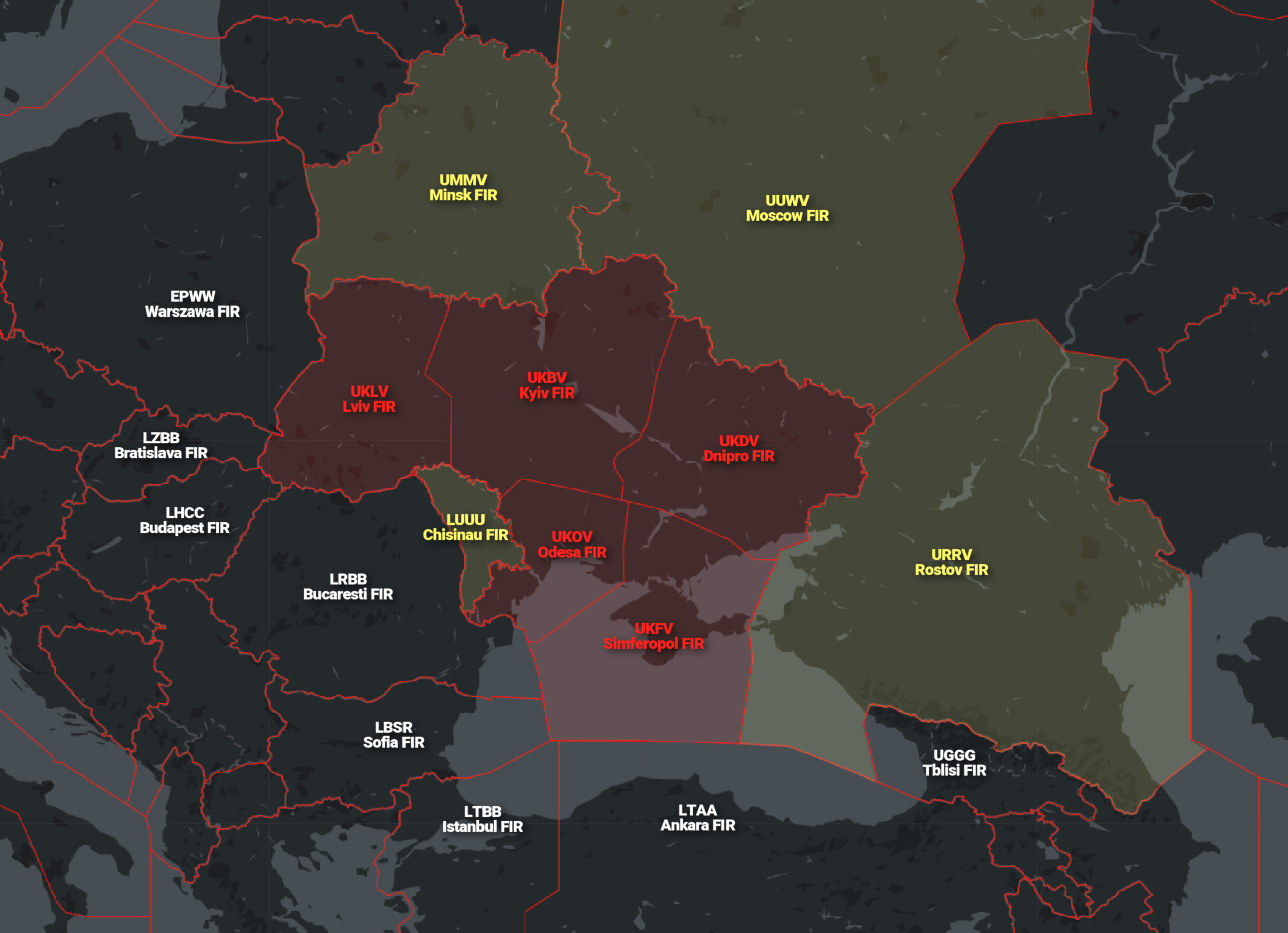
Oct 2026: Drone attacks continue across Russia. On 6 October, Moscow reported more than 650 Ukrainian drones targeting the capital region, most of them intercepted. Most operators avoid Russian airspace. Those still flying there should expect short-notice closures or reroutes, including during the day. Ukraine’s airspace remains closed to civil aviation, and restrictions remain in place in Russian airspace near the border.
See OPSGROUP Briefing: Ukraine and Russia Update March 2022
The primary risk is that civil aircraft could be misidentified or caught in air-defence activity as Russia responds to Ukrainian drones and missiles. EASA advises operators within its scope to avoid Russian airspace west of 60°E at all altitudes. Several countries also restrict flights near the Ukraine border, and GNSS interference adds to the risk.
Major events:
Oct 2026: More than 650 Ukrainian drones reportedly targeted the Moscow region. Most were intercepted, and air-defence activity added to the risk for civil flights.
Jul 2026: EASA extended its recommendation to avoid Russian airspace west of 60°E.
Dec 2024: Azerbaijan Airlines Flight 8243 was shot down near URMG/Grozny during Russian air-defence activity. EASA cites the incident as an example of the risk of misidentification.
Jul 2023 - ongoing: Drone strikes around Moscow have triggered air-defence activity and repeated temporary airport closures.
Feb 2022: Russia invaded Ukraine. Ukraine’s airspace closed to civil aviation, and several countries restricted their operators near the Russia-Ukraine border.
See OPSGROUP Briefing: Ukraine and Russia Update March 2022
The primary risk is that civil aircraft could be misidentified or caught in air-defence activity as Russia responds to Ukrainian drones and missiles. EASA advises operators within its scope to avoid Russian airspace west of 60°E at all altitudes. Several countries also restrict flights near the Ukraine border, and GNSS interference adds to the risk.
Major events:
Oct 2026: More than 650 Ukrainian drones reportedly targeted the Moscow region. Most were intercepted, and air-defence activity added to the risk for civil flights.
Jul 2026: EASA extended its recommendation to avoid Russian airspace west of 60°E.
Dec 2024: Azerbaijan Airlines Flight 8243 was shot down near URMG/Grozny during Russian air-defence activity. EASA cites the incident as an example of the risk of misidentification.
Jul 2023 - ongoing: Drone strikes around Moscow have triggered air-defence activity and repeated temporary airport closures.
Feb 2022: Russia invaded Ukraine. Ukraine’s airspace closed to civil aviation, and several countries restricted their operators near the Russia-Ukraine border.
Haiti
Level One - Do Not Fly
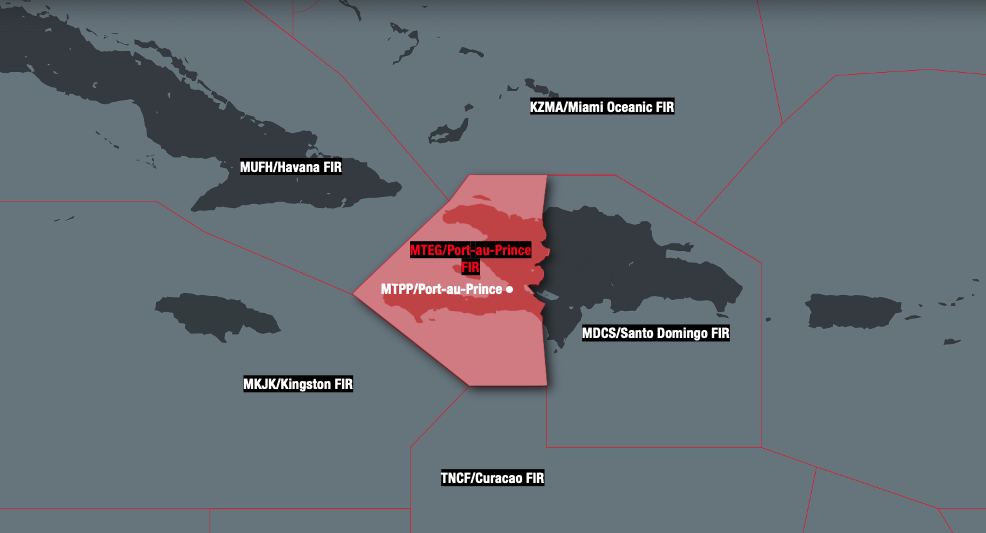
Oct 2026: FAA restrictions remain in force for covered US operators below 10,000 ft MSL in designated areas of Haiti, including around MTPP/Port-au-Prince. Overflights above 10,000 ft MSL and ops outside the restricted areas do not require FAA authorisation.
See OPSGROUP Briefing: Haiti Crisis: Airport Attacked, Aircraft Shot, March 2024
The primary risk is gang gunfire and drone activity against aircraft flying low near MTPP/Port-au-Prince. The FAA reports at least 11 aircraft attacked in the area since February 2024, and keeps covered US operators out of low-level ops in designated areas. Canada, France and the UK also advise against low-level flights in the MTEG/Port-au-Prince FIR. France advises its operators not to serve MTPP/Port-au-Prince.
Major events:
Sep 2026: The FAA extended its low-altitude restrictions.
Nov 2024: Gunfire hit a Spirit aircraft approaching MTPP/Port-au-Prince. A JetBlue aircraft later found a bullet hole after returning to KJFK/New York.
March-May 2024: Gang violence and attacks forced MTPP/Port-au-Prince to close for nearly three months.
See OPSGROUP Briefing: Haiti Crisis: Airport Attacked, Aircraft Shot, March 2024
The primary risk is gang gunfire and drone activity against aircraft flying low near MTPP/Port-au-Prince. The FAA reports at least 11 aircraft attacked in the area since February 2024, and keeps covered US operators out of low-level ops in designated areas. Canada, France and the UK also advise against low-level flights in the MTEG/Port-au-Prince FIR. France advises its operators not to serve MTPP/Port-au-Prince.
Major events:
Sep 2026: The FAA extended its low-altitude restrictions.
Nov 2024: Gunfire hit a Spirit aircraft approaching MTPP/Port-au-Prince. A JetBlue aircraft later found a bullet hole after returning to KJFK/New York.
March-May 2024: Gang violence and attacks forced MTPP/Port-au-Prince to close for nearly three months.
Saudi Arabia
Level One - Do Not Fly
Oct 2026: Saudi airspace remains technically open, but Houthi attacks are now increasingly targeting airports. Several recent attacks on OERK/Riyadh have caused fatalities and damaged the airport's passenger terminal. OERK is now closed until Oct 17. Recent attacks have also been reported near OEDF/Dammam.
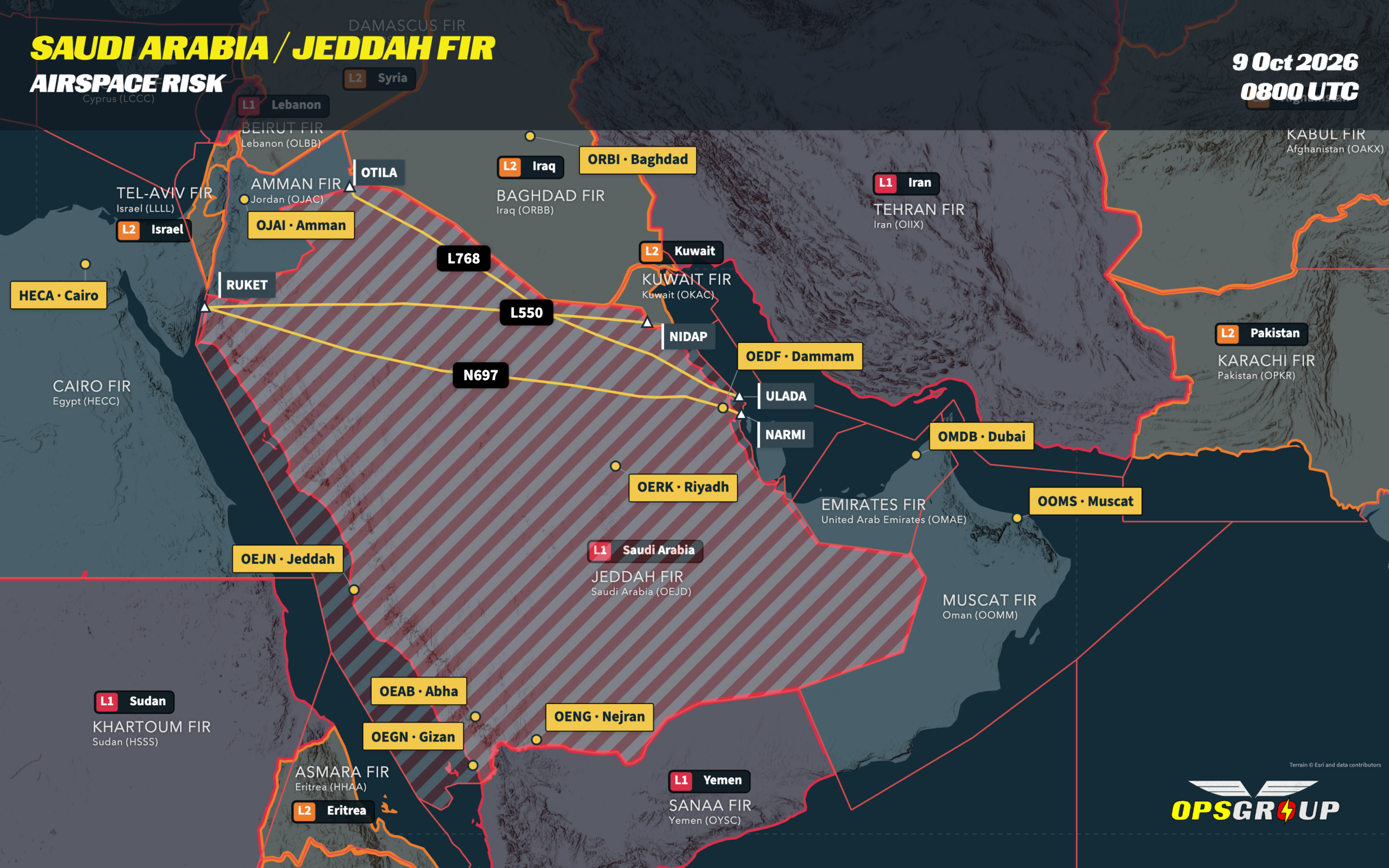
The primary risk is sustained missile and drone attacks by Houthi forces in Yemen, with recent strikes demonstrating that the threat extends across Saudi Arabia, including Riyadh. Air-defence responses also create a risk of misidentification and miscommunication - including along overflight routes.
Several states have issued airspace warnings for the OEJD/Jeddah FIR. We recommend avoiding Saudi airspace entirely, including overflights and the use of Saudi airports as en-route alternates. The northern route via Turkey, Azerbaijan and the Caspian Sea is the preferred alternative for Europe-Asia traffic.
Major events:
Oct 2026: Repeated Houthi attacks targeted OERK/Riyadh, including the passenger terminal. Attacks also reported near OEDF/Dammam, plus OEAB/Abha, OEGN/Jazan and OENG/Najran in the south.
Oct 2026: Safe Airspace raised Saudi Arabia warning to Level 1 - Do Not Fly.
Sep 2026: A Houthi ballistic missile targeted Riyadh, with subsequent disruption at OERK. Jeddah also closed at short notice during an air-defence response.
July 2026: Yemeni government forces struck the runway at OYSN/Sanaa to prevent an Iranian aircraft from landing. Houthi forces subsequently warned airlines against overflying Saudi Arabia.
2020-2022: Repeated Houthi drone and missile attacks targeted airports in southwest Saudi Arabia.
The primary risk is sustained missile and drone attacks by Houthi forces in Yemen, with recent strikes demonstrating that the threat extends across Saudi Arabia, including Riyadh. Air-defence responses also create a risk of misidentification and miscommunication - including along overflight routes.
Several states have issued airspace warnings for the OEJD/Jeddah FIR. We recommend avoiding Saudi airspace entirely, including overflights and the use of Saudi airports as en-route alternates. The northern route via Turkey, Azerbaijan and the Caspian Sea is the preferred alternative for Europe-Asia traffic.
Major events:
Oct 2026: Repeated Houthi attacks targeted OERK/Riyadh, including the passenger terminal. Attacks also reported near OEDF/Dammam, plus OEAB/Abha, OEGN/Jazan and OENG/Najran in the south.
Oct 2026: Safe Airspace raised Saudi Arabia warning to Level 1 - Do Not Fly.
Sep 2026: A Houthi ballistic missile targeted Riyadh, with subsequent disruption at OERK. Jeddah also closed at short notice during an air-defence response.
July 2026: Yemeni government forces struck the runway at OYSN/Sanaa to prevent an Iranian aircraft from landing. Houthi forces subsequently warned airlines against overflying Saudi Arabia.
2020-2022: Repeated Houthi drone and missile attacks targeted airports in southwest Saudi Arabia.
Iran
Level One - Do Not Fly
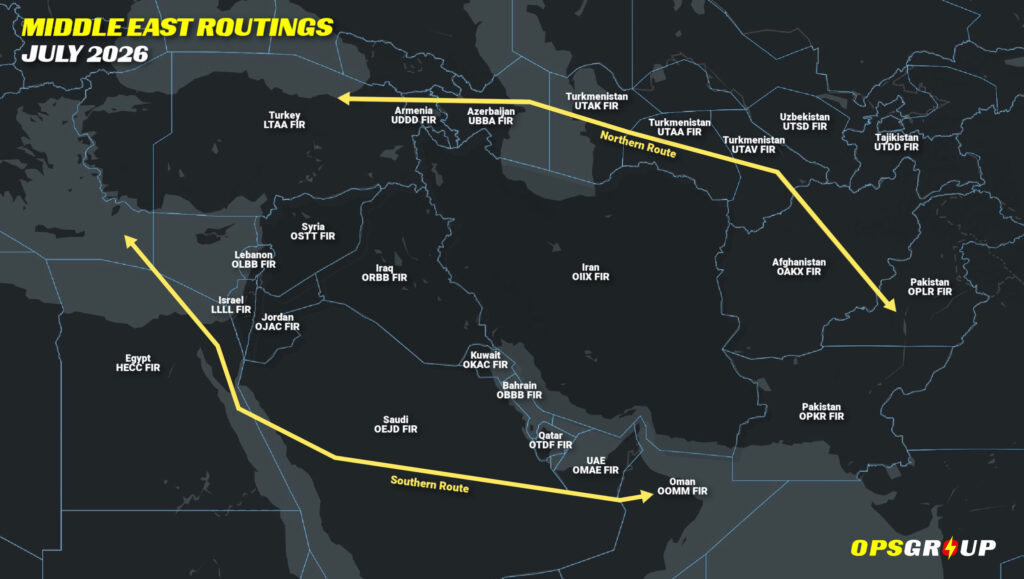
Oct 2026: OIIX/Tehran FIR remains only partially open. The eastern part is available for overflights, while the western part remains closed, and very few international operators are using Iranian airspace. Multiple states now advise their operators not to enter the FIR.
See OPSGROUP Briefing: Middle East airspace situation - 2026
The primary risk is misidentification of civil aircraft by Iranian air-defence systems during heightened military tension. Iran remains on high military alert, while missile activity, air-defence operations and the risk of sudden escalation create a high risk at all altitudes. The shoot-down of Ukraine International Airlines flight 752 over Tehran in Jan 2020 shows how quickly this can affect civil aviation. France, Germany, Italy, the UK, Canada and the US all advise against, or prohibit, ops in OIIX/Tehran FIR.
Major events:
Sep 2026: France, Germany and Italy issued or renewed warnings advising their operators not to enter OIIX/Tehran FIR.
Jun 2026: Iran partially reopened the eastern part of OIIX/Tehran FIR for overflights, while the western part remained closed.
Mar 2026: OIIX/Tehran FIR closed following large-scale US and Israeli strikes on Iranian military targets and subsequent Iranian missile and drone retaliation.
Jun 2025: Israel and Iran exchanged missile strikes, prompting renewed airspace warnings.
Oct 2024: Israel and Iran exchanged missile attacks, leading to widespread airspace avoidance.
Jan 2020: Iran shot down Ukraine International Airlines flight 752 over Tehran after misidentifying the aircraft as a hostile target.
See OPSGROUP Briefing: Middle East airspace situation - 2026
The primary risk is misidentification of civil aircraft by Iranian air-defence systems during heightened military tension. Iran remains on high military alert, while missile activity, air-defence operations and the risk of sudden escalation create a high risk at all altitudes. The shoot-down of Ukraine International Airlines flight 752 over Tehran in Jan 2020 shows how quickly this can affect civil aviation. France, Germany, Italy, the UK, Canada and the US all advise against, or prohibit, ops in OIIX/Tehran FIR.
Major events:
Sep 2026: France, Germany and Italy issued or renewed warnings advising their operators not to enter OIIX/Tehran FIR.
Jun 2026: Iran partially reopened the eastern part of OIIX/Tehran FIR for overflights, while the western part remained closed.
Mar 2026: OIIX/Tehran FIR closed following large-scale US and Israeli strikes on Iranian military targets and subsequent Iranian missile and drone retaliation.
Jun 2025: Israel and Iran exchanged missile strikes, prompting renewed airspace warnings.
Oct 2024: Israel and Iran exchanged missile attacks, leading to widespread airspace avoidance.
Jan 2020: Iran shot down Ukraine International Airlines flight 752 over Tehran after misidentifying the aircraft as a hostile target.
Yemen
Level One - Do Not Fly
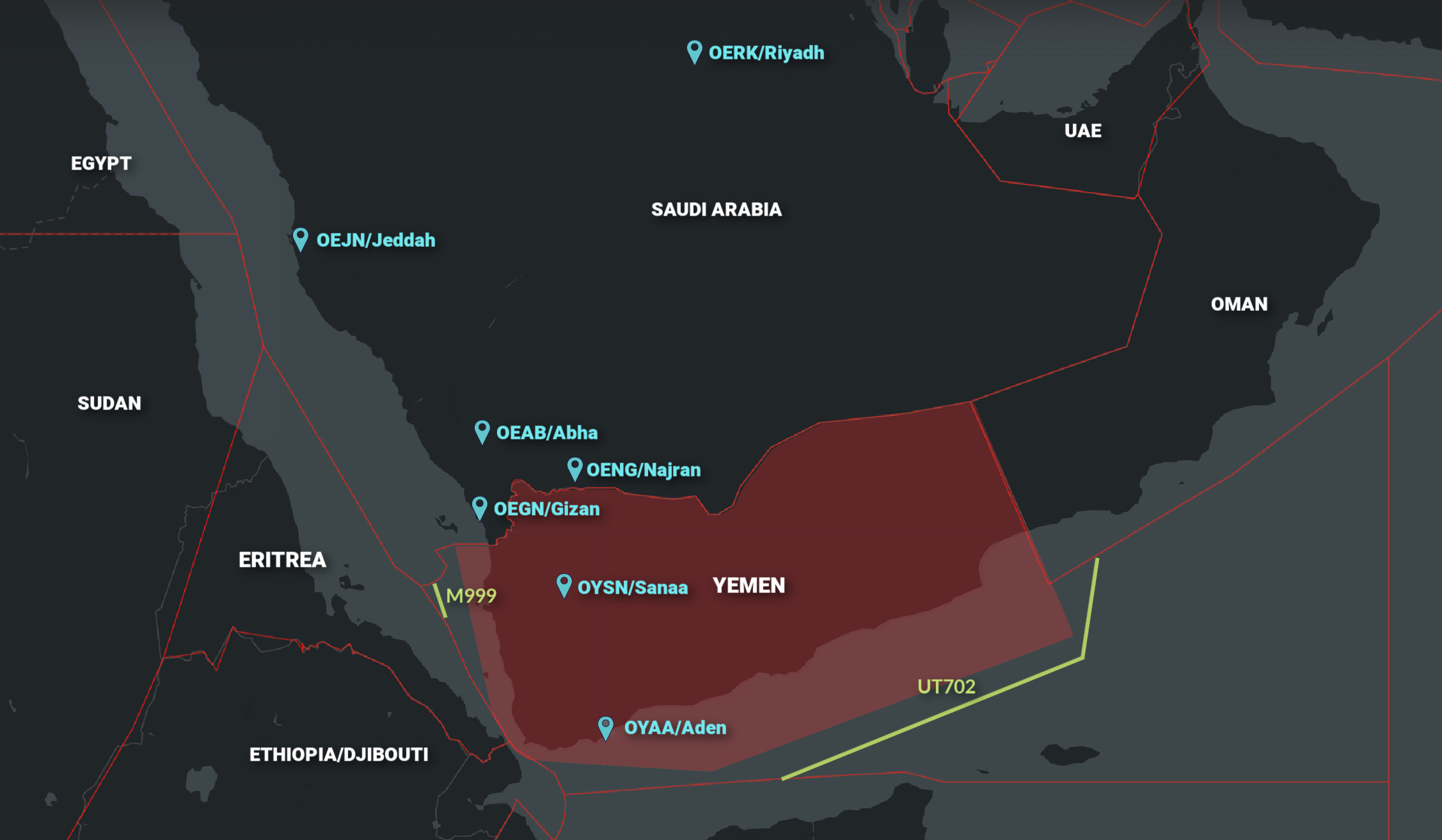
Oct 2026: Yemen remains an active conflict zone, and the vast majority of Yemeni airspace (the OYSC/Sanaa FIR) should be avoided. Several countries prohibit aircraft from overflying any land portion of the FIR. US operators can still use offshore routes UT702 and M999, while other countries permit flights on overwater portions of Yemeni airspace. The security situation has deteriorated sharply since Sep 2026, with renewed fighting between Houthi and Saudi-backed government forces and an increase in missile and drone attacks. Saudi airspace to the north and Somali airspace to the south also carry risks.
The primary risk is intentional targeting by Houthi forces and other groups with access to sophisticated missiles, drones and anti-aircraft weaponry. Civil aircraft are also exposed to the wider military activity, including Saudi-led airstrikes and Houthi missile and drone attacks.
Major events:
Oct 2026: Fighting has intensified between Houthi and Saudi-backed government forces, particularly around the Bab el-Mandeb area.
Oct 2026: OYAA/Aden airport was targeted - a missile landed near the runway as a Cairo flight was approaching and the flight was diverted to Jeddah.
Jul 2026: Yemeni government forces struck the runway at OYSN/Sanaa airport to prevent an Iranian aircraft from landing.
Dec 2024 - ongoing: OYSN/Sanaa Airport remains closed following Israeli airstrikes.
Jan 2024: US and UK airstrikes against Houthi targets began following missile and drone attacks in the Red Sea.
The primary risk is intentional targeting by Houthi forces and other groups with access to sophisticated missiles, drones and anti-aircraft weaponry. Civil aircraft are also exposed to the wider military activity, including Saudi-led airstrikes and Houthi missile and drone attacks.
Major events:
Oct 2026: Fighting has intensified between Houthi and Saudi-backed government forces, particularly around the Bab el-Mandeb area.
Oct 2026: OYAA/Aden airport was targeted - a missile landed near the runway as a Cairo flight was approaching and the flight was diverted to Jeddah.
Jul 2026: Yemeni government forces struck the runway at OYSN/Sanaa airport to prevent an Iranian aircraft from landing.
Dec 2024 - ongoing: OYSN/Sanaa Airport remains closed following Israeli airstrikes.
Jan 2024: US and UK airstrikes against Houthi targets began following missile and drone attacks in the Red Sea.
Lebanon
Level One - Do Not Fly
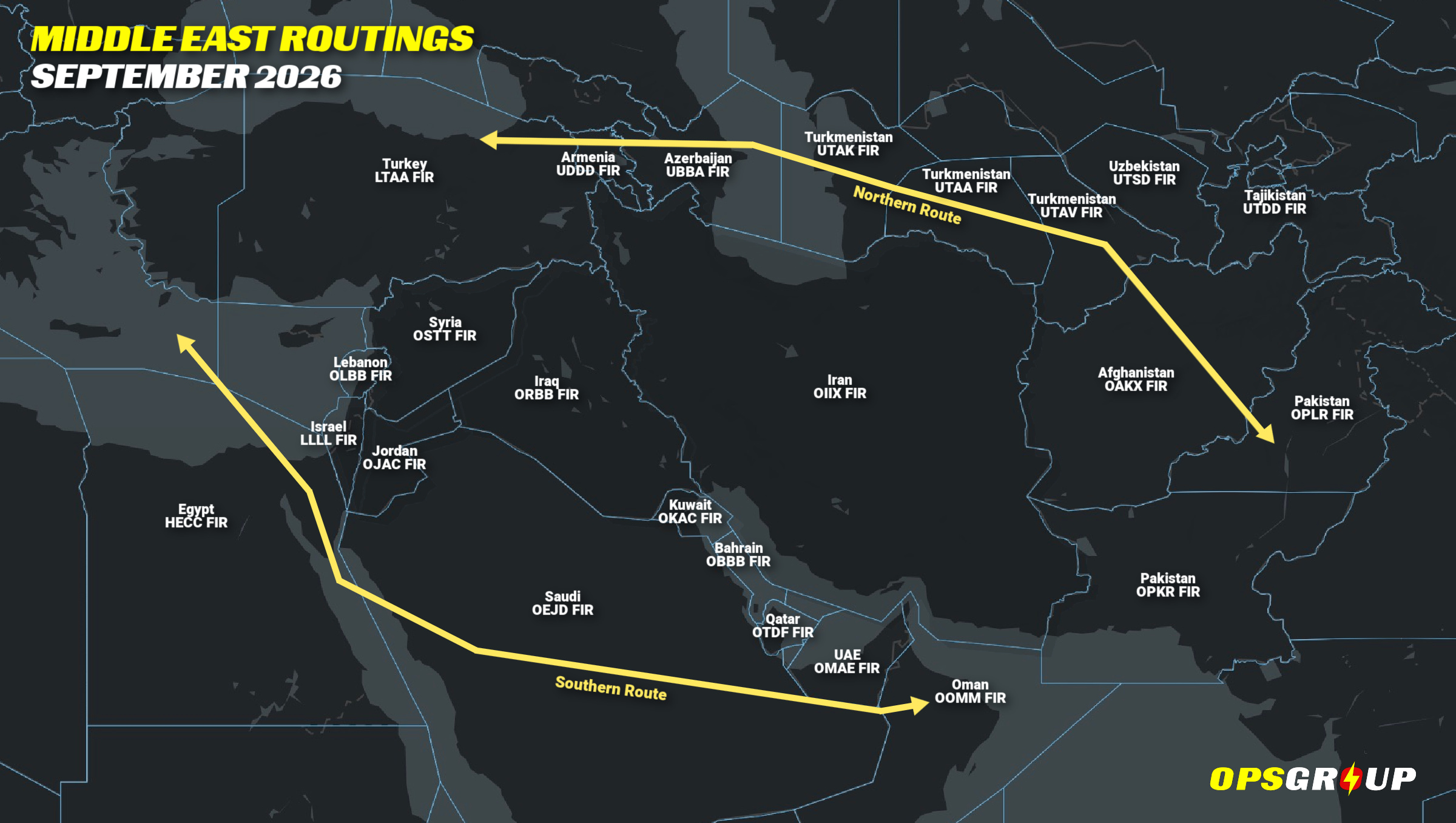
Oct 2026: Lebanese airspace (the OLBB/Beirut FIR) remains high risk, with Israeli military activity continuing despite ceasefire efforts. Most international operators continue to avoid the airspace.
See OPSGROUP Briefing: Middle East airspace situation - 2026
The primary risk is military activity linked to the Israel-Hezbollah conflict, including Israeli airstrikes and the risk of misidentification by air defence systems. Several countries advise operators to avoid Lebanese airspace. EASA maintains this advice at all altitudes, except for flights to and from Beirut that approach from the sea or depart over the sea. GPS jamming and spoofing are also reported in the FIR.
Major events:
Oct 2026: EASA maintains its warning against Lebanese airspace, with exceptions for Beirut flights over the sea.
Sep 2026: Germany, Italy, France and the UK maintain airspace warnings for Lebanon.
Aug 2026: Lebanon warns of increased GPS jamming and spoofing, recommending conventional ATS routes.
Feb - July 2026: Israeli airstrikes continued despite ceasefire extensions.
Oct 2024: Israel launched a ground operation against Hezbollah in southern Lebanon.
Nov 2023 - ongoing: GNSS jamming and spoofing reported in the OLBB/Beirut FIR.
See OPSGROUP Briefing: Middle East airspace situation - 2026
The primary risk is military activity linked to the Israel-Hezbollah conflict, including Israeli airstrikes and the risk of misidentification by air defence systems. Several countries advise operators to avoid Lebanese airspace. EASA maintains this advice at all altitudes, except for flights to and from Beirut that approach from the sea or depart over the sea. GPS jamming and spoofing are also reported in the FIR.
Major events:
Oct 2026: EASA maintains its warning against Lebanese airspace, with exceptions for Beirut flights over the sea.
Sep 2026: Germany, Italy, France and the UK maintain airspace warnings for Lebanon.
Aug 2026: Lebanon warns of increased GPS jamming and spoofing, recommending conventional ATS routes.
Feb - July 2026: Israeli airstrikes continued despite ceasefire extensions.
Oct 2024: Israel launched a ground operation against Hezbollah in southern Lebanon.
Nov 2023 - ongoing: GNSS jamming and spoofing reported in the OLBB/Beirut FIR.
Sudan
Level One - Do Not Fly
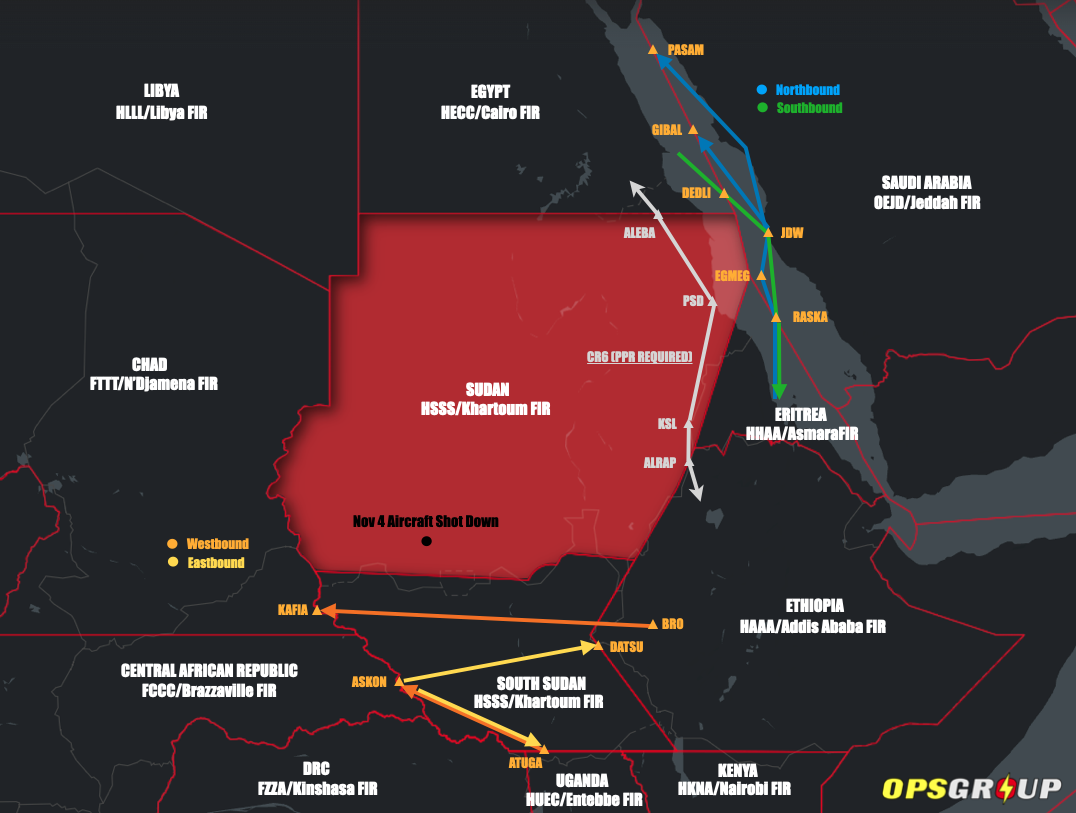
Following a military coup in April 2023, Sudan remains closed to all civilian flights. In South Sudan, air navigation services remain suspended above FL245. There is ongoing fighting in Sudan between government and militant forces. HSSK/Khartoum airport is closed, but no Notams are being issued. There is a Contingency Plan available with published overflight routes via HSPN/Port Sudan, Egypt, Saudi Arabia and South Sudan. If routing via nearby airspace, be aware of other active warnings in close proximity.
Several countries have issued airspace warning advising their operators not to enter the airspace of Sudan, due to risks from anti-aircraft weaponry and military activity.
Read: OPSGROUP article: Sudan Airspace Update, Nov 2025
The primary risk now relates to security on the ground for any unplanned diversions to airports in Sudan. Throughout the conflict, there have been reports of passenger jets being targeted by gunfire at HSSK/Khartoum Airport.
The secondary risk relates to Sudan’s proximity to South Sudan - which has poor levels of ATC provision for overflights below FL245.
Major events:
Nov 2025: Il-76 reportedly shot down by a surface-to-air missile near Babanusa, southern Sudan.
May 2025: Drone attack targeting critical infrastructure including HSPN/Port Sudan airport.
Oct 2024: Foreign-registered cargo aircraft was shot down by local militia over North Darfur (Western Sudan, near the border with Chad).
Apr 2023: Military coup on Apr 15. Sudan’s airspace closed, South Sudan’s airspace closed above FL245.
Oct 2021: Military coup on Oct 25. HSSK/Khartoum airport closed for two days, with all flights suspended.
Several countries have issued airspace warning advising their operators not to enter the airspace of Sudan, due to risks from anti-aircraft weaponry and military activity.
Read: OPSGROUP article: Sudan Airspace Update, Nov 2025
The primary risk now relates to security on the ground for any unplanned diversions to airports in Sudan. Throughout the conflict, there have been reports of passenger jets being targeted by gunfire at HSSK/Khartoum Airport.
The secondary risk relates to Sudan’s proximity to South Sudan - which has poor levels of ATC provision for overflights below FL245.
Major events:
Nov 2025: Il-76 reportedly shot down by a surface-to-air missile near Babanusa, southern Sudan.
May 2025: Drone attack targeting critical infrastructure including HSPN/Port Sudan airport.
Oct 2024: Foreign-registered cargo aircraft was shot down by local militia over North Darfur (Western Sudan, near the border with Chad).
Apr 2023: Military coup on Apr 15. Sudan’s airspace closed, South Sudan’s airspace closed above FL245.
Oct 2021: Military coup on Oct 25. HSSK/Khartoum airport closed for two days, with all flights suspended.
Libya
Level One - Do Not Fly
A civil war has been ongoing since 2014. Some progress made in Oct 2020 with the formation of a new government, but Libya remains an active conflict zone with armed clashes between various rival militia groups across the country. There is a high risk to civil aircraft. Libyan airspace (HLLL/Tripoli FIR) should be avoided entirely. Total flight ban for US operators, and several other countries have warnings in place.
The primary risk is a misident by Libyan air defense systems, or by militia who have threatened to shoot down aircraft operating in western Libya, including HLLM/Tripoli Mitiga airport. Military activity reported over the high-seas which is either operating as OAT or not in control with ATC. Risk remains high across Libya at all flight levels, and avoidance of all airspace and airports is strongly recommended.
The secondary risk is that reliable ATC services cannot be guaranteed. The past few years have seen regular ATS and radar outages across the HLLL FIR airspace, and severe limitations in VHF capability, with operators having to communicate with Malta ATC for guidance.
Read: Libya Airspace Update, Feb 2024 (OPSGROUP article)
Major events:
August 2023: Major evacuation of aircraft from Tripoli due to violent clashes and gunfire at Mitiga airport. Read: Tripoli mass evacuation of aircraft (OPSGROUP article)
July 2023: Italy cancelled its 10-year ban on flights to/from Libya. Aircraft are no longer banned from Italian airports and airspace if they want to fly from Libya.
Aug 2022: Militia air defense forces claimed to have shot down a US drone operating in the vicinity of Benghazi during a period of increased tensions and threats of renewed violence between competing militias vying for control of Tripoli.
June 2022: Failed attempt by militia to enter Tripoli to seize control of government offices, resulting in armed clashes and suspension of flights at HLLM/Mitiga airport.
Jan 2020: Multiple airstrikes targeting HLLM/Mitiga airport. Videos on social media showing planes landing at the airport as shells are falling in the background.
Nov 2019: Militia advancing on the capital, Tripoli, declared a no-fly-zone around the city, threatening to shoot-down civil aircraft attempting to fly to HLLM/Mitiga airport.
2014: HLLT/Tripoli airport closed after clashes between rival militias destroyed most of the airport's facilities. The airport remains closed to this day; most flights operate out of HLLM/Mitiga airport.
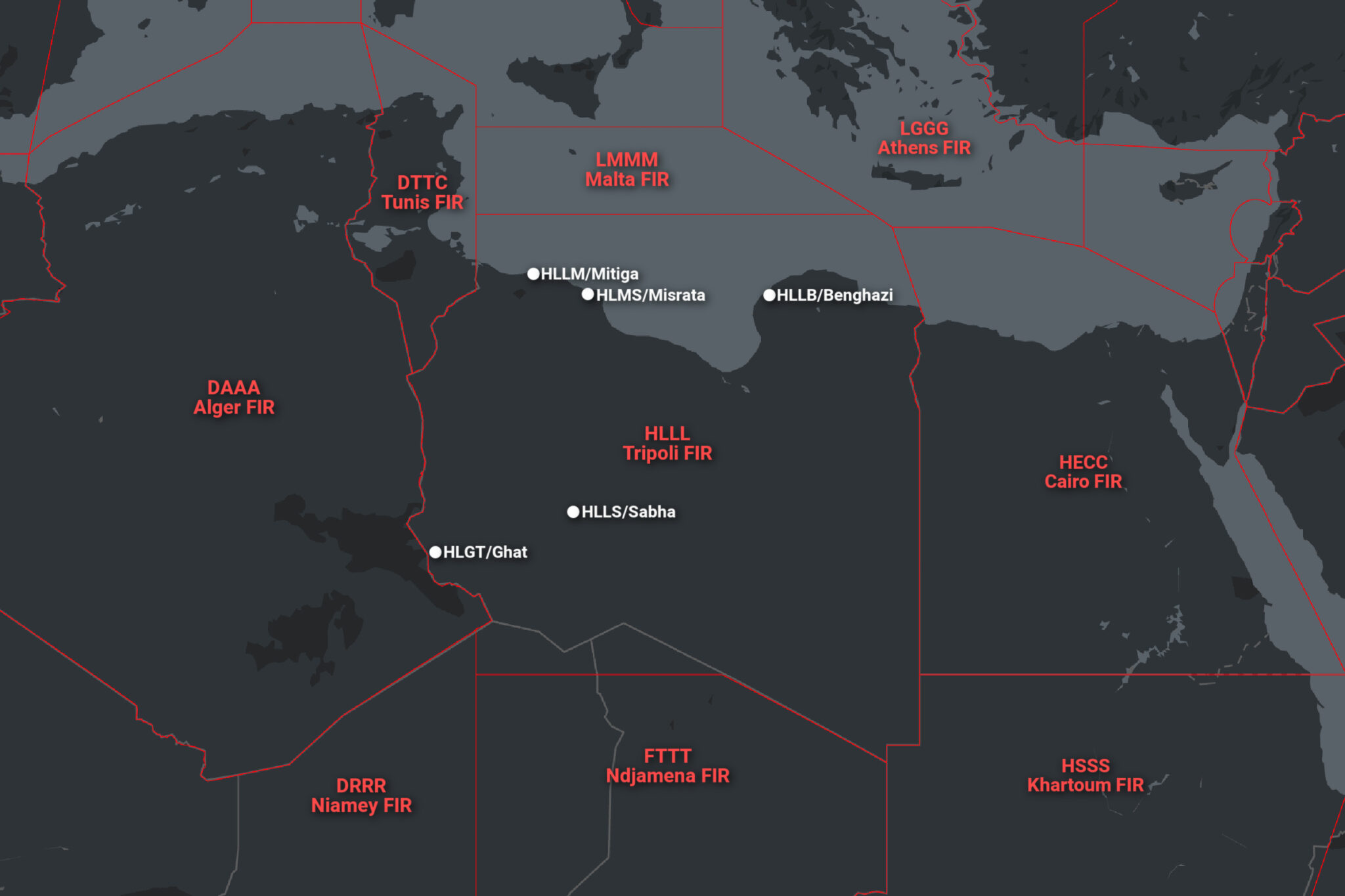
The primary risk is a misident by Libyan air defense systems, or by militia who have threatened to shoot down aircraft operating in western Libya, including HLLM/Tripoli Mitiga airport. Military activity reported over the high-seas which is either operating as OAT or not in control with ATC. Risk remains high across Libya at all flight levels, and avoidance of all airspace and airports is strongly recommended.
The secondary risk is that reliable ATC services cannot be guaranteed. The past few years have seen regular ATS and radar outages across the HLLL FIR airspace, and severe limitations in VHF capability, with operators having to communicate with Malta ATC for guidance.
Read: Libya Airspace Update, Feb 2024 (OPSGROUP article)
Major events:
August 2023: Major evacuation of aircraft from Tripoli due to violent clashes and gunfire at Mitiga airport. Read: Tripoli mass evacuation of aircraft (OPSGROUP article)
July 2023: Italy cancelled its 10-year ban on flights to/from Libya. Aircraft are no longer banned from Italian airports and airspace if they want to fly from Libya.
Aug 2022: Militia air defense forces claimed to have shot down a US drone operating in the vicinity of Benghazi during a period of increased tensions and threats of renewed violence between competing militias vying for control of Tripoli.
June 2022: Failed attempt by militia to enter Tripoli to seize control of government offices, resulting in armed clashes and suspension of flights at HLLM/Mitiga airport.
Jan 2020: Multiple airstrikes targeting HLLM/Mitiga airport. Videos on social media showing planes landing at the airport as shells are falling in the background.
Nov 2019: Militia advancing on the capital, Tripoli, declared a no-fly-zone around the city, threatening to shoot-down civil aircraft attempting to fly to HLLM/Mitiga airport.
2014: HLLT/Tripoli airport closed after clashes between rival militias destroyed most of the airport's facilities. The airport remains closed to this day; most flights operate out of HLLM/Mitiga airport.
Ukraine
Level One - Do Not Fly
Ukraine closed its entire airspace to all civil traffic on Feb 24, 2022, due to a military invasion by Russia. There is an ongoing active conflict in Ukraine between Russian and Ukrainian forces. Russia, Belarus and Moldova have closed large sections of their own airspace near to their FIR boundaries with Ukraine.
All the major countries who regularly issue airspace warnings (the US, UK, Canada, France, Germany, Italy) have since issued total flight bans for Ukraine due to risk from military activity at all levels. (Several other countries have also issued flight bans for Ukraine but we have not listed them all here due to sheer volume).
The primary risk is an unintended targeting of civil aircraft by military, including misidentification (as with MAS17, UIA752), or confusion.
The secondary risk is potential lack of Ukrainian Air Traffic Control Service at short notice (Cyber Attack), and other unforeseeable non-normal operating environments for civil aircraft.
Read: OPSGROUP article: Ukraine and Russia Update March 2022
Prior to February 2022, there were two areas of concern in Ukraine - the conflict in the far east of the country (affecting UKDV/Dnipro FIR) and the double claim over ATC and airspace in Crimea (UKFV/URFV/Simferopol FIR).
All the major countries who regularly issue airspace warnings (the US, UK, Canada, France, Germany, Italy) have since issued total flight bans for Ukraine due to risk from military activity at all levels. (Several other countries have also issued flight bans for Ukraine but we have not listed them all here due to sheer volume).
The primary risk is an unintended targeting of civil aircraft by military, including misidentification (as with MAS17, UIA752), or confusion.
The secondary risk is potential lack of Ukrainian Air Traffic Control Service at short notice (Cyber Attack), and other unforeseeable non-normal operating environments for civil aircraft.
Read: OPSGROUP article: Ukraine and Russia Update March 2022
Prior to February 2022, there were two areas of concern in Ukraine - the conflict in the far east of the country (affecting UKDV/Dnipro FIR) and the double claim over ATC and airspace in Crimea (UKFV/URFV/Simferopol FIR).
Congo DRC
Level Two - Danger exists
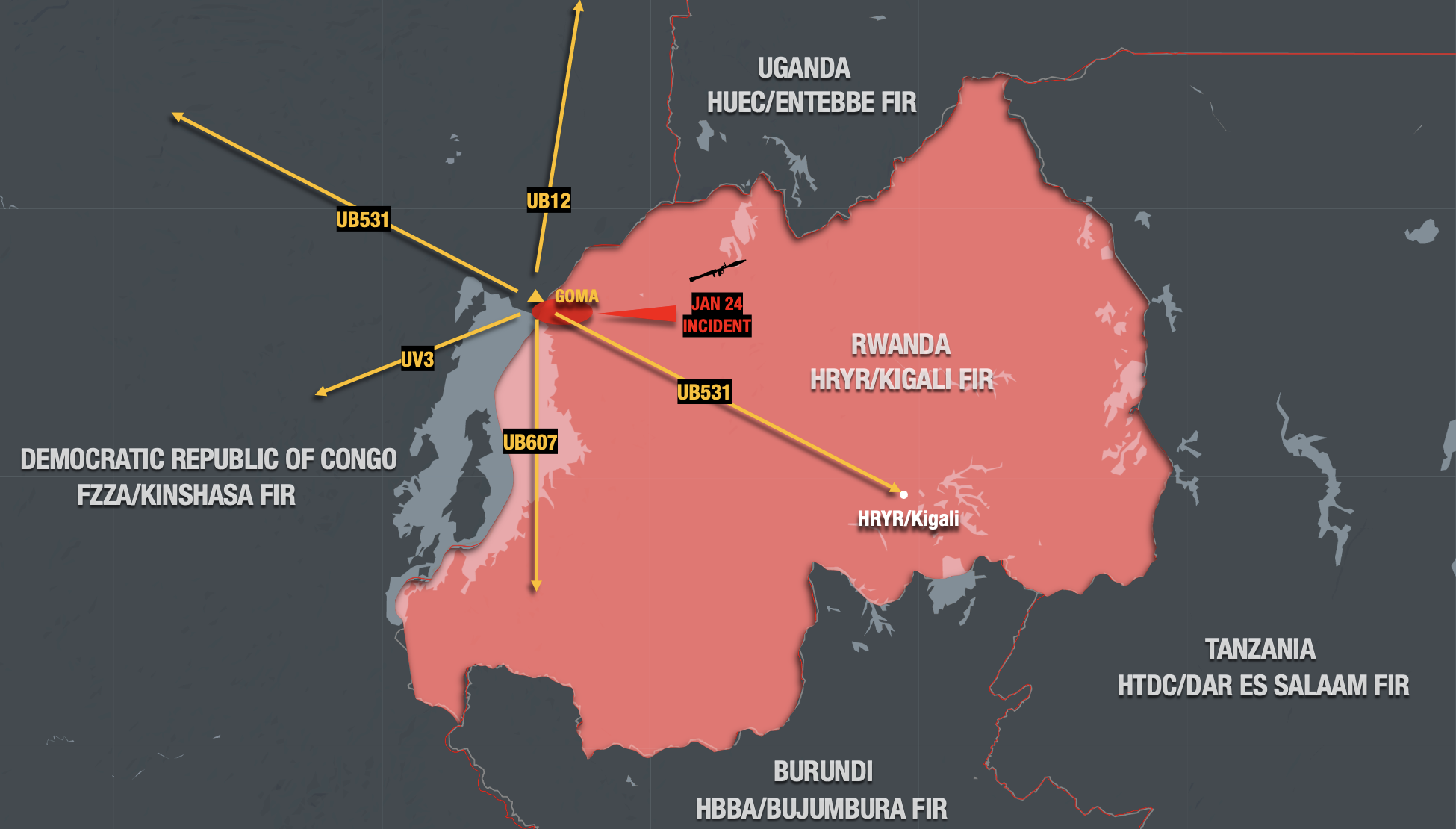
Oct 2026: Fighting continues between Congolese forces and AFC/M23 rebels in North Kivu around FZNA/Goma, near the Rwandan border. AFC (Congo River Alliance) is a rebel alliance that includes the M23 movement, and the front line remains unpredictable.
See OPSGROUP Briefing: Africa Airspace Risk: Jet Shot in Rwanda - 2023
The primary risk is anti-aircraft fire and other military activity in eastern DRC, particularly at low altitude and near airports in conflict areas. The UK advises operators to avoid an area within 200 NM of the eastern boundary of the FZZA/Kinshasa FIR, between 1°N and 5°S. Canada recommends that its operators remain at or above FL260 in a defined area near the Rwanda and Burundi borders.
Major events:
Feb 2026: The AFC/M23 rebel coalition claimed an explosive-drone attack targeting FZIC/Kisangani, showing its reach extends beyond North Kivu/Goma.
Jan 2025: M23 rebel forces took control of Goma during heavy fighting, and FZNA/Goma closed.
Feb 2024: A drone attack damaged a parked military aircraft at FZNA/Goma. The aircraft appeared to be the target.
Jan 2023: Rwanda fired on a DRC fighter near Goma, saying it had entered Rwandan airspace. The damaged aircraft landed at FZNA/Goma.
See OPSGROUP Briefing: Africa Airspace Risk: Jet Shot in Rwanda - 2023
The primary risk is anti-aircraft fire and other military activity in eastern DRC, particularly at low altitude and near airports in conflict areas. The UK advises operators to avoid an area within 200 NM of the eastern boundary of the FZZA/Kinshasa FIR, between 1°N and 5°S. Canada recommends that its operators remain at or above FL260 in a defined area near the Rwanda and Burundi borders.
Major events:
Feb 2026: The AFC/M23 rebel coalition claimed an explosive-drone attack targeting FZIC/Kisangani, showing its reach extends beyond North Kivu/Goma.
Jan 2025: M23 rebel forces took control of Goma during heavy fighting, and FZNA/Goma closed.
Feb 2024: A drone attack damaged a parked military aircraft at FZNA/Goma. The aircraft appeared to be the target.
Jan 2023: Rwanda fired on a DRC fighter near Goma, saying it had entered Rwandan airspace. The damaged aircraft landed at FZNA/Goma.
Pakistan
Level Two - Danger exists
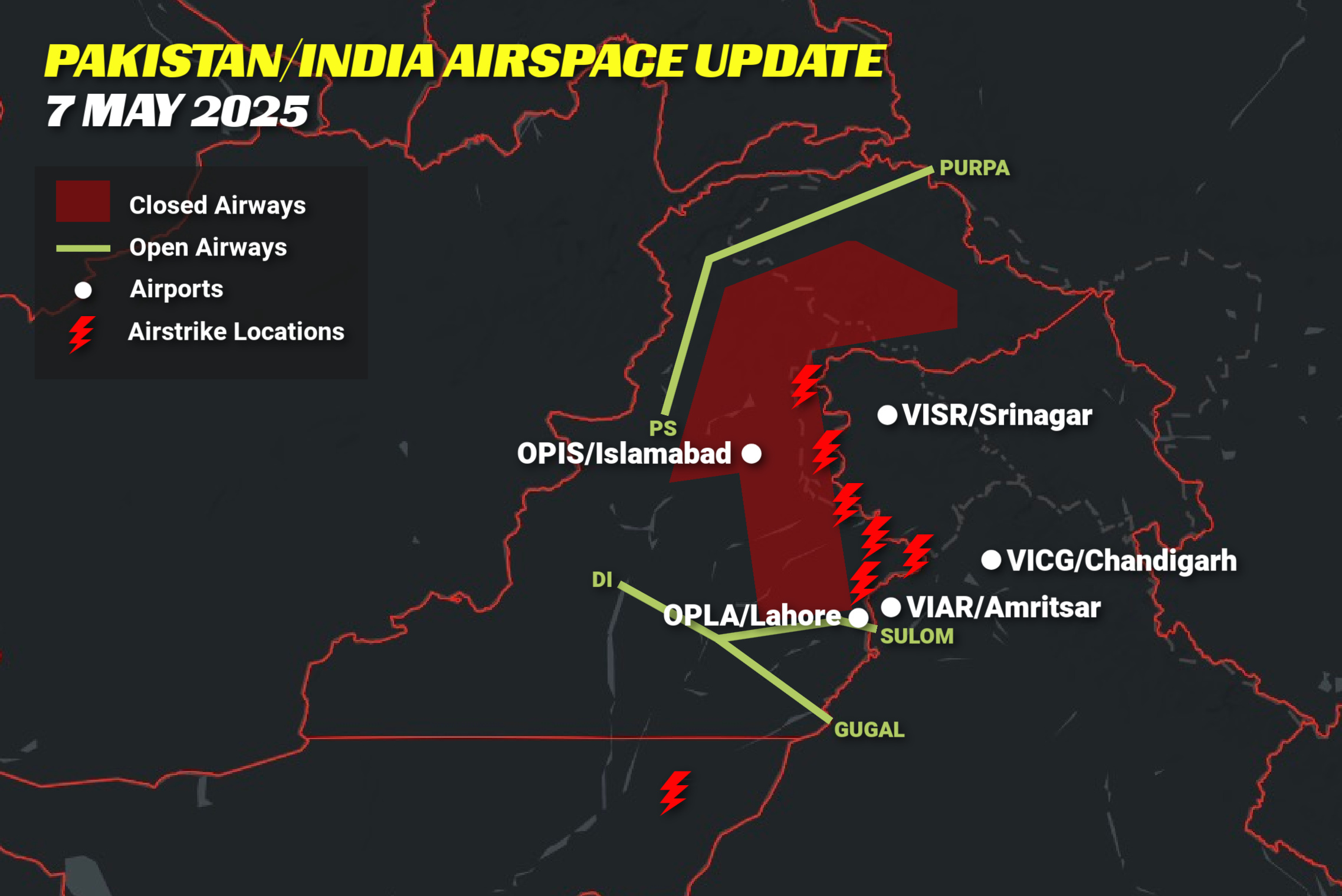
Oct 2026: The OPKR/Karachi FIR and OPLR/Lahore FIR remain open to international traffic, but Indian-registered aircraft and Indian operators are still barred. The ceasefire between India and Pakistan has largely held since May 2025, but the situation remains fragile and military activity could resume with little warning. Separately, tensions along the Afghanistan border have risen again.
See OPSGROUP Briefing: Pakistan/India Airspace Update - 2025
The primary risk is militant activity and anti-aircraft weapons, including missiles that can be fired from the ground, especially at lower altitudes in western Pakistan. In Kashmir, renewed fighting between India and Pakistan could put aircraft at risk of being mistaken for military targets. EASA advises against flights below FL260 over Balochistan and Khyber Pakhtunkhwa. France, Germany and Italy also advise caution at lower altitudes in the OPKR/Karachi FIR and OPLR/Lahore FIR.
Major events:
Oct 2026: Pakistani airstrikes in Afghanistan’s Kunar and Helmand provinces renewed cross-border fighting.
Feb 2026: Cross-border strikes between Pakistan and Afghanistan escalated, but no new airspace closures or overflight bans were issued. Commercial traffic continued through the OAKX/Kabul FIR, including on routes P500 and G500.
May 2025: India and Pakistan exchanged strikes and shelling in Kashmir. A ceasefire followed, but both countries continue to bar each other’s aircraft.
Jan 2024: Iran carried out missile and drone strikes against a militant group in western Pakistan.
Dec 2023 - ongoing: Pilots reported GPS spoofing around the OPLR/Lahore FIR, particularly near OPLA/Lahore.
Feb-Aug 2019: Pakistan closed its airspace to overflights after major clashes with India.
See OPSGROUP Briefing: Pakistan/India Airspace Update - 2025
The primary risk is militant activity and anti-aircraft weapons, including missiles that can be fired from the ground, especially at lower altitudes in western Pakistan. In Kashmir, renewed fighting between India and Pakistan could put aircraft at risk of being mistaken for military targets. EASA advises against flights below FL260 over Balochistan and Khyber Pakhtunkhwa. France, Germany and Italy also advise caution at lower altitudes in the OPKR/Karachi FIR and OPLR/Lahore FIR.
Major events:
Oct 2026: Pakistani airstrikes in Afghanistan’s Kunar and Helmand provinces renewed cross-border fighting.
Feb 2026: Cross-border strikes between Pakistan and Afghanistan escalated, but no new airspace closures or overflight bans were issued. Commercial traffic continued through the OAKX/Kabul FIR, including on routes P500 and G500.
May 2025: India and Pakistan exchanged strikes and shelling in Kashmir. A ceasefire followed, but both countries continue to bar each other’s aircraft.
Jan 2024: Iran carried out missile and drone strikes against a militant group in western Pakistan.
Dec 2023 - ongoing: Pilots reported GPS spoofing around the OPLR/Lahore FIR, particularly near OPLA/Lahore.
Feb-Aug 2019: Pakistan closed its airspace to overflights after major clashes with India.
Ethiopia
Level Two - Danger exists
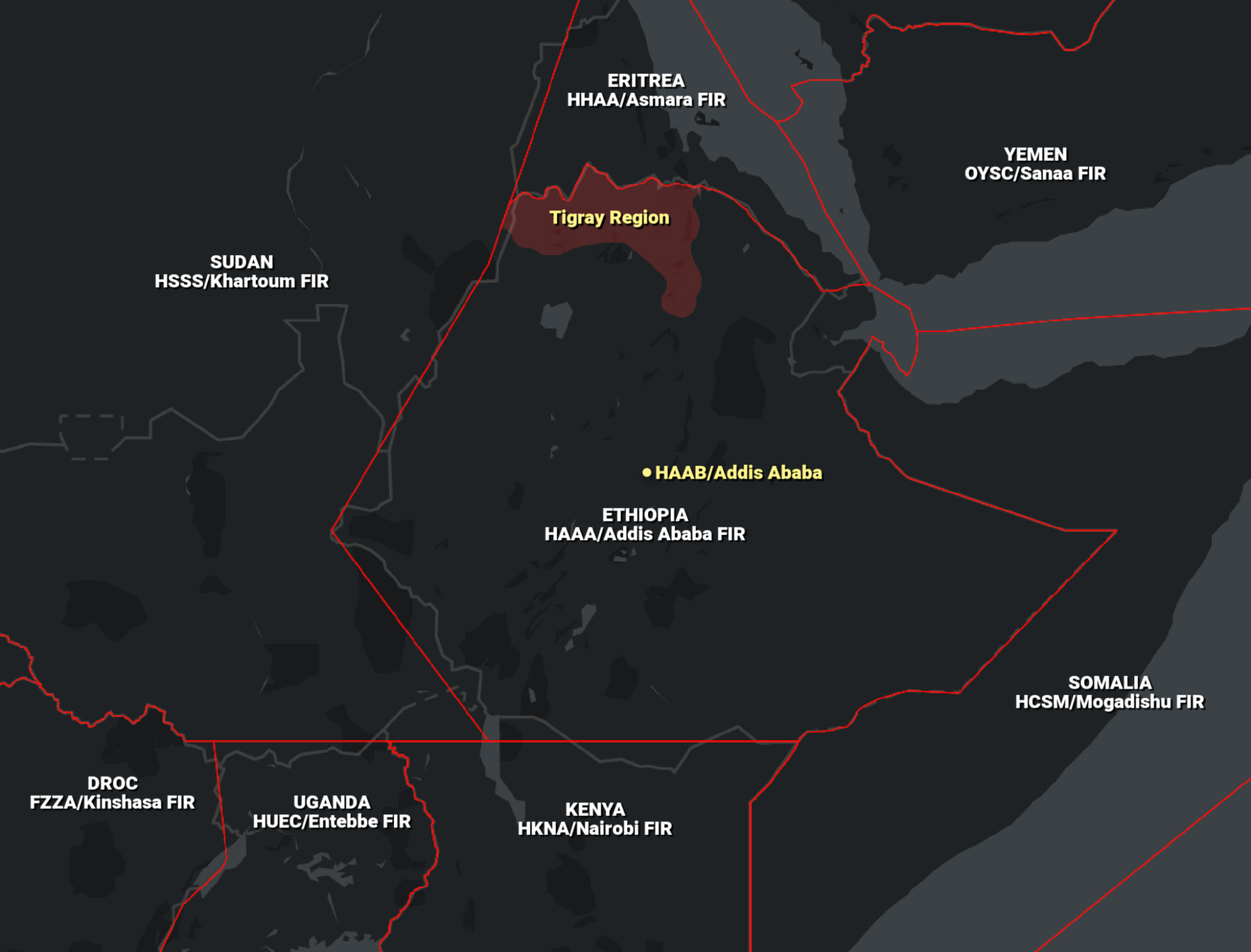
Oct 2026: Government-aligned forces have retaken Mekelle after Tigrayan forces withdrew from the city on 3 October. Ethiopian Airlines resumed flights to HAMK/Mekelle on 11 October, but fighting and wider tensions in northern Ethiopia continue.
The primary risk is armed conflict, including drone, artillery and anti-aircraft activity, particularly in Tigray, Afar and Amhara. The UK advises operators to consider the risk when overflying these regions. Italy and Germany warn of military threats across the HAAA/Addis Ababa FIR. EASA advises risk assessment below FL260, especially north of 8.5°N. French operators should remain at or above FL320 in specified northern airspace and use great caution below FL320 elsewhere in the FIR.
Major Events:
Oct 2026: Government-aligned forces retook Mekelle. Ethiopian Airlines resumed flights to HAMK/Mekelle on 11 Oct. Fighting and regional tensions continue.
Sep 2026: Tigrayan forces took control of HAMK/Mekelle. Ethiopian Airlines suspended flights to HAMK/Mekelle, HATF/Axum and HASI/Shire as fighting escalated.
Feb 2024: Fighting flared again in Amhara, including air strikes.
Nov 2022: A peace deal was agreed in Tigray. Ethiopian Airlines planned to resume flights to HAMK/Mekelle.
July 2021: HAAA/Addis Ababa FIR airspace below FL290 was closed over Tigray after a military aircraft was reportedly shot down near Mekelle.
Nov 2020: Conflict escalated in Tigray. Airways were closed, airports hit by rockets and missiles fired into Eritrea.
Sep 2018: Ethiopian ATC controllers went on strike. Retired and foreign controllers were brought in to cover ops.
The primary risk is armed conflict, including drone, artillery and anti-aircraft activity, particularly in Tigray, Afar and Amhara. The UK advises operators to consider the risk when overflying these regions. Italy and Germany warn of military threats across the HAAA/Addis Ababa FIR. EASA advises risk assessment below FL260, especially north of 8.5°N. French operators should remain at or above FL320 in specified northern airspace and use great caution below FL320 elsewhere in the FIR.
Major Events:
Oct 2026: Government-aligned forces retook Mekelle. Ethiopian Airlines resumed flights to HAMK/Mekelle on 11 Oct. Fighting and regional tensions continue.
Sep 2026: Tigrayan forces took control of HAMK/Mekelle. Ethiopian Airlines suspended flights to HAMK/Mekelle, HATF/Axum and HASI/Shire as fighting escalated.
Feb 2024: Fighting flared again in Amhara, including air strikes.
Nov 2022: A peace deal was agreed in Tigray. Ethiopian Airlines planned to resume flights to HAMK/Mekelle.
July 2021: HAAA/Addis Ababa FIR airspace below FL290 was closed over Tigray after a military aircraft was reportedly shot down near Mekelle.
Nov 2020: Conflict escalated in Tigray. Airways were closed, airports hit by rockets and missiles fired into Eritrea.
Sep 2018: Ethiopian ATC controllers went on strike. Retired and foreign controllers were brought in to cover ops.
Afghanistan
Level Two - Danger exists
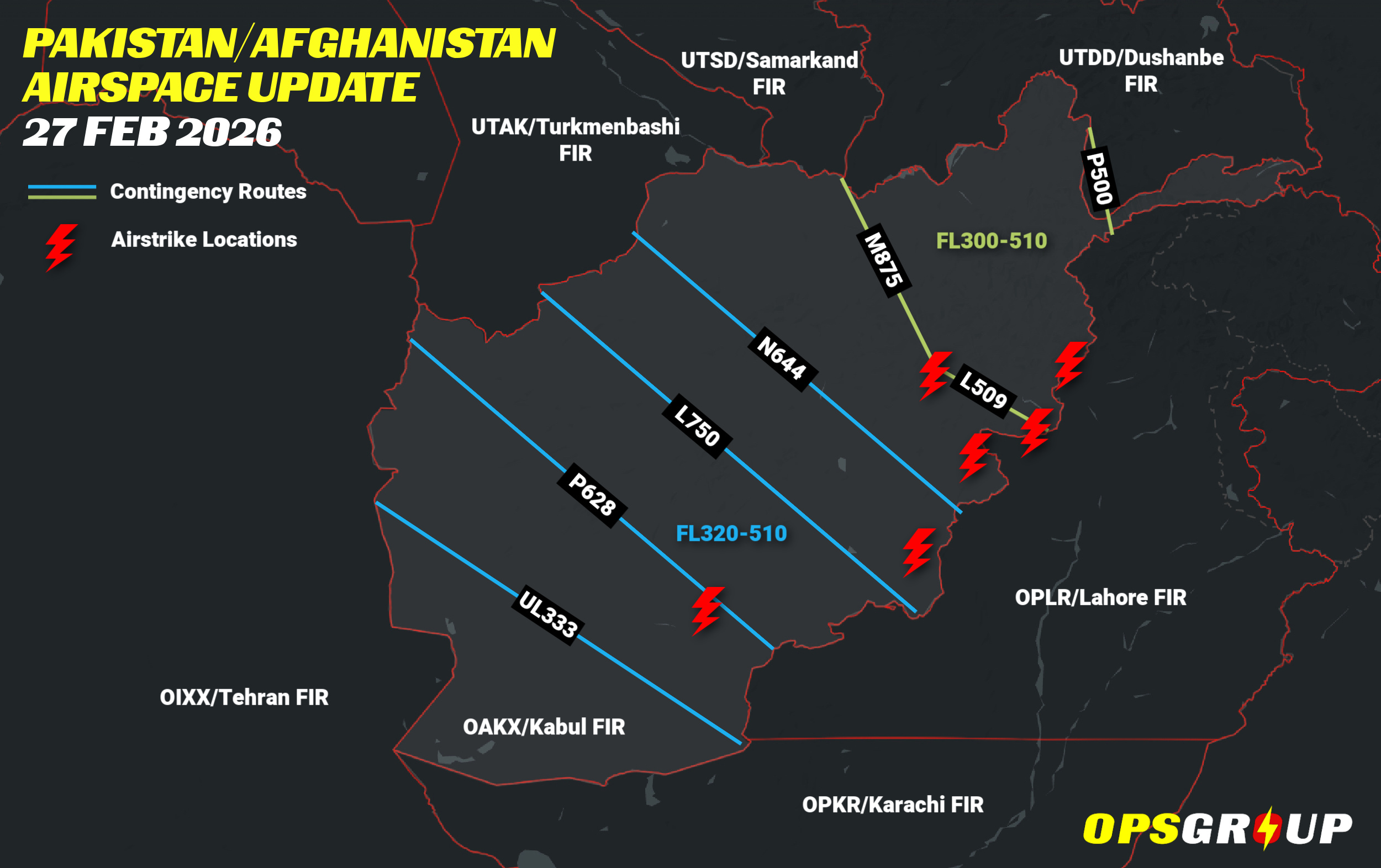
Oct 2026: The OAKX/Kabul FIR remains open and uncontrolled, with no ATC service. It continues to carry Europe-Asia traffic rerouted around Middle East restrictions. Renewed Pakistani airstrikes have raised the risk near the border.
See OPSGROUP Briefing: March 2026 - Afghanistan Overflight Update.
The primary risk comes from military activity near the Pakistan border and the lack of ATC across the OAKX/Kabul FIR. EASA, France, Germany and Canada advise against ops below FL320. Italy’s restriction allows P500 and G500 below its 25,000 ft AGL limit, while US operators may use those routes from FL300. With no ATC, aircraft must follow published contingency routes and use TIBA procedures to maintain separation.
Major events:
Oct 2026: Pakistani airstrikes in Kunar and Helmand renewed cross-border fighting. The UN reported civilian casualties, while Pakistan said it had targeted militants.
March 2026: Middle East airspace closures sent more Europe-Asia traffic through the OAKX/Kabul FIR. Cross-border fighting with Pakistan also resumed.
Feb 2026: Cross-border strikes between Pakistan and Afghanistan escalated; commercial traffic continues to transit the FIR including via P500 and G500.
Aug 2021: After the Taliban takeover and allied withdrawal, the OAKX/Kabul FIR lost ATC service and became uncontrolled Class G airspace.
See OPSGROUP Briefing: March 2026 - Afghanistan Overflight Update.
The primary risk comes from military activity near the Pakistan border and the lack of ATC across the OAKX/Kabul FIR. EASA, France, Germany and Canada advise against ops below FL320. Italy’s restriction allows P500 and G500 below its 25,000 ft AGL limit, while US operators may use those routes from FL300. With no ATC, aircraft must follow published contingency routes and use TIBA procedures to maintain separation.
Major events:
Oct 2026: Pakistani airstrikes in Kunar and Helmand renewed cross-border fighting. The UN reported civilian casualties, while Pakistan said it had targeted militants.
March 2026: Middle East airspace closures sent more Europe-Asia traffic through the OAKX/Kabul FIR. Cross-border fighting with Pakistan also resumed.
Feb 2026: Cross-border strikes between Pakistan and Afghanistan escalated; commercial traffic continues to transit the FIR including via P500 and G500.
Aug 2021: After the Taliban takeover and allied withdrawal, the OAKX/Kabul FIR lost ATC service and became uncontrolled Class G airspace.
Israel
Level Two - Danger exists
Oct 2026: LLLL/Tel Aviv FIR is open, but the security situation remains volatile. Missile and drone threats can lead to short-notice restrictions or disruption, and some international airlines have still not returned to LLBG/Tel Aviv.
See OPSGROUP Briefing: Middle East airspace situation - 2026
The primary risk is missile and drone attacks linked to Iran and regional militant groups, including Hezbollah in Lebanon and the Houthis in Yemen. Air-defence activity and interceptions add a risk of falling debris and sudden operational restrictions. Operators should account for the potential risk across the FIR and closely follow any short-notice instructions from Israeli authorities.
Major events:
Sep 2026: European guidance was updated to advise caution in LLLL/Tel Aviv FIR. Italy also issued an enhanced-caution warning for its operators.
Feb-Jul 2026: Israeli airspace closed and reopened several times during the Iran conflict following US and Israeli strikes on Iran and Iranian missile and drone retaliation.
Jun 2025: Israel and Iran exchanged missile strikes across the region.
Oct 2024: Israel and Iran carried out missile attacks against each other.
Oct 2023: Hamas and Hezbollah launched major attacks against Israel, triggering a large-scale Israeli military response.
See OPSGROUP Briefing: Middle East airspace situation - 2026
The primary risk is missile and drone attacks linked to Iran and regional militant groups, including Hezbollah in Lebanon and the Houthis in Yemen. Air-defence activity and interceptions add a risk of falling debris and sudden operational restrictions. Operators should account for the potential risk across the FIR and closely follow any short-notice instructions from Israeli authorities.
Major events:
Sep 2026: European guidance was updated to advise caution in LLLL/Tel Aviv FIR. Italy also issued an enhanced-caution warning for its operators.
Feb-Jul 2026: Israeli airspace closed and reopened several times during the Iran conflict following US and Israeli strikes on Iran and Iranian missile and drone retaliation.
Jun 2025: Israel and Iran exchanged missile strikes across the region.
Oct 2024: Israel and Iran carried out missile attacks against each other.
Oct 2023: Hamas and Hezbollah launched major attacks against Israel, triggering a large-scale Israeli military response.
Syria
Level Two - Danger exists
Oct 2026: Syrian airspace (the OSTT/Damascus FIR) remains high risk, but some regional operators have started using it again as an alternative to the more restricted Iran/Iraq routing. EASA has eased its advice, now allowing flights at FL260 and above in most of the FIR, although restrictions remain in the western part of the airspace.
The primary risk is military activity in and around Syrian airspace, including Israeli airstrikes and the interception of missiles and drones. Falling debris from intercepted weapons can pose a risk to civil aircraft, while air defence systems also create a risk of misidentification. Drones, rockets and MANPADS are an additional threat at lower levels.
Major events:
Oct 2026: EASA eased its Syria CZIB, allowing FL260+ in most of the Damascus FIR.
Oct 2026: Regional operators increasingly using Syrian airspace as an alternative to Iran and Iraq.
March 2026: OSTT/Damascus FIR closed following US and Israeli strikes on Iran.
Dec 2024: Syrian airspace closed following the fall of the Assad regime.
Oct 2023: Airstrikes damaged runways at OSDI/Damascus and OSAP/Aleppo.
Feb 2020: A320 diverted after being caught in crossfire near Damascus.
Sep 2018: Russian IL-20 shot down in error near the Syria-Cyprus FIR boundary.
The primary risk is military activity in and around Syrian airspace, including Israeli airstrikes and the interception of missiles and drones. Falling debris from intercepted weapons can pose a risk to civil aircraft, while air defence systems also create a risk of misidentification. Drones, rockets and MANPADS are an additional threat at lower levels.
Major events:
Oct 2026: EASA eased its Syria CZIB, allowing FL260+ in most of the Damascus FIR.
Oct 2026: Regional operators increasingly using Syrian airspace as an alternative to Iran and Iraq.
March 2026: OSTT/Damascus FIR closed following US and Israeli strikes on Iran.
Dec 2024: Syrian airspace closed following the fall of the Assad regime.
Oct 2023: Airstrikes damaged runways at OSDI/Damascus and OSAP/Aleppo.
Feb 2020: A320 diverted after being caught in crossfire near Damascus.
Sep 2018: Russian IL-20 shot down in error near the Syria-Cyprus FIR boundary.
Iraq
Level Two - Danger exists
Oct 2026: The US and coalition military mission in Iraq ended on Sep 30, with forces departing Erbil. Iraqi airspace remains open to overflights, but the withdrawal removes a layer of US air defence around ORER/Erbil while armed factions remain active. This leaves Iraq more exposed to missile and drone attacks and localised insecurity, particularly in the Kurdistan Region.
See OPSGROUP Briefing: Middle East airspace situation - 2026
The primary risk remains missile and drone activity linked to regional conflicts, alongside the potential for misidentification by air defence systems and the presence of armed groups with access to anti-aircraft weapons. EASA continues to advise operators not to operate in the ORBB/Baghdad FIR at any altitude. Despite the FIR remaining open, most Europe-Asia traffic continues to route south via Egypt/Saudi or north via the Caucasus/Afghanistan.
Major events:
Oct 2026: US and coalition forces leave Erbil, removing a layer of air defence as armed factions remain active.
Mar 2026: ORBB/Baghdad FIR closed following strikes on Iran and Iranian retaliation.
Jun 2025: Airspace closed after Israeli strikes on Iran, missiles and drones transited Iraq.
Apr 2024: Airspace closed during Iran's drone and missile attack on Israel.
Apr 2023: Drone and missile attacks in northern Iraq launched from Turkey and Iran.
Oct 2021: US operators permitted to overfly ORBB/Baghdad FIR above FL320 under revised FAA rules.
See OPSGROUP Briefing: Middle East airspace situation - 2026
The primary risk remains missile and drone activity linked to regional conflicts, alongside the potential for misidentification by air defence systems and the presence of armed groups with access to anti-aircraft weapons. EASA continues to advise operators not to operate in the ORBB/Baghdad FIR at any altitude. Despite the FIR remaining open, most Europe-Asia traffic continues to route south via Egypt/Saudi or north via the Caucasus/Afghanistan.
Major events:
Oct 2026: US and coalition forces leave Erbil, removing a layer of air defence as armed factions remain active.
Mar 2026: ORBB/Baghdad FIR closed following strikes on Iran and Iranian retaliation.
Jun 2025: Airspace closed after Israeli strikes on Iran, missiles and drones transited Iraq.
Apr 2024: Airspace closed during Iran's drone and missile attack on Israel.
Apr 2023: Drone and missile attacks in northern Iraq launched from Turkey and Iran.
Oct 2021: US operators permitted to overfly ORBB/Baghdad FIR above FL320 under revised FAA rules.
Kuwait
Level Two - Danger exists
Sep 2026: Kuwait has kept restrictions on the OKAC/Kuwait FIR in place following the wider US-Iran conflict. The airspace is open for approved flights to OKKK/Kuwait airport, but overflights remain prohibited. The restriction has now been extended into November.
See OPSGROUP Briefing: Middle East airspace situation - 2026
The primary risk remains missile and drone activity linked to the wider regional conflict. Kuwait has already been directly affected by Iranian attacks, including strikes on OKKK/Kuwait airport where Terminal 1 was damaged in June. Military activity around the Kuwait/Bahrain FIR boundary has also been reported. GPS interference, ATC congestion and reroutes remain wider operational issues across the region.
Major events:
Sep 2026: Kuwait extended its airspace restrictions, with overflights still prohibited and approved arrivals/departures permitted.
Aug 2026: EASA issued revised guidance for the Persian Gulf following the US-Iran conflict, identifying continued risks from missile and drone activity, air defence operations and military activity.
Feb-July 2026: OKAC/Kuwait FIR was closed and reopened several times during the Iran conflict.
See OPSGROUP Briefing: Middle East airspace situation - 2026
The primary risk remains missile and drone activity linked to the wider regional conflict. Kuwait has already been directly affected by Iranian attacks, including strikes on OKKK/Kuwait airport where Terminal 1 was damaged in June. Military activity around the Kuwait/Bahrain FIR boundary has also been reported. GPS interference, ATC congestion and reroutes remain wider operational issues across the region.
Major events:
Sep 2026: Kuwait extended its airspace restrictions, with overflights still prohibited and approved arrivals/departures permitted.
Aug 2026: EASA issued revised guidance for the Persian Gulf following the US-Iran conflict, identifying continued risks from missile and drone activity, air defence operations and military activity.
Feb-July 2026: OKAC/Kuwait FIR was closed and reopened several times during the Iran conflict.
Somalia
Level Two - Danger exists
The situation on the ground is highly unstable and there is an inherent risk to civilians and aircraft. The central government has little control of the major cities and ports, with ongoing attacks from extremist militants targeting civilians who continue to show an intent to target aviation interests.
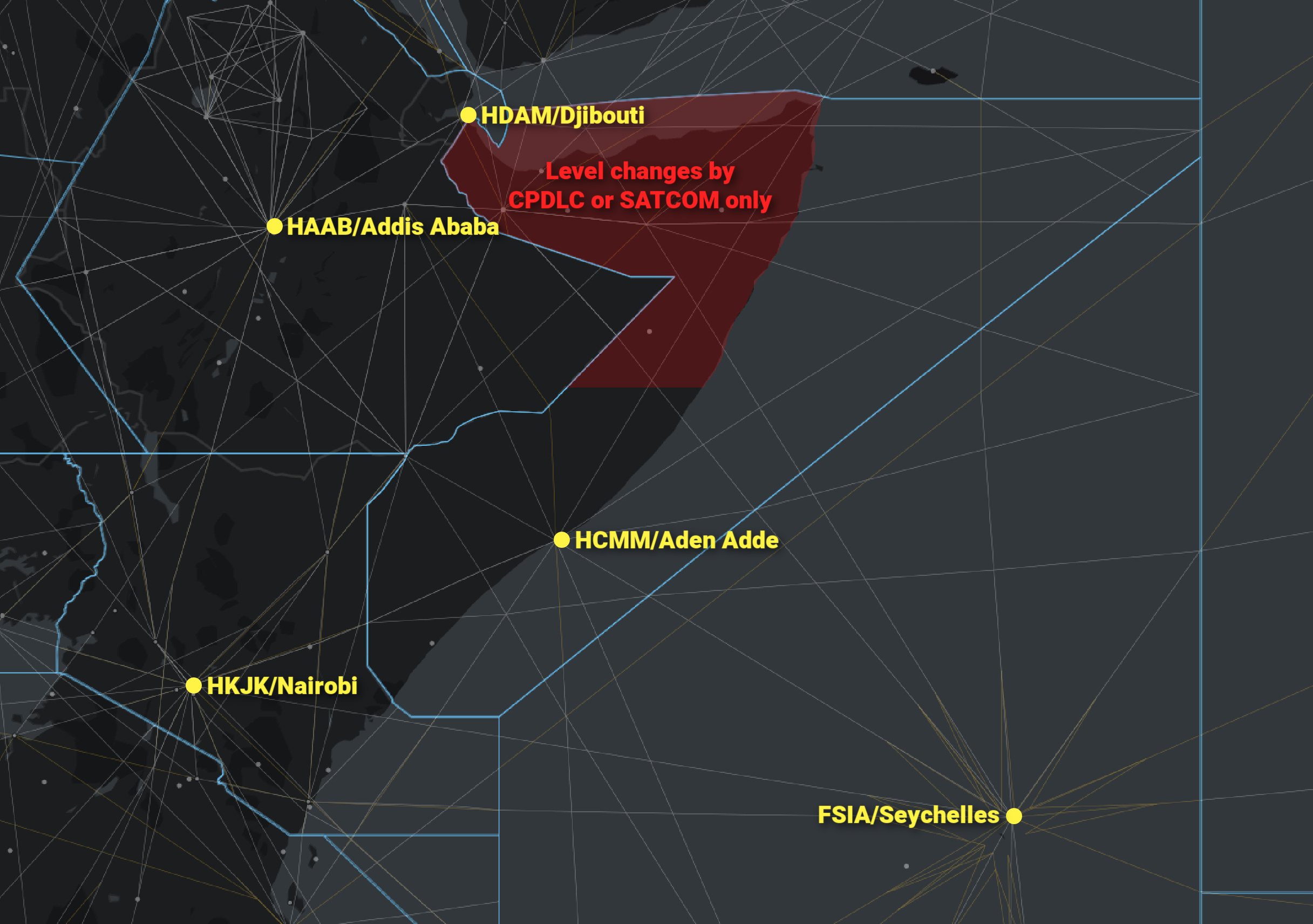
The primary risk is to overflying aircraft at the lower flight levels, which may be targeted by anti-aircraft-capable weapons. The US prohibits flights across Somalia’s airspace (the HCSM/Mogadishu FIR) below FL260 except for flights transiting the overwater portion of the airspace going to/from HDAM/Djibouti airport across the border in Ethiopia. Several other countries have issued airspace warnings advising against operating below FL260.
The secondary risk is from aircraft transiting Somalia being contacted by unauthorized ATC units, who have been issuing climb/descent instructions that conflict with the official ones issued by Mogadishu Control. There’s also an authority dispute in the north of the HCSM/Mogadishu FIR. From Nov 2025, Somaliland has said all overflights require a PPR from its own CAA, while Somalia has reaffirmed through an AIC that it controls the entire FIR. Expect conflicting permit instructions near Hargeisa and northern Somalia.
Major events:
Feb 2024: OPSGROUP received several reports of aircraft within the Mogadishu FIR being contacted by a ‘fake controller’ on the same frequency, issuing conflicting instructions. More info here.
Aug 2023: Reports of uncontrolled operations including combat helicopters flying at low levels (FL030) not reporting position, altitude or routing,
Oct 2022: The Somalian government issued a warning that HCMM/Mogadishu airport may be targeted by militant groups amid the escalating conflict in the country.
May 2022: Class A airspace implemented in the HCSM/Mogadishu FIR above FL245. More info here.
2020-ongoing: Multiple instances of Al-Shabaab attacks on HCMM/Mogadishu and nearby targets, including a UN compound.
May 2020: An Embraer EMB-120 was shot down while on approach to Bardale airstrip, killing all six people on board - an accidental shoot-down by Ethiopian forces stationed in the region to combat Al-Shabaab.
The primary risk is to overflying aircraft at the lower flight levels, which may be targeted by anti-aircraft-capable weapons. The US prohibits flights across Somalia’s airspace (the HCSM/Mogadishu FIR) below FL260 except for flights transiting the overwater portion of the airspace going to/from HDAM/Djibouti airport across the border in Ethiopia. Several other countries have issued airspace warnings advising against operating below FL260.
The secondary risk is from aircraft transiting Somalia being contacted by unauthorized ATC units, who have been issuing climb/descent instructions that conflict with the official ones issued by Mogadishu Control. There’s also an authority dispute in the north of the HCSM/Mogadishu FIR. From Nov 2025, Somaliland has said all overflights require a PPR from its own CAA, while Somalia has reaffirmed through an AIC that it controls the entire FIR. Expect conflicting permit instructions near Hargeisa and northern Somalia.
Major events:
Feb 2024: OPSGROUP received several reports of aircraft within the Mogadishu FIR being contacted by a ‘fake controller’ on the same frequency, issuing conflicting instructions. More info here.
Aug 2023: Reports of uncontrolled operations including combat helicopters flying at low levels (FL030) not reporting position, altitude or routing,
Oct 2022: The Somalian government issued a warning that HCMM/Mogadishu airport may be targeted by militant groups amid the escalating conflict in the country.
May 2022: Class A airspace implemented in the HCSM/Mogadishu FIR above FL245. More info here.
2020-ongoing: Multiple instances of Al-Shabaab attacks on HCMM/Mogadishu and nearby targets, including a UN compound.
May 2020: An Embraer EMB-120 was shot down while on approach to Bardale airstrip, killing all six people on board - an accidental shoot-down by Ethiopian forces stationed in the region to combat Al-Shabaab.
Mali
Level Two - Danger exists
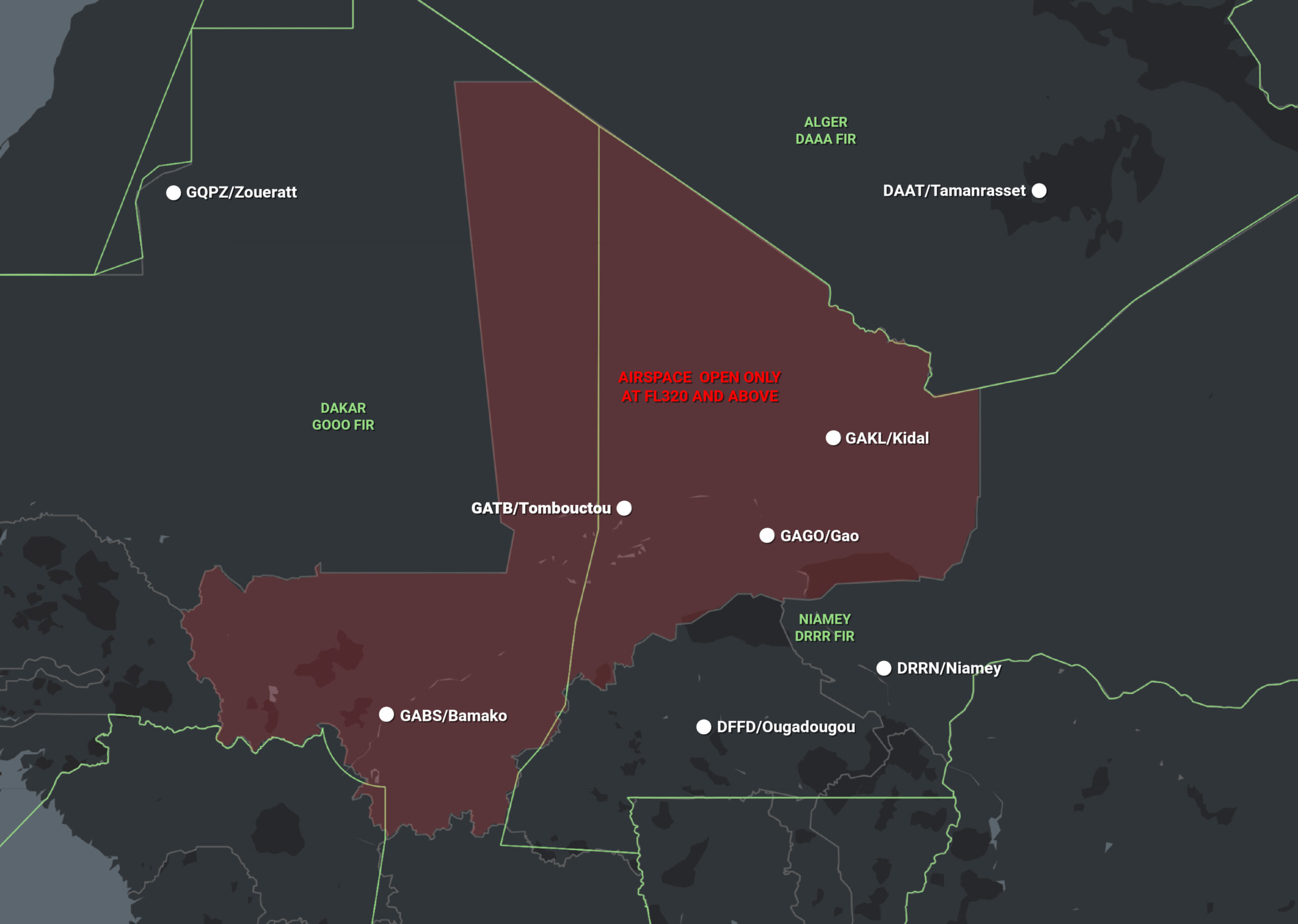
The conflict in northern and central Mali has continued since 2012 and the security situation remains volatile. Several countries have airspace warnings in place, typically advising operations at or above FL250 or FL260 and avoiding GATB/Timbuktu, GAGO/Gao and GAKL/Kidal.
The US advises caution in Mali airspace at all levels due to ongoing fighting, expanding militant activity, and the presence of a state run paramilitary force operating anti aircraft systems, military aircraft, UAS and electronic warfare equipment.
The primary risks include MANPADS and other surface to air weapons, indirect fire near airports, and the potential for misidentification or spillover from military activity. Low level and airport phase operations carry the highest exposure.
ATS in Mali is provided by the GOOO/Dakar and DRRR/Niamey FIRs. They have a long-standing restriction for overflights of Mali to published ATS routes at FL320 and above. More info can be found in this ASECNA AIP SUP.
Major events:
April 2026: The security situation has escalated sharply. On April 25, multiple armed groups carried out coordinated attacks nationwide against state and military targets, with gunfire and explosions reported near GABS/Bamako. Sporadic fighting is ongoing. France has issued a new airspace warning advising French operators not to operate to/from GABS, or use it as an alternate. Several other states maintain active airspace warnings due to risk of anti-aircraft fire and terrorist activity.
Sep 2024: Insurgents breached GABS/Bamako and set the presidential jet on fire. Multiple attacks occurred across the city and the airport closed temporarily. This was the first major attack in Bamako in several years.
Dec 2023: Germany prohibited its operators below FL260 in northern Mali due to escalating militant activity. Commercial flights to GATB/Timbuktu were cancelled after shelling near the airport. A military jet crashed near GAGO/Gao the same day, with reports it may have been shot down.
Aug 2020: All airports closed for two days during a military coup. Bamako ACC remained operational and overflights were unaffected.
Apr 2018: Militants attacked UN bases near GATB/Timbuktu using indirect fire and vehicle bombs.
Jan 2017 and Nov 2016: Vehicle bomb and rocket attacks targeted GAGO/Gao and GATB/Timbuktu airports.
The US advises caution in Mali airspace at all levels due to ongoing fighting, expanding militant activity, and the presence of a state run paramilitary force operating anti aircraft systems, military aircraft, UAS and electronic warfare equipment.
The primary risks include MANPADS and other surface to air weapons, indirect fire near airports, and the potential for misidentification or spillover from military activity. Low level and airport phase operations carry the highest exposure.
ATS in Mali is provided by the GOOO/Dakar and DRRR/Niamey FIRs. They have a long-standing restriction for overflights of Mali to published ATS routes at FL320 and above. More info can be found in this ASECNA AIP SUP.
Major events:
April 2026: The security situation has escalated sharply. On April 25, multiple armed groups carried out coordinated attacks nationwide against state and military targets, with gunfire and explosions reported near GABS/Bamako. Sporadic fighting is ongoing. France has issued a new airspace warning advising French operators not to operate to/from GABS, or use it as an alternate. Several other states maintain active airspace warnings due to risk of anti-aircraft fire and terrorist activity.
Sep 2024: Insurgents breached GABS/Bamako and set the presidential jet on fire. Multiple attacks occurred across the city and the airport closed temporarily. This was the first major attack in Bamako in several years.
Dec 2023: Germany prohibited its operators below FL260 in northern Mali due to escalating militant activity. Commercial flights to GATB/Timbuktu were cancelled after shelling near the airport. A military jet crashed near GAGO/Gao the same day, with reports it may have been shot down.
Aug 2020: All airports closed for two days during a military coup. Bamako ACC remained operational and overflights were unaffected.
Apr 2018: Militants attacked UN bases near GATB/Timbuktu using indirect fire and vehicle bombs.
Jan 2017 and Nov 2016: Vehicle bomb and rocket attacks targeted GAGO/Gao and GATB/Timbuktu airports.
North Korea
Level Two - Danger exists
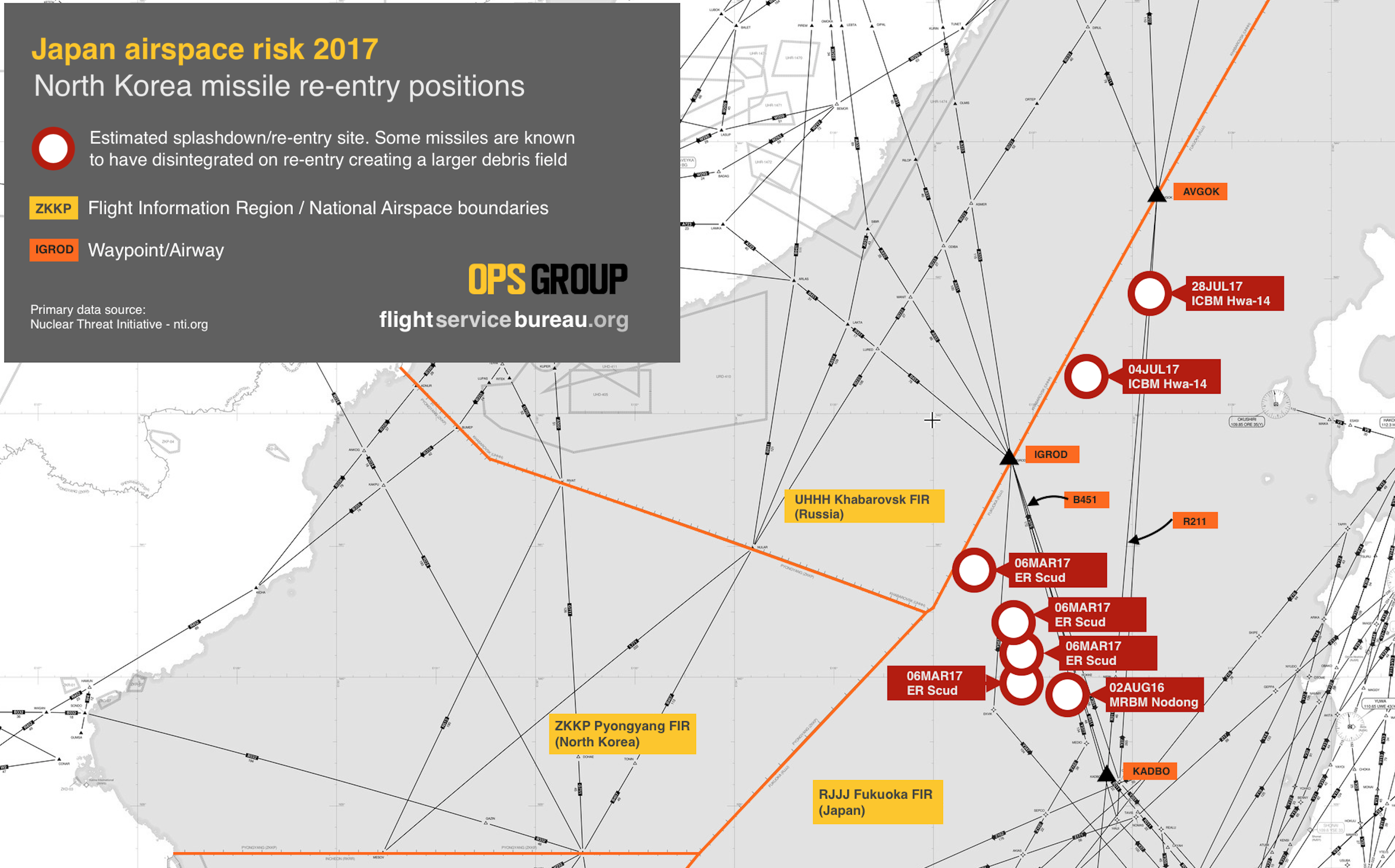
The primary risk is from debris from missile re-entries striking aircraft overflying the oceanic part of the ZKKP/Pyongyang FIR over the Sea of Japan. North Korea regularly conducts unannounced missile tests in this area. Consider rerouting to remain over the Japanese landmass or east of it.
There is also a risk of mistaken identity in or near the ZKKP/Pyongyang FIR boundary, as North Korea are threatening to actively shoot down reconnaissance aircraft in their airspace.
The US prohibits flights across all North Korean airspace, including the oceanic part of the ZKKP/Pyongyang FIR over the Sea of Japan. Several other countries have airspace warnings in place which advise caution due to the risk posed by unannounced rocket launches.
Major events:
July 2023: North Korea is threatening to actively shoot down reconnaissance aircraft in their airspace. This may put civil aviation at higher risk of mistaken identity in or near the ZKKP/Pyongyang FIR boundary.
Feb 2023: Ballistic missile fired over the UHHH/Khabarovsk FIR and then landed inside the RJJJ/Fukuoka FIR near several international airways.
Oct 2022: Ballistic missile fired directly over Japan - the first to incur on Japanese airspace since 2017.
2017: North Korea launched two intercontinental ballistic missiles. Both of these landed in the Sea of Japan, well inside the Fukuoka Flight Information Region (Japanese airspace), and significantly, at least one did not re-enter the atmosphere intact – meaning that a debris field of missile fragments passed through the airspace, not just one complete missile.
2015: North Korea gradually stopped notifying ICAO of missile launches, so that aircraft could avoid the launch and splashdown areas.
Read: North Korea Missile Threat, Oct 2022 (OPSGROUP article)
There is also a risk of mistaken identity in or near the ZKKP/Pyongyang FIR boundary, as North Korea are threatening to actively shoot down reconnaissance aircraft in their airspace.
The US prohibits flights across all North Korean airspace, including the oceanic part of the ZKKP/Pyongyang FIR over the Sea of Japan. Several other countries have airspace warnings in place which advise caution due to the risk posed by unannounced rocket launches.
Major events:
July 2023: North Korea is threatening to actively shoot down reconnaissance aircraft in their airspace. This may put civil aviation at higher risk of mistaken identity in or near the ZKKP/Pyongyang FIR boundary.
Feb 2023: Ballistic missile fired over the UHHH/Khabarovsk FIR and then landed inside the RJJJ/Fukuoka FIR near several international airways.
Oct 2022: Ballistic missile fired directly over Japan - the first to incur on Japanese airspace since 2017.
2017: North Korea launched two intercontinental ballistic missiles. Both of these landed in the Sea of Japan, well inside the Fukuoka Flight Information Region (Japanese airspace), and significantly, at least one did not re-enter the atmosphere intact – meaning that a debris field of missile fragments passed through the airspace, not just one complete missile.
2015: North Korea gradually stopped notifying ICAO of missile launches, so that aircraft could avoid the launch and splashdown areas.
Read: North Korea Missile Threat, Oct 2022 (OPSGROUP article)
South Sudan
Level Two - Danger exists
Following a military coup in neighbouring Sudan in April 2023, Sudan remains closed to all civilian flights, and in South Sudan, air navigation services remain suspended above FL245.
In South Sudan itself, following five years of civil war, a ceasefire has largely held since Sept 2018. Significant reduction in violence, but the political and security situation remains volatile. In the event of a serious deterioration, similar to those of July 2016 and Dec 2013, HJJJ/Juba airport may be closed at short notice.
The UK and France still advise against overflying South Sudan below FL250/260 due to the risk posed by anti-aircraft weaponry. The US published a similar warning but rescinded it in Aug 2019. Germany withdrew their warning in March 2025.
The primary risk now comes from no ATC above FL245 due to the military coup in Sudan, and poor levels of ATC provision for overflights below FL245 or for aircraft operating to HSSJ/Juba airport. In Jan 2021, ICAO published a letter warning of service disruptions and lack of qualified ATC personnel, the lack of contingencies in place, communication issues, the number of withdrawn navigation aids and above all, the lack of information being supplied to operators regarding these issues.
Major events:
April 2023: Military coup in Sudan. Sudan’s airspace now closed, South Sudan’s airspace now closed above FL245.
April 2019: Military coup in Sudan led to the temporary closure of South Sudan’s airspace.
June 2016: The South Sudanese army declared intention to shoot down aircraft without permits and/or not following proper procedures.
Read: OPSGROUP article: Sudan Airspace Update, Apr 2023
In South Sudan itself, following five years of civil war, a ceasefire has largely held since Sept 2018. Significant reduction in violence, but the political and security situation remains volatile. In the event of a serious deterioration, similar to those of July 2016 and Dec 2013, HJJJ/Juba airport may be closed at short notice.
The UK and France still advise against overflying South Sudan below FL250/260 due to the risk posed by anti-aircraft weaponry. The US published a similar warning but rescinded it in Aug 2019. Germany withdrew their warning in March 2025.
The primary risk now comes from no ATC above FL245 due to the military coup in Sudan, and poor levels of ATC provision for overflights below FL245 or for aircraft operating to HSSJ/Juba airport. In Jan 2021, ICAO published a letter warning of service disruptions and lack of qualified ATC personnel, the lack of contingencies in place, communication issues, the number of withdrawn navigation aids and above all, the lack of information being supplied to operators regarding these issues.
Major events:
April 2023: Military coup in Sudan. Sudan’s airspace now closed, South Sudan’s airspace now closed above FL245.
April 2019: Military coup in Sudan led to the temporary closure of South Sudan’s airspace.
June 2016: The South Sudanese army declared intention to shoot down aircraft without permits and/or not following proper procedures.
Read: OPSGROUP article: Sudan Airspace Update, Apr 2023
Moldova
Level Two - Danger exists
There is an ongoing active conflict in Ukraine between Russian and Ukrainian forces. Ukraine closed its entire airspace to all civil traffic in Feb 2022. Russia and Belarus have closed large sections of their own airspace near to their FIR boundaries with Ukraine. Moldova initially closed all their airspace too, but have since opened a section on their western border with the LRBB/Bucharesti FIR for flights to LUKK/Chisinau airport.
The primary risk is an unintended targeting of civil aircraft by military near the Moldova-Ukraine border, including misidentification (as with MAS17, UIA752), or confusion. The secondary risk is from spillover from the conflict such as Russian drones and missiles.
Major events:
Feb 2023: The LUUU/Chisinau FIR closed temporarily following reports of Russian drones infringing its airspace. Earlier in the month, at least two missiles also transited Moldova during a major military operation in Ukraine. Spill over risks from the conflict are being frequently reported.
Read: OPSGROUP article: Ukraine and Russia Update March 2022
The primary risk is an unintended targeting of civil aircraft by military near the Moldova-Ukraine border, including misidentification (as with MAS17, UIA752), or confusion. The secondary risk is from spillover from the conflict such as Russian drones and missiles.
Major events:
Feb 2023: The LUUU/Chisinau FIR closed temporarily following reports of Russian drones infringing its airspace. Earlier in the month, at least two missiles also transited Moldova during a major military operation in Ukraine. Spill over risks from the conflict are being frequently reported.
Read: OPSGROUP article: Ukraine and Russia Update March 2022
Belarus
Level Two - Danger exists
There is an ongoing active conflict in Ukraine between Russian and Ukrainian forces. Ukraine closed its entire airspace to all civil traffic in Feb 2022. Russia and Belarus have closed large sections of their own airspace near to their FIR boundaries with Ukraine.
The US and Canada have issued an outright ban barring their operators from the entire airspace of Belarus, and several other countries have issued warnings.
The primary risk is an unintended targeting of civil aircraft by military near the Belarus-Ukraine border, including misidentification (as with MAS17, UIA752), or confusion.
Read: OPSGROUP article: Ukraine and Russia Update March 2022
Prior to Feb 2022, several countries and aviation organisations had urged airlines and operators to avoid the airspace of Belarus, following the country’s interception of an international flight bound for Lithuania and forced to land in Minsk on May 23, 2021. The forced landing of this flight was politically motivated, and the crew were misled into believing that there was a credible security threat against the aircraft.
The US and Canada have issued an outright ban barring their operators from the entire airspace of Belarus, and several other countries have issued warnings.
The primary risk is an unintended targeting of civil aircraft by military near the Belarus-Ukraine border, including misidentification (as with MAS17, UIA752), or confusion.
Read: OPSGROUP article: Ukraine and Russia Update March 2022
Prior to Feb 2022, several countries and aviation organisations had urged airlines and operators to avoid the airspace of Belarus, following the country’s interception of an international flight bound for Lithuania and forced to land in Minsk on May 23, 2021. The forced landing of this flight was politically motivated, and the crew were misled into believing that there was a credible security threat against the aircraft.
Eritrea
Level Two - Danger exists
HHAS/Asmara airport was targeted on 14 Nov 2020 by missiles from the Tigray TPLF, bringing Eritrea into the conflict and meaning that operations here should be avoided. See Ethiopia summary for more detail.
Venezuela
Level Three - Caution
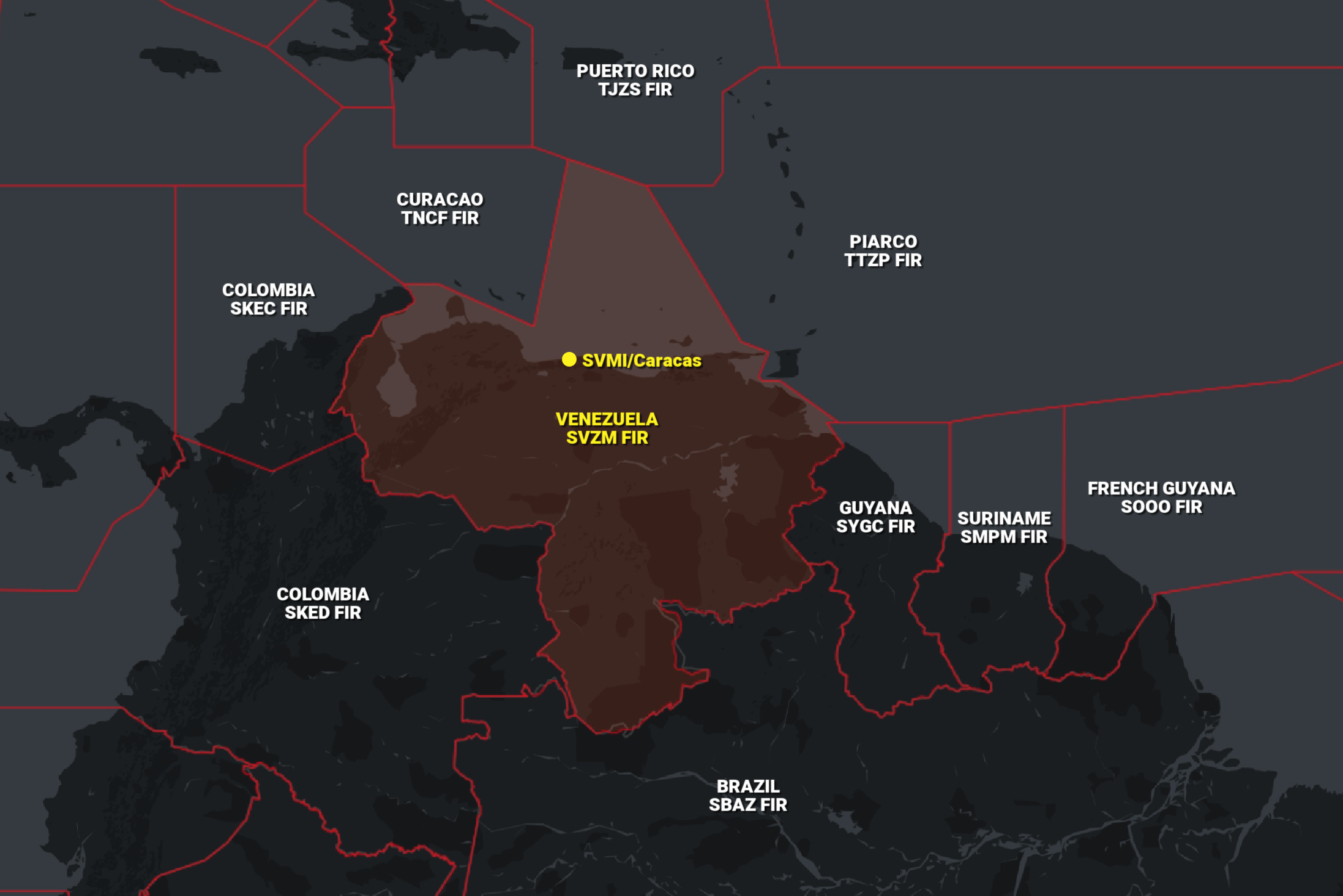
Oct 2026: The immediate disruption after the US strikes in January has passed. The FAA lifted its temporary restrictions and removed the related Notams. EASA’s warning expired in March, and no FAA flight bans or caution Notams are currently in force.
See OPSGROUP Briefing: Venezuela & Caribbean Airspace Update - Jan 2026
The primary risk is lingering GPS interference and military activity. The FAA warns that GPS problems can continue after aircraft leave the SVZM/Maiquetia FIR, and that Venezuelan air-defence systems could reach civil flight levels, raising the risk of misidentification.
Major events:
Jan 2026: US strikes in Venezuela led the FAA to briefly restrict flights in the SVZM/Maiquetia FIR and nearby Caribbean FIRs. The restrictions were lifted within hours, and the disruption soon eased.
Nov 2025: The FAA warned of GPS interference and increased military activity. Several airlines suspended or rerouted flights, and Venezuela revoked six airlines’ operating permits.
See OPSGROUP Briefing: Venezuela & Caribbean Airspace Update - Jan 2026
The primary risk is lingering GPS interference and military activity. The FAA warns that GPS problems can continue after aircraft leave the SVZM/Maiquetia FIR, and that Venezuelan air-defence systems could reach civil flight levels, raising the risk of misidentification.
Major events:
Jan 2026: US strikes in Venezuela led the FAA to briefly restrict flights in the SVZM/Maiquetia FIR and nearby Caribbean FIRs. The restrictions were lifted within hours, and the disruption soon eased.
Nov 2025: The FAA warned of GPS interference and increased military activity. Several airlines suspended or rerouted flights, and Venezuela revoked six airlines’ operating permits.
Puerto Rico
Level Three - Caution
Oct 2026: The FAA restrictions introduced after the US strikes in Venezuela have ended. Related Caribbean Notams were removed, and no FAA flight bans or cautionary advisories are currently in force for the TJZS/San Juan FIR.
The primary risk is unexpected military or state aircraft activity in a busy civil airspace corridor, especially if flights are not fully coordinated with civilian ATC. The FAA’s temporary restrictions and caution notices have all been lifted.
Major events:
Jan 2026: After US strikes in Venezuela, the FAA temporarily restricted US civil flights in the TJZS/San Juan FIR. The restriction was lifted within 24 hours, and related Caribbean Notams were removed later that month.
Nov 2025: The FAA warned of increased state aircraft activity in the TJZS/San Juan FIR as US military activity grew across the southern Caribbean.
The primary risk is unexpected military or state aircraft activity in a busy civil airspace corridor, especially if flights are not fully coordinated with civilian ATC. The FAA’s temporary restrictions and caution notices have all been lifted.
Major events:
Jan 2026: After US strikes in Venezuela, the FAA temporarily restricted US civil flights in the TJZS/San Juan FIR. The restriction was lifted within 24 hours, and related Caribbean Notams were removed later that month.
Nov 2025: The FAA warned of increased state aircraft activity in the TJZS/San Juan FIR as US military activity grew across the southern Caribbean.
Rwanda
Level Three - Caution
Oct 2026: Fighting between Congolese forces and AFC/M23 rebels continues in eastern DRC near Rwanda’s western border, and front lines remain fluid. The conflict raises the risk of military activity near the border.
See OPSGROUP Briefing: Africa Airspace Risk: Jet Shot in Rwanda - 2023
The primary risk is spillover from the conflict in eastern DRC. UK and Canadian warnings cite anti-aircraft weapons, but apply to specified areas within the FZZA/Kinshasa FIR in DRC, not the HRYR/Kigali FIR in Rwanda.
Major events:
Jan 2026: Fighting continued in eastern DRC despite diplomatic efforts, with rebels active near the Rwandan and Burundian borders.
Feb 2025: DRC closed its airspace to Rwandan-registered and Rwanda-based aircraft. RwandAir rerouted affected flights.
Jan 2025: M23 rebel forces took control of Goma and its airport, FZNA/Goma, during heavy fighting.
Jan 2023: Rwandan forces fired on a DRC fighter near Goma, saying it had entered Rwandan airspace. The damaged aircraft landed at FZNA/Goma.
See OPSGROUP Briefing: Africa Airspace Risk: Jet Shot in Rwanda - 2023
The primary risk is spillover from the conflict in eastern DRC. UK and Canadian warnings cite anti-aircraft weapons, but apply to specified areas within the FZZA/Kinshasa FIR in DRC, not the HRYR/Kigali FIR in Rwanda.
Major events:
Jan 2026: Fighting continued in eastern DRC despite diplomatic efforts, with rebels active near the Rwandan and Burundian borders.
Feb 2025: DRC closed its airspace to Rwandan-registered and Rwanda-based aircraft. RwandAir rerouted affected flights.
Jan 2025: M23 rebel forces took control of Goma and its airport, FZNA/Goma, during heavy fighting.
Jan 2023: Rwandan forces fired on a DRC fighter near Goma, saying it had entered Rwandan airspace. The damaged aircraft landed at FZNA/Goma.
Cambodia
Level Three - Caution
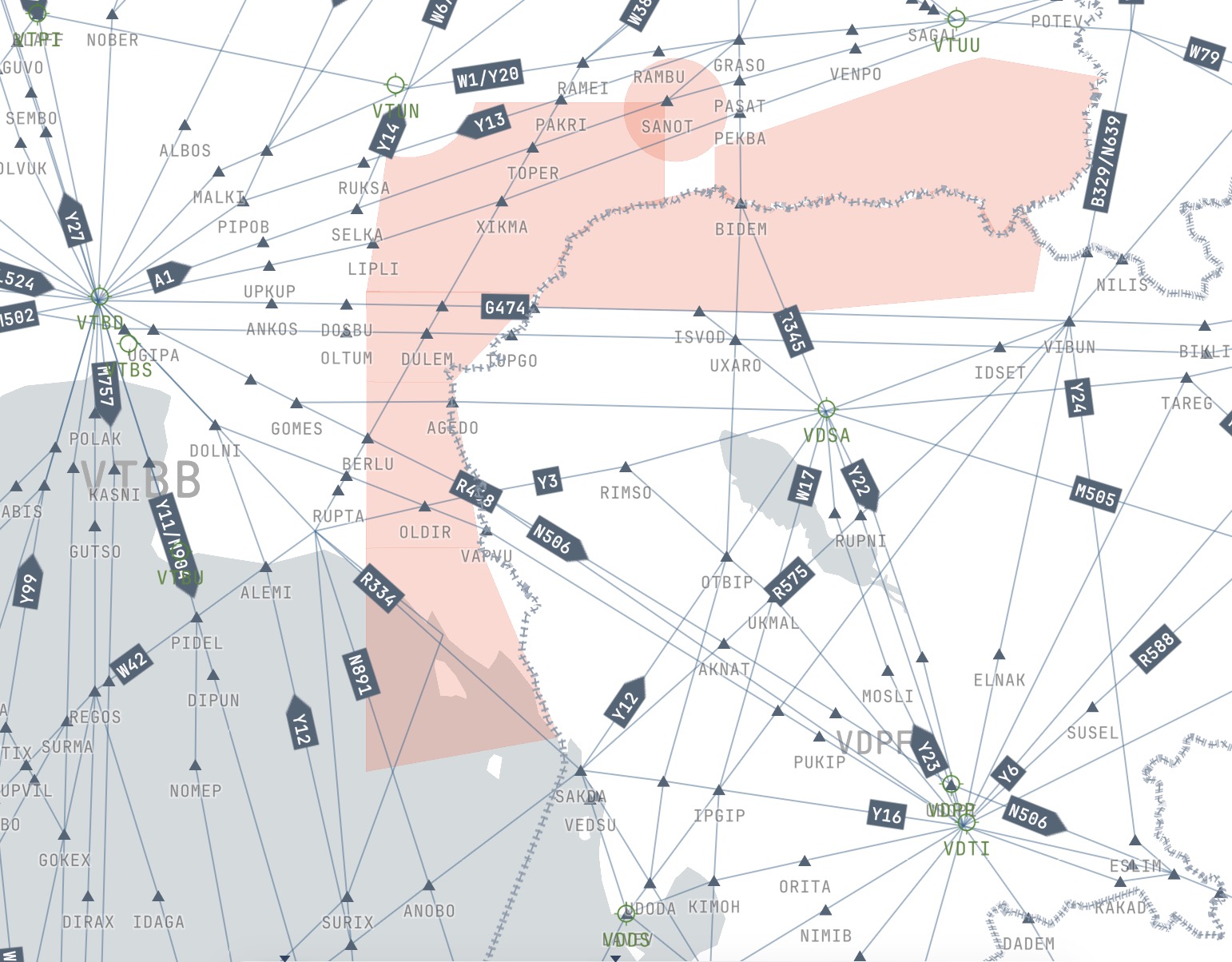
Oct 2026: The ceasefire with Thailand is holding, but tensions remain along the border. The VDPF/Phnom Penh FIR is open, though Cambodia has set up a danger area near the border and rerouted some eastbound flights from L880/G474 via B204. In the VTBB/Bangkok FIR, Thai Notams report unmanned-aircraft activity near the border, so ATC may give aircraft radar vectors.
See OPSGROUP Briefing: Emerging Airspace Risk: Cambodia & Thailand - 2025
The primary risk is that fighting could flare up again and disrupt nearby routes. Check the latest Notams for the VDPF/Phnom Penh FIR and VTBB/Bangkok FIR before departure.
Major events:
Sep 2026: Cambodia protested what it said was a Thai military helicopter incursion. Thailand denied that the helicopter crossed the border.
Dec 2025: Fighting resumed after the July ceasefire broke down. A new ceasefire took effect on 27 December after weeks of clashes.
Jul 2025: 5 days of border clashes, including airstrikes and artillery fire, ended in a ceasefire.
See OPSGROUP Briefing: Emerging Airspace Risk: Cambodia & Thailand - 2025
The primary risk is that fighting could flare up again and disrupt nearby routes. Check the latest Notams for the VDPF/Phnom Penh FIR and VTBB/Bangkok FIR before departure.
Major events:
Sep 2026: Cambodia protested what it said was a Thai military helicopter incursion. Thailand denied that the helicopter crossed the border.
Dec 2025: Fighting resumed after the July ceasefire broke down. A new ceasefire took effect on 27 December after weeks of clashes.
Jul 2025: 5 days of border clashes, including airstrikes and artillery fire, ended in a ceasefire.
Curacao
Level Three - Caution
Oct 2026: The temporary FAA restrictions following US strikes in Venezuela have ended. The FAA removed the related Caribbean Notams, and no FAA flight bans or caution advisories are currently in force for the TNCF/Curacao FIR.
The primary risk is military aircraft mixing with civil traffic in a busy corridor, especially when they are difficult for ATC to track. Two close encounters were reported near Curacao in December 2025. The FAA has since removed its warnings for the TNCF/Curacao FIR.
Major events:
Jan 2026: After US strikes in Venezuela, the FAA briefly restricted flights in the TNCF/Curacao FIR and nearby Caribbean airspace. It lifted the restrictions within a day and removed the remaining Notams later that month.
Dec 2025: A JetBlue flight from TNCC/Curacao narrowly avoided a US Air Force tanker. A private jet also reported unidentified traffic nearby.
Nov 2025: Curacao’s aviation authority warned flights to and from TNCA/Aruba, TNCC/Curacao, and TNCB/Bonaire after unidentified aircraft were detected in the area.
The primary risk is military aircraft mixing with civil traffic in a busy corridor, especially when they are difficult for ATC to track. Two close encounters were reported near Curacao in December 2025. The FAA has since removed its warnings for the TNCF/Curacao FIR.
Major events:
Jan 2026: After US strikes in Venezuela, the FAA briefly restricted flights in the TNCF/Curacao FIR and nearby Caribbean airspace. It lifted the restrictions within a day and removed the remaining Notams later that month.
Dec 2025: A JetBlue flight from TNCC/Curacao narrowly avoided a US Air Force tanker. A private jet also reported unidentified traffic nearby.
Nov 2025: Curacao’s aviation authority warned flights to and from TNCA/Aruba, TNCC/Curacao, and TNCB/Bonaire after unidentified aircraft were detected in the area.
Central America
Level Three - Caution
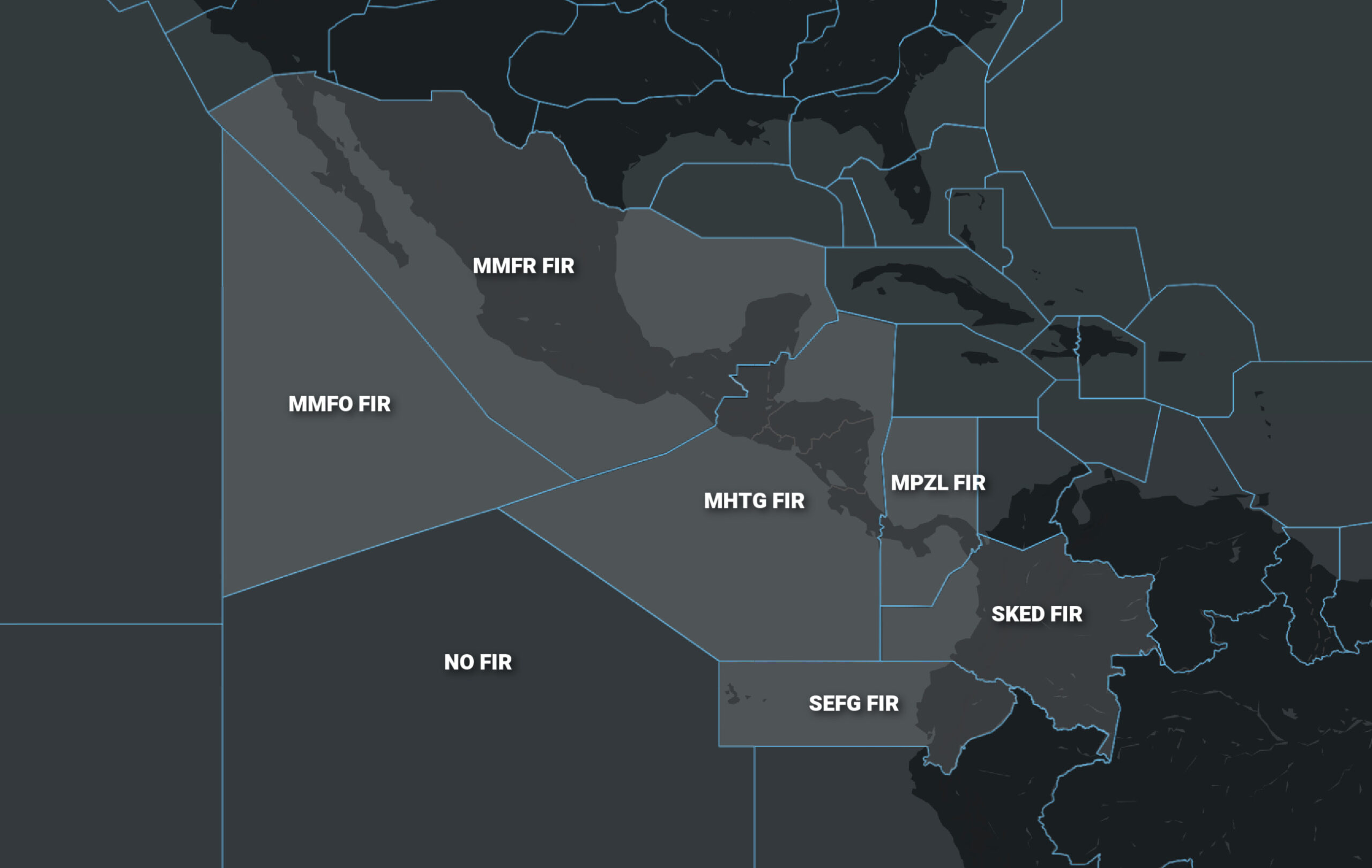
Oct 2026: FAA caution notices remain in effect for US operators in specified Pacific overwater areas. They cover MHTG/Cenamer, MMFR/Mexico, MMFO/Mazatlan Oceanic, MPZL/Panama, SKED/Bogota, SEFG/Guayaquil and XX01/unassigned eastern Pacific. A separate FAA notice also covers MHCC/Central America FIR.
The primary risk is intermittent GNSS interference and military activity. The FAA advises US operators to use caution: military aircraft may operate near normal cruising levels with little warning, sometimes with transponders off, and GNSS problems may continue after leaving the affected area. The risk applies at all altitudes, including during arrivals and departures. There are no specific routing bans.
Major events:
Sep 2026: The FAA extended caution notices across Pacific overwater areas. They remain in effect through 13 March 2027.
Jan 2026: Reports of intermittent GNSS interference and US military counter-narcotics flights in the eastern Pacific prompted the FAA’s first caution notices.
The primary risk is intermittent GNSS interference and military activity. The FAA advises US operators to use caution: military aircraft may operate near normal cruising levels with little warning, sometimes with transponders off, and GNSS problems may continue after leaving the affected area. The risk applies at all altitudes, including during arrivals and departures. There are no specific routing bans.
Major events:
Sep 2026: The FAA extended caution notices across Pacific overwater areas. They remain in effect through 13 March 2027.
Jan 2026: Reports of intermittent GNSS interference and US military counter-narcotics flights in the eastern Pacific prompted the FAA’s first caution notices.
Qatar
Level Three - Caution
Oct 2026: OTDF/Doha FIR remains open, but the risk picture is still elevated following the US-Iran conflict and continuing military activity in the Persian Gulf. Some restrictions remain in place over the FIR’s waters, while short-notice disruption remains possible.
See OPSGROUP Briefing: Middle East airspace situation - 2026
The primary risk is missile and drone activity linked to the wider regional conflict. Qatar hosts major US military facilities and could be directly exposed to Iranian attacks. Air-defence activity also creates a risk of misidentification, falling debris and sudden airspace restrictions. EASA advises avoiding the Persian Gulf waters within OTDF/Doha FIR except for necessary arrivals and departures, while France advises great caution throughout the FIR.
Major events:
Sep 2026: France renewed its warning for French operators to exercise great caution in OTDF/Doha FIR.
Jul-Sep 2026: A Persian Gulf airspace advisory was issued and later revised following renewed military activity. It now advises avoiding the waters within OTDF/Doha FIR except for necessary arrivals and departures.
Feb-Jul 2026: OTDF/Doha FIR closed and reopened several times during the Iran conflict before returning to normal overflight operations.
Mar 2026: An Iranian missile strike was reported near Al Udeid Air Base, close to Doha.
See OPSGROUP Briefing: Middle East airspace situation - 2026
The primary risk is missile and drone activity linked to the wider regional conflict. Qatar hosts major US military facilities and could be directly exposed to Iranian attacks. Air-defence activity also creates a risk of misidentification, falling debris and sudden airspace restrictions. EASA advises avoiding the Persian Gulf waters within OTDF/Doha FIR except for necessary arrivals and departures, while France advises great caution throughout the FIR.
Major events:
Sep 2026: France renewed its warning for French operators to exercise great caution in OTDF/Doha FIR.
Jul-Sep 2026: A Persian Gulf airspace advisory was issued and later revised following renewed military activity. It now advises avoiding the waters within OTDF/Doha FIR except for necessary arrivals and departures.
Feb-Jul 2026: OTDF/Doha FIR closed and reopened several times during the Iran conflict before returning to normal overflight operations.
Mar 2026: An Iranian missile strike was reported near Al Udeid Air Base, close to Doha.
Bahrain
Level Three - Caution
Oct 2026: OBBB/Bahrain FIR remains open, but the risk picture is still elevated following the US-Iran conflict and military activity around the Strait of Hormuz. Some restrictions remain in place over the FIR’s waters, while short-notice disruption remains possible.
See OPSGROUP Briefing: Middle East airspace situation - 2026
The primary risk is missile and drone activity linked to the wider regional conflict. Bahrain hosts major US military facilities and could be directly exposed to Iranian attacks. Air-defence activity also creates a risk of misidentification, falling debris and sudden airspace restrictions. Ops over the Persian Gulf waters within OBBB/Bahrain FIR should be avoided except for necessary arrivals and departures, while France advises to exercise great caution throughout the FIR.
Major events:
Sep 2026: France renewed its warning for French operators to exercise great caution in OBBB/Bahrain FIR.
Jul-Sep 2026: A Persian Gulf airspace advisory was issued and later revised following renewed military activity. It now advises avoiding the waters within OBBB/Bahrain FIR except for necessary arrivals and departures.
Feb-Jul 2026: OBBB/Bahrain FIR closed and reopened several times during the Iran conflict before returning to normal overflight operations.
Mar 2026: Iranian missile and drone attacks affected several Gulf states, including airspace around Bahrain.
See OPSGROUP Briefing: Middle East airspace situation - 2026
The primary risk is missile and drone activity linked to the wider regional conflict. Bahrain hosts major US military facilities and could be directly exposed to Iranian attacks. Air-defence activity also creates a risk of misidentification, falling debris and sudden airspace restrictions. Ops over the Persian Gulf waters within OBBB/Bahrain FIR should be avoided except for necessary arrivals and departures, while France advises to exercise great caution throughout the FIR.
Major events:
Sep 2026: France renewed its warning for French operators to exercise great caution in OBBB/Bahrain FIR.
Jul-Sep 2026: A Persian Gulf airspace advisory was issued and later revised following renewed military activity. It now advises avoiding the waters within OBBB/Bahrain FIR except for necessary arrivals and departures.
Feb-Jul 2026: OBBB/Bahrain FIR closed and reopened several times during the Iran conflict before returning to normal overflight operations.
Mar 2026: Iranian missile and drone attacks affected several Gulf states, including airspace around Bahrain.
Jordan
Level Three - Caution
Oct 2026: OJAC/Amman FIR remains open and Jordan has not published conflict-related airspace restrictions. However, the security situation deteriorated after renewed attacks in early September, and current international guidance is to avoid the FIR at all altitudes.
See OPSGROUP Briefing: Middle East airspace situation - 2026
The primary risk is missile and drone activity linked to regional conflicts. Jordan has previously been affected by missiles and drones crossing its airspace during escalations involving Israel and Iran. Air-defence activity adds a risk of interception, misidentification and falling debris. France and Germany advise not to enter the FIR, while European guidance also recommends avoiding it at all altitudes.
Major events:
Sep 2026: Renewed attacks in early September increased the risk to civil aviation in Jordanian airspace. France subsequently renewed its warning for French operators not to enter OJAC/Amman FIR.
Aug 2026: Germany advised its operators not to enter OJAC/Amman FIR.
Feb-Jul 2026: Jordan remained open throughout the Iran conflict, although missile and drone activity affected several neighbouring countries.
Apr 2024: Jordan temporarily closed its airspace during Iran’s drone and missile attack on Israel.
See OPSGROUP Briefing: Middle East airspace situation - 2026
The primary risk is missile and drone activity linked to regional conflicts. Jordan has previously been affected by missiles and drones crossing its airspace during escalations involving Israel and Iran. Air-defence activity adds a risk of interception, misidentification and falling debris. France and Germany advise not to enter the FIR, while European guidance also recommends avoiding it at all altitudes.
Major events:
Sep 2026: Renewed attacks in early September increased the risk to civil aviation in Jordanian airspace. France subsequently renewed its warning for French operators not to enter OJAC/Amman FIR.
Aug 2026: Germany advised its operators not to enter OJAC/Amman FIR.
Feb-Jul 2026: Jordan remained open throughout the Iran conflict, although missile and drone activity affected several neighbouring countries.
Apr 2024: Jordan temporarily closed its airspace during Iran’s drone and missile attack on Israel.
United Arab Emirates
Level Three - Caution
Oct 2026: OMAE/Emirates FIR remains open, but the risk picture is still elevated following the US-Iran conflict and military activity around the Strait of Hormuz. Ops over the Persian Gulf waters within the FIR should be avoided except for necessary arrivals/departures.
See OPSGROUP Briefing: Middle East airspace situation - 2026
The primary risk is missile and drone activity linked to the wider regional conflict. The UAE could be directly exposed to Iranian attacks, while air-defence activity raises the risk of misidentification, interception activity and falling debris. Debris from intercepted drones has previously fallen in Abu Dhabi, and GPS spoofing has been reported across the FIR. France advises to exercise great caution throughout OMAE/Emirates FIR.
Major events:
Sep 2026: France renewed its warning for French operators to exercise great caution in OMAE/Emirates FIR.
Jul-Sep 2026: A Persian Gulf airspace advisory was issued and later revised following renewed military activity. It now advises avoiding the waters within OMAE/Emirates FIR except for necessary arrivals and departures.
Feb-Jul 2026: UAE airspace closed and reopened several times during the Iran conflict.
Mar 2026: Debris from intercepted drones fell in Abu Dhabi, causing injuries and damage.
Feb 2022: Multiple Houthi drone and missile attacks targeted Abu Dhabi.
See OPSGROUP Briefing: Middle East airspace situation - 2026
The primary risk is missile and drone activity linked to the wider regional conflict. The UAE could be directly exposed to Iranian attacks, while air-defence activity raises the risk of misidentification, interception activity and falling debris. Debris from intercepted drones has previously fallen in Abu Dhabi, and GPS spoofing has been reported across the FIR. France advises to exercise great caution throughout OMAE/Emirates FIR.
Major events:
Sep 2026: France renewed its warning for French operators to exercise great caution in OMAE/Emirates FIR.
Jul-Sep 2026: A Persian Gulf airspace advisory was issued and later revised following renewed military activity. It now advises avoiding the waters within OMAE/Emirates FIR except for necessary arrivals and departures.
Feb-Jul 2026: UAE airspace closed and reopened several times during the Iran conflict.
Mar 2026: Debris from intercepted drones fell in Abu Dhabi, causing injuries and damage.
Feb 2022: Multiple Houthi drone and missile attacks targeted Abu Dhabi.
Oman
Level Three - Caution
Oct 2026: OOMM/Muscat FIR remains open and is a key part of the main southern bypass route around the Middle East conflict zone. The risk remains elevated due to military activity around the Strait of Hormuz. Ops over the Gulf of Oman within the FIR west of 58°E should be avoided.
See OPSGROUP Briefing: Middle East airspace situation - 2026
The primary risk is military activity around the Strait of Hormuz. Oman sits close to the strait and remains an important link in the Egypt-Saudi-Oman routing used by many operators. Ops over the Gulf of Oman within OOMM/Muscat FIR west of 58°E should be avoided. France advises to exercise great caution throughout the FIR.
Major events:
Sep 2026: France renewed its warning for French operators to exercise great caution in OOMM/Muscat FIR.
Jul-Sep 2026: A Persian Gulf airspace advisory was issued and later revised following renewed military activity. It continues to advise avoiding the Gulf of Oman within OOMM west of 58°E.
Feb-Jul 2026: Oman remained open throughout the Iran conflict and became a key part of the southern bypass route.
Jun 2025: Israel and Iran exchanged missile strikes, prompting renewed airspace warnings.
Oct 2024: Israel and Iran exchanged missile attacks, leading to widespread airspace avoidance.
See OPSGROUP Briefing: Middle East airspace situation - 2026
The primary risk is military activity around the Strait of Hormuz. Oman sits close to the strait and remains an important link in the Egypt-Saudi-Oman routing used by many operators. Ops over the Gulf of Oman within OOMM/Muscat FIR west of 58°E should be avoided. France advises to exercise great caution throughout the FIR.
Major events:
Sep 2026: France renewed its warning for French operators to exercise great caution in OOMM/Muscat FIR.
Jul-Sep 2026: A Persian Gulf airspace advisory was issued and later revised following renewed military activity. It continues to advise avoiding the Gulf of Oman within OOMM west of 58°E.
Feb-Jul 2026: Oman remained open throughout the Iran conflict and became a key part of the southern bypass route.
Jun 2025: Israel and Iran exchanged missile strikes, prompting renewed airspace warnings.
Oct 2024: Israel and Iran exchanged missile attacks, leading to widespread airspace avoidance.
Egypt
Level Three - Caution
July 2025: The ceasefire between Israel and Iran has held so far. All airspace in the region has largely reopened, but the corridor between Israel and Iran remains high risk if the conflict resumes.
See OPSGROUP Briefing: Middle East airspace situation – June 2025
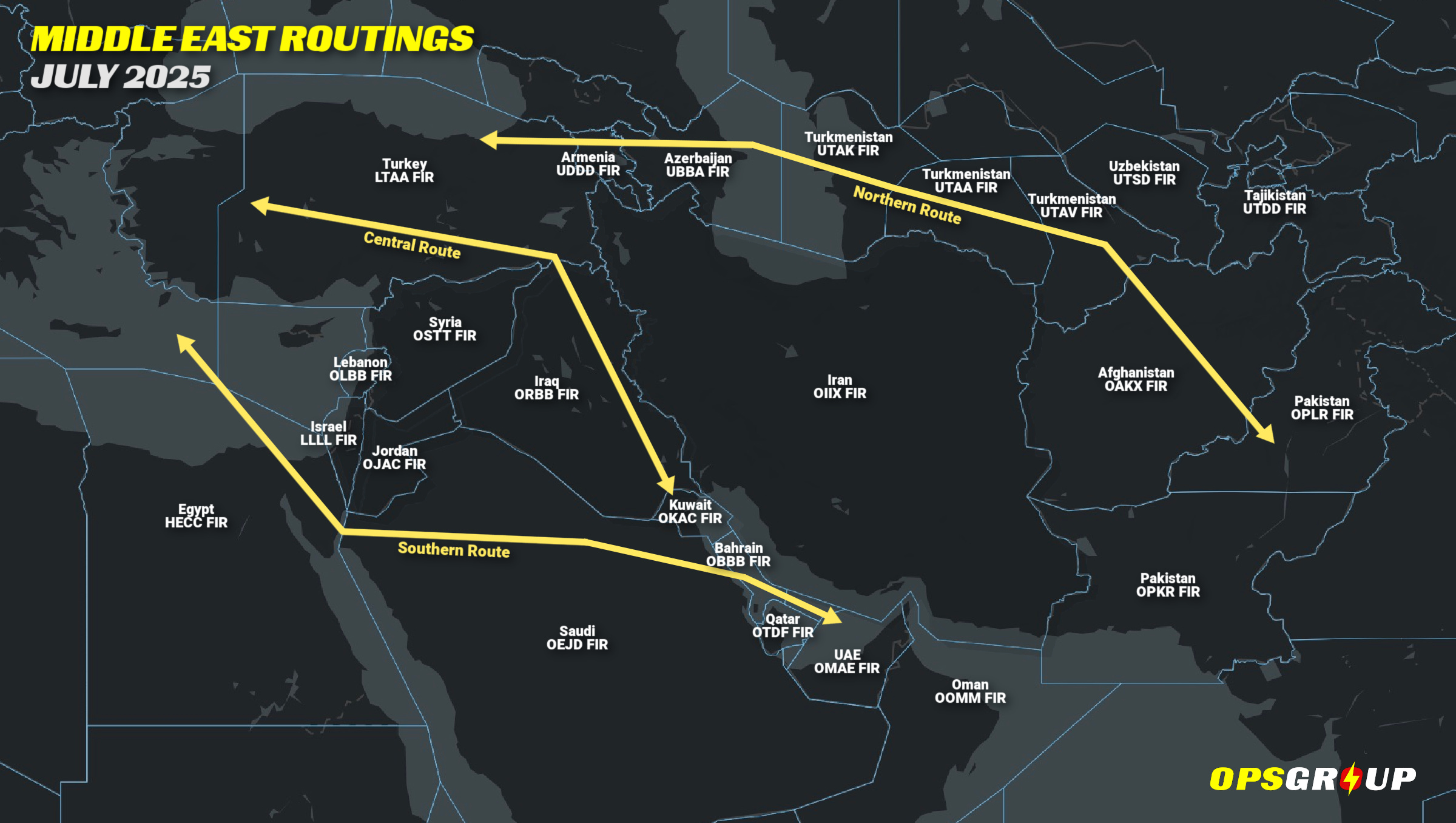
Prior to the June 2025 conflict between Israel and Iran, the only airspace warnings for Egypt were those published by the UK in Nov 2023, advising caution over the Gulf of Aqaba and the Red Sea due to the potential risk from heightened military activity related to the conflict in Israel/Gaza.
Major events:
June 2025: EASA issues CZIB warning of spillover risk in the airspace of Egypt and Saudi Arabia from the conflict between Israel and Iran.
Nov 2023: UK published Notams warning of increased risk over the Gulf of Aqaba and the Red Sea due to the conflict in Israel/Gaza. Cruise missiles and drones launched from Yemen targeted Israel. Some shot down over the Red Sea, others landed on Egypt/Israel border. New Airspace Warning: The Red Sea, Nov 2023 (OPSGROUP article)
July 2019: British Airways suspends Cairo operations for one week due to security concerns.
Feb 2017: An SA-7 anti-aircraft missile tube was found less than a mile from HECA/Cairo airport.
Oct 2015: A Russian A321 was brought down over the Sinai peninsula by a bomb loaded at HESH/Sharm El Sheikh. The group claimed the IED was placed aboard the aircraft prior to departing HESH, raising concerns of potential insider threats at the airport.
See OPSGROUP Briefing: Middle East airspace situation – June 2025
Prior to the June 2025 conflict between Israel and Iran, the only airspace warnings for Egypt were those published by the UK in Nov 2023, advising caution over the Gulf of Aqaba and the Red Sea due to the potential risk from heightened military activity related to the conflict in Israel/Gaza.
Major events:
June 2025: EASA issues CZIB warning of spillover risk in the airspace of Egypt and Saudi Arabia from the conflict between Israel and Iran.
Nov 2023: UK published Notams warning of increased risk over the Gulf of Aqaba and the Red Sea due to the conflict in Israel/Gaza. Cruise missiles and drones launched from Yemen targeted Israel. Some shot down over the Red Sea, others landed on Egypt/Israel border. New Airspace Warning: The Red Sea, Nov 2023 (OPSGROUP article)
July 2019: British Airways suspends Cairo operations for one week due to security concerns.
Feb 2017: An SA-7 anti-aircraft missile tube was found less than a mile from HECA/Cairo airport.
Oct 2015: A Russian A321 was brought down over the Sinai peninsula by a bomb loaded at HESH/Sharm El Sheikh. The group claimed the IED was placed aboard the aircraft prior to departing HESH, raising concerns of potential insider threats at the airport.
India
Level Three - Caution
The primary risk in India’s airspace in in the VIDF/Delhi FIR. The risk is from military activity by Pakistan and India in the disputed Kashmir region, which poses a potential inadvertent risk to aviation at all altitudes.
There was a period of intense shelling and aerial incursions from both sides from 7-10 May 2025. A ceasefire announced on May 10 appears to be holding. We continue to advise caution in the Kashmir region where air defense activity could resume with little warning if hostilities were to restart.
Flight tracking indicates that some operators have resumed overflights of this region, although most are still avoiding the area, opting instead to reroute south via the Gulf of Oman and the UAE.
Since the events of May 2025, the only country to have issued a new airspace warning to avoid the Kashmir area is France.
Major events:
May 2025: Ceasefire on May 10 following four days of conflict in Kashmir region. Most operators still avoiding the region and routing via Gulf of Oman and UAE.
There was a period of intense shelling and aerial incursions from both sides from 7-10 May 2025. A ceasefire announced on May 10 appears to be holding. We continue to advise caution in the Kashmir region where air defense activity could resume with little warning if hostilities were to restart.
Flight tracking indicates that some operators have resumed overflights of this region, although most are still avoiding the area, opting instead to reroute south via the Gulf of Oman and the UAE.
Since the events of May 2025, the only country to have issued a new airspace warning to avoid the Kashmir area is France.
Major events:
May 2025: Ceasefire on May 10 following four days of conflict in Kashmir region. Most operators still avoiding the region and routing via Gulf of Oman and UAE.
Western Sahara
Level Three - Caution
In Sep 2021, there were concerns of a new conflict zone emerging in Western Sahara. The country is split down the middle - Morocco controls the west, and the region’s independence movement, the Polisario, controls the east. The Polisario declared war on Morocco.
The FAA warned that the Polisario likely had access to anti-aircraft weaponry which may pose an inadvertent risk to civil aircraft up to FL120. The GCCC/Canarias FIR issued a Notam warning operators to avoid using the airways over Western Sahara below FL200.
But since then, the intensity of the hostilities has remained fairly limited. No new warnings were issued, and the Canarias Notam was withdrawn in Nov 2021.
For ops over Western Sahara, note that there is a lack of continuous ATC coverage. Western Sahara does not control its own airspace - it falls within both the GCCC/Canarias and the GOOO/Dakar FIRs, which may complicate airspace management should the conflict escalate again. The FAA advise aircraft operating in the region to stay in touch with ATC and be prepared for possible airspace restrictions and reroutes.
Read: Opsgroup article - Western Sahara Airspace Update, May 2021.
The FAA warned that the Polisario likely had access to anti-aircraft weaponry which may pose an inadvertent risk to civil aircraft up to FL120. The GCCC/Canarias FIR issued a Notam warning operators to avoid using the airways over Western Sahara below FL200.
But since then, the intensity of the hostilities has remained fairly limited. No new warnings were issued, and the Canarias Notam was withdrawn in Nov 2021.
For ops over Western Sahara, note that there is a lack of continuous ATC coverage. Western Sahara does not control its own airspace - it falls within both the GCCC/Canarias and the GOOO/Dakar FIRs, which may complicate airspace management should the conflict escalate again. The FAA advise aircraft operating in the region to stay in touch with ATC and be prepared for possible airspace restrictions and reroutes.
Read: Opsgroup article - Western Sahara Airspace Update, May 2021.
South Korea
Level Three - Caution
In 2024, South Korea started warning of GPS interference in the north of the country, likely originating from North Korea, advising pilots to watch out for ops to the Seoul airports of RKSS and RKSI. It’s especially important to watch out for GPS spoofing here - it’s right next to the border with North Korea and a bunch of prohibited areas which carry chart warnings that say in very clear language that you might get shot at if you inadvertently enter.
South Korea previously had warnings in place due to the risk posed by unannounced North Korea missile launches and regional volatility. A US Notam on GPS interference expired on May 27, 2019.
Major events:
May 2024: Member report of GPS spoofing into RKSS/Seoul on approach to RWY 32R. They disabled hybrid and deselected GPS after seeing the risk reported on ATIS.
South Korea previously had warnings in place due to the risk posed by unannounced North Korea missile launches and regional volatility. A US Notam on GPS interference expired on May 27, 2019.
Major events:
May 2024: Member report of GPS spoofing into RKSS/Seoul on approach to RWY 32R. They disabled hybrid and deselected GPS after seeing the risk reported on ATIS.
Myanmar
Level Three - Caution
The security situation in Myanmar has deteriorated since the military coup in Feb 2021. There is conflict and violence across many parts of the country, involving air strikes and armed clashes.
Several countries have issued airspace warnings at the lower flight levels due to the potential risk from military ops, surface-to-air fire and anti-aviation weaponry. We have also had reports of GPS jamming (and maybe spoofing) in the north of the FIR for overflights between China and Bangladesh airspace.
Major events:
Feb 2026: Armed groups targeted an ATR with passengers on board preparing to depart VYMK/Myitkyina with a first-person view suicide drone. Damage was caused to the nose, midesection and tail and was later declared a war crime under the Geneva Convention. The airport was temporarily closed.
Jan 2024: Armed group shot down a military helicopter in the northern state of Kachin, which borders China. They likely used a man portable air defence system (MANPAD).
Sep 2023: Several attacks by rebel groups against military targets across the country, including a makeshift drone which dropped bombs on aircraft hangars at an airbase next to VYNT/Naypyitaw airport.
Sep 2023: Reports of intermittent GPS jamming on airway N895 over the mainland in the VYYF/Yangon FIR.
Apr 2023: Myanmar’s main airport VYYY/Yangon temporarily closed following attack by resistance groups with improvised artillery rounds.
Sep 2022: A Myanmar National Airlines passenger was reportedly shot as bullets passed through the fuselage of the ATR 72 aircraft on approach to VYLK/Loikaw.
Feb 2021: Military coup ousted the government. ATC strike at the end of Feb resulted in no ATC service provided to overflights (read more on that here). Since then, there have been increasing strikes and mass protests by opposition activists, as well as clashes with militia and airstrikes on areas where militia are known to be active.
Read: OPSGROUP Article - Myanmar, Nov 2022
Several countries have issued airspace warnings at the lower flight levels due to the potential risk from military ops, surface-to-air fire and anti-aviation weaponry. We have also had reports of GPS jamming (and maybe spoofing) in the north of the FIR for overflights between China and Bangladesh airspace.
Major events:
Feb 2026: Armed groups targeted an ATR with passengers on board preparing to depart VYMK/Myitkyina with a first-person view suicide drone. Damage was caused to the nose, midesection and tail and was later declared a war crime under the Geneva Convention. The airport was temporarily closed.
Jan 2024: Armed group shot down a military helicopter in the northern state of Kachin, which borders China. They likely used a man portable air defence system (MANPAD).
Sep 2023: Several attacks by rebel groups against military targets across the country, including a makeshift drone which dropped bombs on aircraft hangars at an airbase next to VYNT/Naypyitaw airport.
Sep 2023: Reports of intermittent GPS jamming on airway N895 over the mainland in the VYYF/Yangon FIR.
Apr 2023: Myanmar’s main airport VYYY/Yangon temporarily closed following attack by resistance groups with improvised artillery rounds.
Sep 2022: A Myanmar National Airlines passenger was reportedly shot as bullets passed through the fuselage of the ATR 72 aircraft on approach to VYLK/Loikaw.
Feb 2021: Military coup ousted the government. ATC strike at the end of Feb resulted in no ATC service provided to overflights (read more on that here). Since then, there have been increasing strikes and mass protests by opposition activists, as well as clashes with militia and airstrikes on areas where militia are known to be active.
Read: OPSGROUP Article - Myanmar, Nov 2022
Niger
Level Three - Caution
Risk elevated for Niger, due to risk of target misidentification for civil traffic. Security on the ground is still a problem. The US continues to advise against all travel there.
Niger’s airspace and airports were temporarily closed to all flights in Aug 2023, following a military coup. The coup leaders are now operating defensively, and actively looking for signs of military intervention from neighbouring states. If this were to happen, it would likely be from ECOWAS states led by Nigeria, and also potentially with troops from Benin, Guinea Bissau, Ivory Coast, and Senegal. In this scenario, such regional escalation would highly likely trigger further airspace closures with increased shootdown risks in the wider area.
Read: OSGROUP article, Aug 2023
Major events:
Jan 2024: Report of intermittent GPS spoofing in Niger, which began during climb out of DRRN/Niamey and remained until descent to DXXX/Lome in Togo to the south.
Dec 2023: Several reports of overflights being denied entry into Niger airspace at short notice. In all cases, a valid permit was in hand but was not accepted by Niger ATC while the flight was airborne. Likely due to CAA computer system errors. Overflights should carry extra fuel for potential holding.
Sep 2023: Niger’s airspace reopened for the first time since a military coup in July. But it now excludes French-registered aircraft, or those chartered by French interests due to a political dispute.
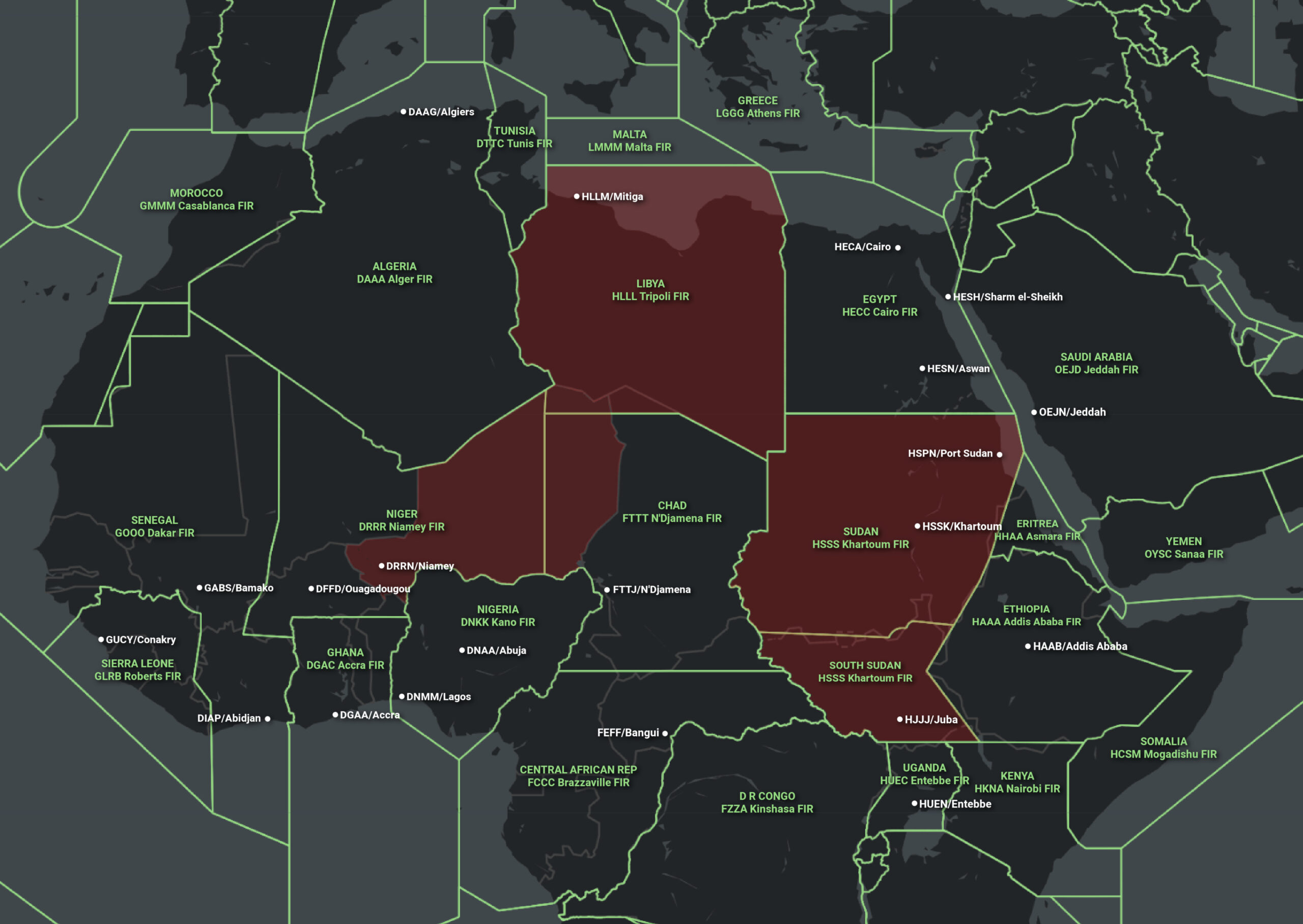
Niger’s airspace and airports were temporarily closed to all flights in Aug 2023, following a military coup. The coup leaders are now operating defensively, and actively looking for signs of military intervention from neighbouring states. If this were to happen, it would likely be from ECOWAS states led by Nigeria, and also potentially with troops from Benin, Guinea Bissau, Ivory Coast, and Senegal. In this scenario, such regional escalation would highly likely trigger further airspace closures with increased shootdown risks in the wider area.
Read: OSGROUP article, Aug 2023
Major events:
Jan 2024: Report of intermittent GPS spoofing in Niger, which began during climb out of DRRN/Niamey and remained until descent to DXXX/Lome in Togo to the south.
Dec 2023: Several reports of overflights being denied entry into Niger airspace at short notice. In all cases, a valid permit was in hand but was not accepted by Niger ATC while the flight was airborne. Likely due to CAA computer system errors. Overflights should carry extra fuel for potential holding.
Sep 2023: Niger’s airspace reopened for the first time since a military coup in July. But it now excludes French-registered aircraft, or those chartered by French interests due to a political dispute.
Turkey
Level Three - Caution
The primary risk is misidentification by local militia who infrequently target Turkish military aircraft with MANPADS and weaponsied drones. Operations to LTAJ/Gaziantep should be carefully reviewed given its proximity to the Syrian border. Along the border with Syria and Iraq in proximity to conflict zones, there is a higher level of airborne military traffic, UAS and the risk of proximity to airstrikes.
The secondary risk is from GPS jamming and spoofing. There are frequent reports from crews of GPS signal interference in Turkish airspace - with some as far away as abeam Baghdad. GPS jamming is common through the LTAA/Ankara FIR, and especially on the border between the ORBB/Baghdad and OIIX/Tehran FIRs. As of Nov 2023, GPS Spoofing is also being encountered over the Black Sea in Turkish airspace. All reports share very similar symptoms: uncommanded turns, position errors, and multiple GPWS warnings. The spoofed locations received all centre on Sevastopol, Crimean peninsula, a difference of between 120-250nm from the actual aircraft position. More info: Special Briefing, OPSGROUP Members Dashboard
Major events:
Nov 2023: GPS Spoofing being encountered over the Black Sea in Turkish airspace.
Nov 2022: Shelling and a rocket strike near a town in southern Turkey, near the border with Syria. Turkey has been carrying out airstrikes on Syria and Kurdish regions of Iraq.
May 2021: Attempted drone attack by local militia on LTCC/Diyabakir airport in South Eastern Turkey.
Jan 2019: Turkish security forces intercepted three weaponised drones during attempted attacks against sites in southern Turkey.
The secondary risk is from GPS jamming and spoofing. There are frequent reports from crews of GPS signal interference in Turkish airspace - with some as far away as abeam Baghdad. GPS jamming is common through the LTAA/Ankara FIR, and especially on the border between the ORBB/Baghdad and OIIX/Tehran FIRs. As of Nov 2023, GPS Spoofing is also being encountered over the Black Sea in Turkish airspace. All reports share very similar symptoms: uncommanded turns, position errors, and multiple GPWS warnings. The spoofed locations received all centre on Sevastopol, Crimean peninsula, a difference of between 120-250nm from the actual aircraft position. More info: Special Briefing, OPSGROUP Members Dashboard
Major events:
Nov 2023: GPS Spoofing being encountered over the Black Sea in Turkish airspace.
Nov 2022: Shelling and a rocket strike near a town in southern Turkey, near the border with Syria. Turkey has been carrying out airstrikes on Syria and Kurdish regions of Iraq.
May 2021: Attempted drone attack by local militia on LTCC/Diyabakir airport in South Eastern Turkey.
Jan 2019: Turkish security forces intercepted three weaponised drones during attempted attacks against sites in southern Turkey.
Cyprus
Level Three - Caution
Two issues the LCCC/Nicosia FIR over Cyprus: proximity to active conflict zone in Syria, and GPS Interference.
The primary risk is from the proximity to Syria: civil aircraft may be targeted in error, or caught in crossfire during ongoing air attacks involving Israel, Russia, Iran. Missiles may erroneously lock on to civil aircraft. There is a risk to civil aircraft operating on overwater airways east of Cyprus.
The secondary risk is from GPS Interference. This has been ongoing since 2018. In April 2018, the Nicosia FIR began being used as a military staging for possible strikes in Syria, prompting EASA to issue a warning, and lead to avoidance of the FIR by many airlines. In Nov 2023, OPSGROUP received several reports of enroute aircraft being targeted with fake GPS signals, leading to complete nav failures. This type of GPS spoofing has not been seen before – IRS is quickly “infected” by false position. Suggested Guidance and Procedures, and original crew reports, in Briefing PDF here: GPS Spoofing, Nov 2023 (OPSGROUP article)
Major events:
Nov 2023 - ongoing: GPS spoofing reported across the Mediterranean region.
Sep 2018: Russian IL-20 shot down in error on FIR boundary with Cyprus (Nicosia FIR) - airline flights on UL620 within 50nm of this position.
The primary risk is from the proximity to Syria: civil aircraft may be targeted in error, or caught in crossfire during ongoing air attacks involving Israel, Russia, Iran. Missiles may erroneously lock on to civil aircraft. There is a risk to civil aircraft operating on overwater airways east of Cyprus.
The secondary risk is from GPS Interference. This has been ongoing since 2018. In April 2018, the Nicosia FIR began being used as a military staging for possible strikes in Syria, prompting EASA to issue a warning, and lead to avoidance of the FIR by many airlines. In Nov 2023, OPSGROUP received several reports of enroute aircraft being targeted with fake GPS signals, leading to complete nav failures. This type of GPS spoofing has not been seen before – IRS is quickly “infected” by false position. Suggested Guidance and Procedures, and original crew reports, in Briefing PDF here: GPS Spoofing, Nov 2023 (OPSGROUP article)
Major events:
Nov 2023 - ongoing: GPS spoofing reported across the Mediterranean region.
Sep 2018: Russian IL-20 shot down in error on FIR boundary with Cyprus (Nicosia FIR) - airline flights on UL620 within 50nm of this position.
Indonesia
Level Three - Caution
The security situation in Papua remains poor. While there are no active airspace warnings for Indonesian Papua or neighbouring Papua New Guinea, the region has a recent history of armed groups targeting either low flying aircraft or airports themselves. Operators should take extra security precautions, including limiting time spent on the ground.
Major events:
Mar 2023: An armed group opened fired at WAYB/Bilorai airport. One plane on the ground was hit and another diverted.
Feb 2023: An aircraft was set on fire and the pilot taken hostage at Paro airfield.
Jan 2023: An armed group fired at an aircraft landing at WAJO/Oksibil airport. It went around and diverted.
June 2022: An armed group fired at an aircraft landing at Kenyam airfield.
Apr 2021: An armed group attacked WABL/Ilaga airport and torched a private helicopter.
Major events:
Mar 2023: An armed group opened fired at WAYB/Bilorai airport. One plane on the ground was hit and another diverted.
Feb 2023: An aircraft was set on fire and the pilot taken hostage at Paro airfield.
Jan 2023: An armed group fired at an aircraft landing at WAJO/Oksibil airport. It went around and diverted.
June 2022: An armed group fired at an aircraft landing at Kenyam airfield.
Apr 2021: An armed group attacked WABL/Ilaga airport and torched a private helicopter.
Central African Republic
Level Three - Caution
The security situation on the ground in the Central African Republic is dire. There have been numerous attacks on civilians and peacekeeping troops in recent years. FEFF/Bangui airport is operating under UN control, and is subject to regular power outages. The US and UK advise against all travel to the entire country due to violent crime, civil unrest, and the presence of armed groups who control large areas of the country. There are no official airspace warnings in place for the CAR, but the general advice is to avoid landings here completely.
Major events:
Nov 2022: An unidentified aircraft dropped bombs targeting a militant group 150nm north of the capital Bangui. The group responded with small arms fire. Low flying aircraft in the area may be at increased risk.
Feb 2021: Deteriorating security situation. A state of emergency was declared due to post election violence. The government suspended use of all airspace by foreign governments and NGOs. For the second time, armed rebels attempted to enter the capital Bangui to overthrow the newly elected president. They got within six miles of the city before being pushed back by local and UN forces.
Major events:
Nov 2022: An unidentified aircraft dropped bombs targeting a militant group 150nm north of the capital Bangui. The group responded with small arms fire. Low flying aircraft in the area may be at increased risk.
Feb 2021: Deteriorating security situation. A state of emergency was declared due to post election violence. The government suspended use of all airspace by foreign governments and NGOs. For the second time, armed rebels attempted to enter the capital Bangui to overthrow the newly elected president. They got within six miles of the city before being pushed back by local and UN forces.
Japan
Level Three - Caution
The primary risk is from debris from missile re-entries striking aircraft overflying the oceanic part of the ZKKP/Pyongyang FIR over the Sea of Japan. North Korea regularly conducts unannounced missile tests in this area. Consider rerouting to remain over the Japanese landmass or east of it.
The US prohibits flights across all North Korean airspace, including the oceanic part of the ZKKP/Pyongyang FIR over the Sea of Japan. Several other countries have airspace warnings in place which advise caution due to the risk posed by unannounced rocket launches.
Major events:
Oct 2022: North Korea fired a ballistic missile directly over Japan - the first to incur on Japanese airspace since 2017.
2017: North Korea launched two intercontinental ballistic missiles. Both of these landed in the Sea of Japan, well inside the Fukuoka Flight Information Region (Japanese airspace), and significantly, at least one did not re-enter the atmosphere intact – meaning that a debris field of missile fragments passed through the airspace, not just one complete missile.
2015: North Korea gradually stopped notifying ICAO of missile launches, so that aircraft could avoid the launch and splashdown areas.
Read: North Korea Missile Threat, Oct 2022 (OPSGROUP article)
The US prohibits flights across all North Korean airspace, including the oceanic part of the ZKKP/Pyongyang FIR over the Sea of Japan. Several other countries have airspace warnings in place which advise caution due to the risk posed by unannounced rocket launches.
Major events:
Oct 2022: North Korea fired a ballistic missile directly over Japan - the first to incur on Japanese airspace since 2017.
2017: North Korea launched two intercontinental ballistic missiles. Both of these landed in the Sea of Japan, well inside the Fukuoka Flight Information Region (Japanese airspace), and significantly, at least one did not re-enter the atmosphere intact – meaning that a debris field of missile fragments passed through the airspace, not just one complete missile.
2015: North Korea gradually stopped notifying ICAO of missile launches, so that aircraft could avoid the launch and splashdown areas.
Read: North Korea Missile Threat, Oct 2022 (OPSGROUP article)
Albania
Level Three - Caution
Pilots should exercise extreme caution while operating in Albanian airspace (the LAAA/Tirana FIR) due to a heightened risk of degraded ATC services.
In April 2021, Albanian airspace (the LAAA/Tirana FIR) along with LATI/Tirana Airport was forced to close, after a number of local air traffic controllers declared themselves temporarily unfit to work.
Local air traffic controllers are working under significant duress and high stress, having been threatened with dismissal (or worse - being arrested and jailed) if they do not declare themselves fit for duty. A number of foreign controllers were temporarily brought in despite not being trained or rated on any of the local positions.
Several international associations have published warnings, including IFALPA and IFATCA.
In April 2021, Albanian airspace (the LAAA/Tirana FIR) along with LATI/Tirana Airport was forced to close, after a number of local air traffic controllers declared themselves temporarily unfit to work.
Local air traffic controllers are working under significant duress and high stress, having been threatened with dismissal (or worse - being arrested and jailed) if they do not declare themselves fit for duty. A number of foreign controllers were temporarily brought in despite not being trained or rated on any of the local positions.
Several international associations have published warnings, including IFALPA and IFATCA.
Chad
Level Three - Caution
Chad in the past was a popular fuel stop in central Africa, but multiple travel warnings now advise against travel here (see the UK advice here, and the US advice here). No official airspace warnings have been issued for Chad, but danger remains high. FTTJ/Ndjamena airport was closed for 2 days in April 2021 due to security concerns following the death of Chad’s long term President - more info here. High threat for terrorism. Avoid landings.