
Lebanon
Risk Level: One - Do Not Fly
[ about risk levels ]
Oct 2026: OLBB/Beirut FIR remains high risk, with Israeli military activity continuing despite ceasefire efforts. EASA and several countries advise against entering Lebanese airspace, with limited exceptions for flights to and from Beirut that approach and depart over the sea.
See OPSGROUP Briefing: Middle East airspace situation - 2026
The primary risk is military activity linked to the Israel-Hezbollah conflict, including Israeli airstrikes and the risk of misidentification by air defence systems. Although ceasefire efforts have reduced the intensity of fighting, military operations have continued - particularly in southern Lebanon. The risk to civil aviation remains high.
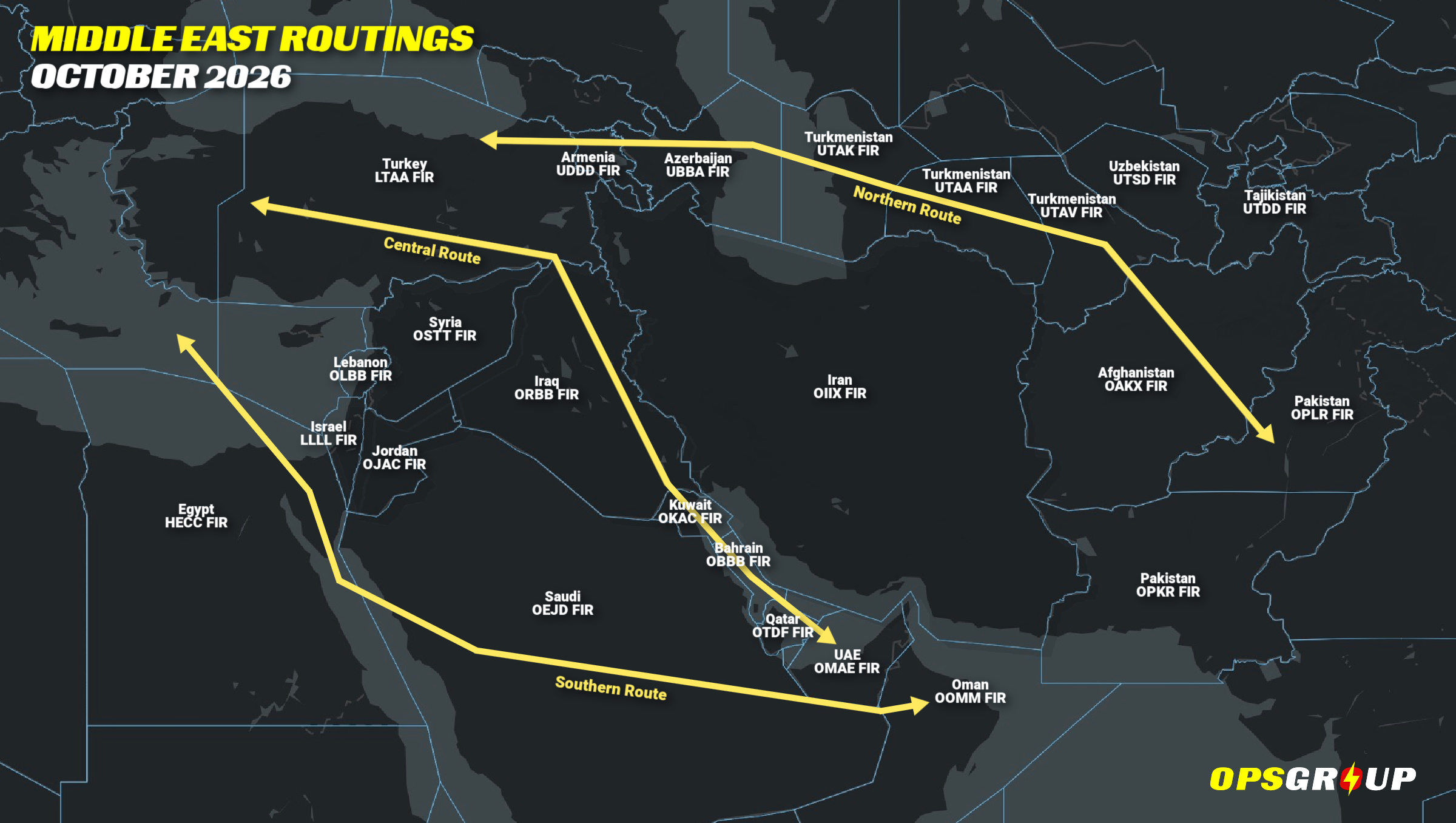
Major events:
Feb-Jul 2026: Israeli airstrikes continued in Lebanon despite ceasefire extensions.
Oct 2024: Israel launched a ground operation against Hezbollah in southern Lebanon.
Nov 2023 onwards: Regional conflict involving Israel and Hezbollah led to prolonged disruption and heightened security risks in Lebanese airspace.
See OPSGROUP Briefing: Middle East airspace situation - 2026
The primary risk is military activity linked to the Israel-Hezbollah conflict, including Israeli airstrikes and the risk of misidentification by air defence systems. Although ceasefire efforts have reduced the intensity of fighting, military operations have continued - particularly in southern Lebanon. The risk to civil aviation remains high.
Major events:
Feb-Jul 2026: Israeli airstrikes continued in Lebanon despite ceasefire extensions.
Oct 2024: Israel launched a ground operation against Hezbollah in southern Lebanon.
Nov 2023 onwards: Regional conflict involving Israel and Hezbollah led to prolonged disruption and heightened security risks in Lebanese airspace.
Current warnings list :
| Source | Reference | Issued | Valid to | |
|---|---|---|---|---|
| UK | Notam EGTT V0034/26 | 23 Oct 2026 | 23 Oct 2027 | |
| Germany | Notam EDWW B0747/26 | 11 Sep 2026 | 12 Nov 2026 | |
| Italy | Notam LIRR E2219/26 | 01 Sep 2026 | 29 Nov 2026 | |
| France | Notam LFFF F1805/26 | 01 Sep 2026 | 25 Nov 2026 | |
| Lebanon | Notam OLBB A0191/26 | 15 Aug 2026 | 15 Nov 2026 | |
| EASA | CZIB 2026-06-R2 | 08 Jul 2026 | 16 Nov 2026 | |
| Canada | AIC 17/26 | 01 Aug 2024 | Ongoing | |
| USA | FAA Information Note Syria/Israel | 23 Apr 2021 | Ongoing | |
| USA | Notam KICZ A0009/18 | 14 Apr 2018 | Ongoing |
Source: UK
Reference: Notam EGTT V0034/26
Issued: 23-Oct-26, valid until: 23 Oct 2027
Plain English: UK operators should avoid Lebanon airspace, except for flights to/from OLBA/Beirut airport over the sea.
V0034/26 NOTAMR V0033/26
Q) EGXX/QROXX/IV/NBO/W /000/999/5218N01451W999
A) EGTT EGGX EGPX B) 2610231431 C) PERM
E) SECURITY - HAZARDOUS SITUATION IN LEBANON. UK REGISTERED AIR OPERATORS ARE RECOMMENDED NOT TO ENTER FIR BEIRUT (OLBB), EXCEPT FOR OPERATIONS TO/FROM OLBA WHICH COMMENCE ARRIVAL AND COMPLETE
DEPARTURE OVER THE MEDITERRANEAN SEA. POTENTIAL RISK FROM HEIGHTENED MILITARY ACTIVITY. THIS SUPERCEDES THE INFORMATION CONTAINED IN THE UK CIVIL AIP ENR 1.1. AR-2026-3194/03.
F) SFC G) UNL
Q) EGXX/QROXX/IV/NBO/W /000/999/5218N01451W999
A) EGTT EGGX EGPX B) 2610231431 C) PERM
E) SECURITY - HAZARDOUS SITUATION IN LEBANON. UK REGISTERED AIR OPERATORS ARE RECOMMENDED NOT TO ENTER FIR BEIRUT (OLBB), EXCEPT FOR OPERATIONS TO/FROM OLBA WHICH COMMENCE ARRIVAL AND COMPLETE
DEPARTURE OVER THE MEDITERRANEAN SEA. POTENTIAL RISK FROM HEIGHTENED MILITARY ACTIVITY. THIS SUPERCEDES THE INFORMATION CONTAINED IN THE UK CIVIL AIP ENR 1.1. AR-2026-3194/03.
F) SFC G) UNL
Source: Germany
Reference: Notam EDWW B0747/26
Issued: 11-Sep-26, valid until: 12 Nov 2026
Plain English: German operators should not enter the airspace of Lebanon.
SECURITY - HAZARDOUS SITUATION IN LEBANON CIVIL GERMAN AIR OPERATORS ARE ADVISED TO TAKE POTENTIAL RISK INTO ACCOUNT IN THEIR RISK ASSESSMENT AND ROUTING DECISIONS WITHIN FIR BEIRUT. POTENTIAL RISK FROM ANTI-AVIATION WEAPONRY, MILITARY OPERATIONS AND ARMED CONFLICTS.
Source: Italy
Reference: Notam LIRR E2219/26
Issued: 01-Sep-26, valid until: 29 Nov 2026
Plain English: Italian operators should not enter the OLBB/Beirut FIR.
ITALIAN AIR CARRIERS AND CAPTAINS OF AIRCRAFT IN CHARGE OF AIR SERVICES OPERATED BY CARRIERS HOLDING AN OPERATING LICENSE ISSUED BY ITALY, WHETHER THEY ARE CONTRACTUAL CARRIERS AND/OR OPERATING CARRIERS, OR PERFORMING AIR SERVICES THROUGH A WET LEASE OR A CODESHARE AGREEMENT AS WELL AS FOR ANY FLIGHT MADE WITH AN AIRCRAFT REGISTERED IN ITALY ARE RECOMMENDED TO OPERATE WITHIN AIRSPACE OF LEBANON FIR BEIRUT (OLBB) ACCORDING TO EASA SAFETY DIRECTIVES ENSURING A ROBUST RISK ASSESSMENT.
Source: France
Reference: Notam LFFF F1805/26
Issued: 01-Sep-26, valid until: 25 Nov 2026
Plain English: French operators should avoid Lebanon airspace, except for flights to/from OLBA/Beirut airport over the sea.
FRENCH AIR CARRIERS AND CAPTAINS OF AIRCRAFT IN CHARGE OF AIR SERVICES OPERATED BY CARRIERS HOLDING AN OPERATING LICENSE ISSUED BY FRANCE, WHETHER THEY ARE CONTRACTUAL CARRIERS AND/OR OPERATING CARRIERS, OR PERFORMING AIR SERVICES THROUGH A WET LEASE OR A CODESHARE AGREEMENT AS WELL AS FOR ANY FLIGHT MADE WITH AN AIRCRAFT REGISTERED IN FRANCE ARE REQUESTED NOT TO PENETRATE INTO THE AIRSPACE OF LEBANON (FIR BEIRUT (OLBB)), EXCEPT FOR THE USE OF BEIRUT AERODROME (OLBA) AND SUBJECT TO THE FOLLOWING CONDITIONS:
- APPROACH AND DEPARTURE BY SEA,
- FULL COORDINATION WITH LOCAL AUTHORITIES AND AIR TRAFFIC CONTROL,
- PRIOR CONDUCT OF A ROBUST RISK ASSESSMENT.
- APPROACH AND DEPARTURE BY SEA,
- FULL COORDINATION WITH LOCAL AUTHORITIES AND AIR TRAFFIC CONTROL,
- PRIOR CONDUCT OF A ROBUST RISK ASSESSMENT.
Source: Lebanon
Reference: Notam OLBB A0191/26
Issued: 15-Aug-26, valid until: 15 Nov 2026
Plain English: Warning of GPS jamming and spoofing in the OLBB/Beirut FIR, pilots should stick to conventional ATS routes.
AIRCRAFT FLYING BEIRUT FIR SHALL BE AWARE OF POSSIBLE LOSS OF GPS/GNSS SIGNAL,AND DUE TO CURRENT SECURITY REASONS PREVAILED IN THE MEDITERRANEAN AREA,THERE HAS BEEN AN INCREASE IN JAMMING AND/OR SPOOFING OF GLOBAL NAVIGATION SATTELITE SYSTEMS (GNSS). LEB ANS SET IN PLACE, CONTINGENCY PLAN ,INCLUDING PROCEDURES TO BE FOLLOWED IN CASE OF LARGE-SCALE GNSS JAMMING AND/OR SPOOFING EVENTS BASED ON:
-CONVENTIONAL ATS ROUTES,STARS AND APPROACH PROCEDURES (REF TO GROUND NAVAIDS) ARE CURRENTLY HIGHLY RECOMMENDED.
-RNAV(GNSS) STARS AND RNP APPROACH PROCEDURES STILL POSSIBLE TO BE FOLLOWED IF PILOT REQUESTED AND UNDER HIS OWN DISCRETION.
-CONVENTIONAL ATS ROUTES,STARS AND APPROACH PROCEDURES (REF TO GROUND NAVAIDS) ARE CURRENTLY HIGHLY RECOMMENDED.
-RNAV(GNSS) STARS AND RNP APPROACH PROCEDURES STILL POSSIBLE TO BE FOLLOWED IF PILOT REQUESTED AND UNDER HIS OWN DISCRETION.
Source: EASA
Reference: CZIB 2026-06-R2
Issued: 08-Jul-26, valid until: 16 Nov 2026
Plain English: Operators should avoid Lebanon airspace, except for operations to/from OLBA/Beirut that approach from the sea or depart over the sea.
This CZIB is issued based on information currently available to EASA, the European Commission and Member States in order to share information which is considered necessary to ensure the safety of flights over zones of interest and indicate areas of high risk.
In the context of the military conflict in the Middle East, which began on 28 February 2026 with the U.S. and Israeli strikes against Iran, tensions have expanded across the region, including Israeli attacks on targets within Lebanese territory and Hezbollah operations against Israel.
A ceasefire between Israel and Lebanon, initially agreed on 16 April 2026 was subsequently extended twice. Furthermore, on 26 June 2026, Israel, Lebanon and the United States signed a Trilateral Framework Agreement, marking a further step towards consolidating the ceasefire, however its long-term implementation remains uncertain. Although, these have contributed to an overall reduction in the intensity of military operations, recurrent violations have been observed in August 2026, primarily in southern Lebanon where military operations have continued.
While residual risks remain high, and should be reflected in operators’ risk assessments, it is considered that approaches starting from the sea and departures ending over the sea, based on an up-to-date risk assessment and continuous risk monitoring, provide sufficient mitigation of the risk of misidentification.
In terms of airspace management, the State concerned has not demonstrated capability to address existing airspace risks by implementing an efficient and proactive approach to the airspace deconfliction. As a result, there are limited mitigating factors, on which air operators can rely at present.
Overall, there is a high-risk in the airspace over the territory of Lebanon, except for operations starting from the sea to Beirut International Airport and departures ending over the sea.
EASA, together with the Commission and Member States, will continue to closely monitor the situation, with a view to assess whether there is an increase or decrease of the risk for EU aircraft operators due to the evolution of the threat and risk situation.
Air operators should:
Not operate within the airspace of Lebanon at all altitudes and flight levels, except for operations to / from Beirut International Airport (BEY / OLBA) under the following conditions:
- approach starting from the sea / departure ending over the sea,
- based on an up-to-date risk assessment and continuous risk monitoring.
Closely monitor airspace developments in the region and follow all available aeronautical publications, in particular airspace closures or restrictions issued by State authorities, alongside available guidance or direction from their national authorities including information shared through the European Information Sharing and Cooperation Platform on Conflict Zones.
In the context of the military conflict in the Middle East, which began on 28 February 2026 with the U.S. and Israeli strikes against Iran, tensions have expanded across the region, including Israeli attacks on targets within Lebanese territory and Hezbollah operations against Israel.
A ceasefire between Israel and Lebanon, initially agreed on 16 April 2026 was subsequently extended twice. Furthermore, on 26 June 2026, Israel, Lebanon and the United States signed a Trilateral Framework Agreement, marking a further step towards consolidating the ceasefire, however its long-term implementation remains uncertain. Although, these have contributed to an overall reduction in the intensity of military operations, recurrent violations have been observed in August 2026, primarily in southern Lebanon where military operations have continued.
While residual risks remain high, and should be reflected in operators’ risk assessments, it is considered that approaches starting from the sea and departures ending over the sea, based on an up-to-date risk assessment and continuous risk monitoring, provide sufficient mitigation of the risk of misidentification.
In terms of airspace management, the State concerned has not demonstrated capability to address existing airspace risks by implementing an efficient and proactive approach to the airspace deconfliction. As a result, there are limited mitigating factors, on which air operators can rely at present.
Overall, there is a high-risk in the airspace over the territory of Lebanon, except for operations starting from the sea to Beirut International Airport and departures ending over the sea.
EASA, together with the Commission and Member States, will continue to closely monitor the situation, with a view to assess whether there is an increase or decrease of the risk for EU aircraft operators due to the evolution of the threat and risk situation.
Air operators should:
Not operate within the airspace of Lebanon at all altitudes and flight levels, except for operations to / from Beirut International Airport (BEY / OLBA) under the following conditions:
- approach starting from the sea / departure ending over the sea,
- based on an up-to-date risk assessment and continuous risk monitoring.
Closely monitor airspace developments in the region and follow all available aeronautical publications, in particular airspace closures or restrictions issued by State authorities, alongside available guidance or direction from their national authorities including information shared through the European Information Sharing and Cooperation Platform on Conflict Zones.
Source: Canada
Reference: AIC 17/26
Issued: 01-Aug-24, valid until: Ongoing
Plain English: Canadian operators should not enter the OLBB/Beirut FIR due to potential risk from military activity.
Level 2 (Recommendation)
SECURITY HAZARDOUS SITUATION IN LEBANON. Canadian Air Operators and owners of aircraft registered in Canada are recommended not to enter FIR Beirut (OLBB). Potential risk to aviation from military activity.
SECURITY HAZARDOUS SITUATION IN LEBANON. Canadian Air Operators and owners of aircraft registered in Canada are recommended not to enter FIR Beirut (OLBB). Potential risk to aviation from military activity.
Source: USA
Reference: FAA Information Note Syria/Israel
Issued: 23-Apr-21, valid until: Ongoing
Plain English: An errant surface-to-air missile fired by Syrian air defences missed its target and landed in Israel on 22 Apr 2021. Syria is actively using long range anti-aircraft weaponry which poses a risk to civil aircraft in the region. While US operators are banned from the OSTT/Damascus FIR, the FAA warns the threat is extended to adjacent FIRs in the Eastern Mediterranean region including the LLLL/Tel Aviv, OJAC/Amman, OLBB/Beirut and LCCC/Nicosia FIRs. Use caution if operating in the area.
Title: FAA Information Note - Syria/Israel - Errant surface to air missile impacts near Israeli critical infrastructure.
Click the link for full text.
Click the link for full text.
Source: USA
Reference: Notam KICZ A0009/18
Issued: 14-Apr-18, valid until: Ongoing
Plain English: Exercise caution within 200 NM of the Damascus FIR due to military activity. Possibility of GPS interference, communication jamming, and long-range surface to air missiles in the area.
SECURITY..UNITED STATES OF AMERICA ADVISORY FOR AIRSPACE IMMEDIATELY ADJACENT TO DAMASCUS FLIGHT INFORMATION REGION (OSTT FIR).
THOSE PERSONS DESCRIBED IN PARAGRAPH A BELOW ARE ADVISED TO EXERCISE CAUTION WHEN OPERATING IN THE AIRSPACE WITHIN 200 NAUTICAL MILES OFTHE DAMASCUS FLIGHT INFORMATION REGION (OSTT FIR) DUE TO HEIGHTENED MILITARY ACTIVITY IN OR AROUND SYRIA. THIS MILITARY ACTIVITY MIGHT INCLUDE GPS INTERFERENCE, COMMUNICATIONS JAMMING, AND POSSIBLE ERRANT LONG-RANGE SURFACE-TO-AIR MISSILES ORIGINATING FROM SYRIAN TERRITORY, WITHIN THE OSTT FIR, AND STRAYING INTO ADJACENT AIRSPACE,THAT COULD POSE AN INADVERTENT RISK TO U.S. CIVIL AVIATION OPERATING IN THIS REGION. TITLE 14, CODE OF FEDERAL REGULATIONS, SECTION 91.1609, SPECIAL FEDERAL AVIATION REGULATION NO. 114 PROHIBITION AGAINST CERTAIN FLIGHTS IN THE DAMASCUS FIR REMAINS IN EFFECT.
A. APPLICABILITY. THIS NOTAM APPLIES TO: ALL U.S. AIR CARRIERS AND COMMERCIAL OPERATORS; ALL PERSONS EXERCISING THE PRIVILEGES OF AN AIRMAN CERTIFICATE ISSUED BY THE FAA, EXCEPT SUCH PERSONS OPERATING U.S.-REGISTERED AIRCRAFT FOR A FOREIGN AIR CARRIER; AND ALL OPERATORS OF AIRCRAFT REGISTERED IN THE UNITED STATES, EXCEPT WHERE THE OPERATOR OF SUCH AIRCRAFT IS A FOREIGN AIR CARRIER.
B. PLANNING. THOSE PERSONS DESCRIBED IN PARAGRAPH A PLANNING TO OPERATE WITHIN 200 NAUTICAL MILES OF THE OSTT FIR SHOULD EXERCISE CAUTION AND MUST REVIEW CURRENT SECURITY/THREAT INFORMATION AND NOTAMS AND COMPLY WITH ALL APPLICABLE FAA REGULATIONS, OPERATIONS SPECIFICATIONS, MANAGEMENT SPECIFICATIONS, AND LETTERS OF AUTHORIZATION, INCLUDING UPDATING B450.
C. OPERATIONS. EXERCISE CAUTION DURING FLIGHT OPERATIONS IN THE ABOVE NAMED AREA DUE TO HEIGHTENED MILITARY ACTIVITY IN OR AROUND SYRIA AND THE POTENTIAL RISK TO U.S. CIVIL AVIATION IN THE REGION.THOSE PERSONS DESCRIBED IN PARAGRAPH A MUST REPORT ANY SAFETY/SECURITY INCIDENTS TO THE FAA AT ASH-AXE-CITE-WATCH@FAA.GOVOR +1 202-267-3333 OR 1-844-412-1794.
ADDITIONAL INFORMATION IS PROVIDED AT: https://www.faa.gov/AIR_TRAFFIC/PUBLICATIONS/US_RESTRICTIONS/
THOSE PERSONS DESCRIBED IN PARAGRAPH A BELOW ARE ADVISED TO EXERCISE CAUTION WHEN OPERATING IN THE AIRSPACE WITHIN 200 NAUTICAL MILES OFTHE DAMASCUS FLIGHT INFORMATION REGION (OSTT FIR) DUE TO HEIGHTENED MILITARY ACTIVITY IN OR AROUND SYRIA. THIS MILITARY ACTIVITY MIGHT INCLUDE GPS INTERFERENCE, COMMUNICATIONS JAMMING, AND POSSIBLE ERRANT LONG-RANGE SURFACE-TO-AIR MISSILES ORIGINATING FROM SYRIAN TERRITORY, WITHIN THE OSTT FIR, AND STRAYING INTO ADJACENT AIRSPACE,THAT COULD POSE AN INADVERTENT RISK TO U.S. CIVIL AVIATION OPERATING IN THIS REGION. TITLE 14, CODE OF FEDERAL REGULATIONS, SECTION 91.1609, SPECIAL FEDERAL AVIATION REGULATION NO. 114 PROHIBITION AGAINST CERTAIN FLIGHTS IN THE DAMASCUS FIR REMAINS IN EFFECT.
A. APPLICABILITY. THIS NOTAM APPLIES TO: ALL U.S. AIR CARRIERS AND COMMERCIAL OPERATORS; ALL PERSONS EXERCISING THE PRIVILEGES OF AN AIRMAN CERTIFICATE ISSUED BY THE FAA, EXCEPT SUCH PERSONS OPERATING U.S.-REGISTERED AIRCRAFT FOR A FOREIGN AIR CARRIER; AND ALL OPERATORS OF AIRCRAFT REGISTERED IN THE UNITED STATES, EXCEPT WHERE THE OPERATOR OF SUCH AIRCRAFT IS A FOREIGN AIR CARRIER.
B. PLANNING. THOSE PERSONS DESCRIBED IN PARAGRAPH A PLANNING TO OPERATE WITHIN 200 NAUTICAL MILES OF THE OSTT FIR SHOULD EXERCISE CAUTION AND MUST REVIEW CURRENT SECURITY/THREAT INFORMATION AND NOTAMS AND COMPLY WITH ALL APPLICABLE FAA REGULATIONS, OPERATIONS SPECIFICATIONS, MANAGEMENT SPECIFICATIONS, AND LETTERS OF AUTHORIZATION, INCLUDING UPDATING B450.
C. OPERATIONS. EXERCISE CAUTION DURING FLIGHT OPERATIONS IN THE ABOVE NAMED AREA DUE TO HEIGHTENED MILITARY ACTIVITY IN OR AROUND SYRIA AND THE POTENTIAL RISK TO U.S. CIVIL AVIATION IN THE REGION.THOSE PERSONS DESCRIBED IN PARAGRAPH A MUST REPORT ANY SAFETY/SECURITY INCIDENTS TO THE FAA AT ASH-AXE-CITE-WATCH@FAA.GOVOR +1 202-267-3333 OR 1-844-412-1794.
ADDITIONAL INFORMATION IS PROVIDED AT: https://www.faa.gov/AIR_TRAFFIC/PUBLICATIONS/US_RESTRICTIONS/