
Venezuela
Risk Level: Three - Caution
[ about risk levels ]
Oct 2026: The immediate disruption after the US strikes in January has passed. The FAA lifted its temporary restrictions and removed the related Notams. EASA’s warning expired in March, and no FAA flight bans or caution Notams are currently in force.
See OPSGROUP Briefing: Venezuela & Caribbean Airspace Update - Jan 2026
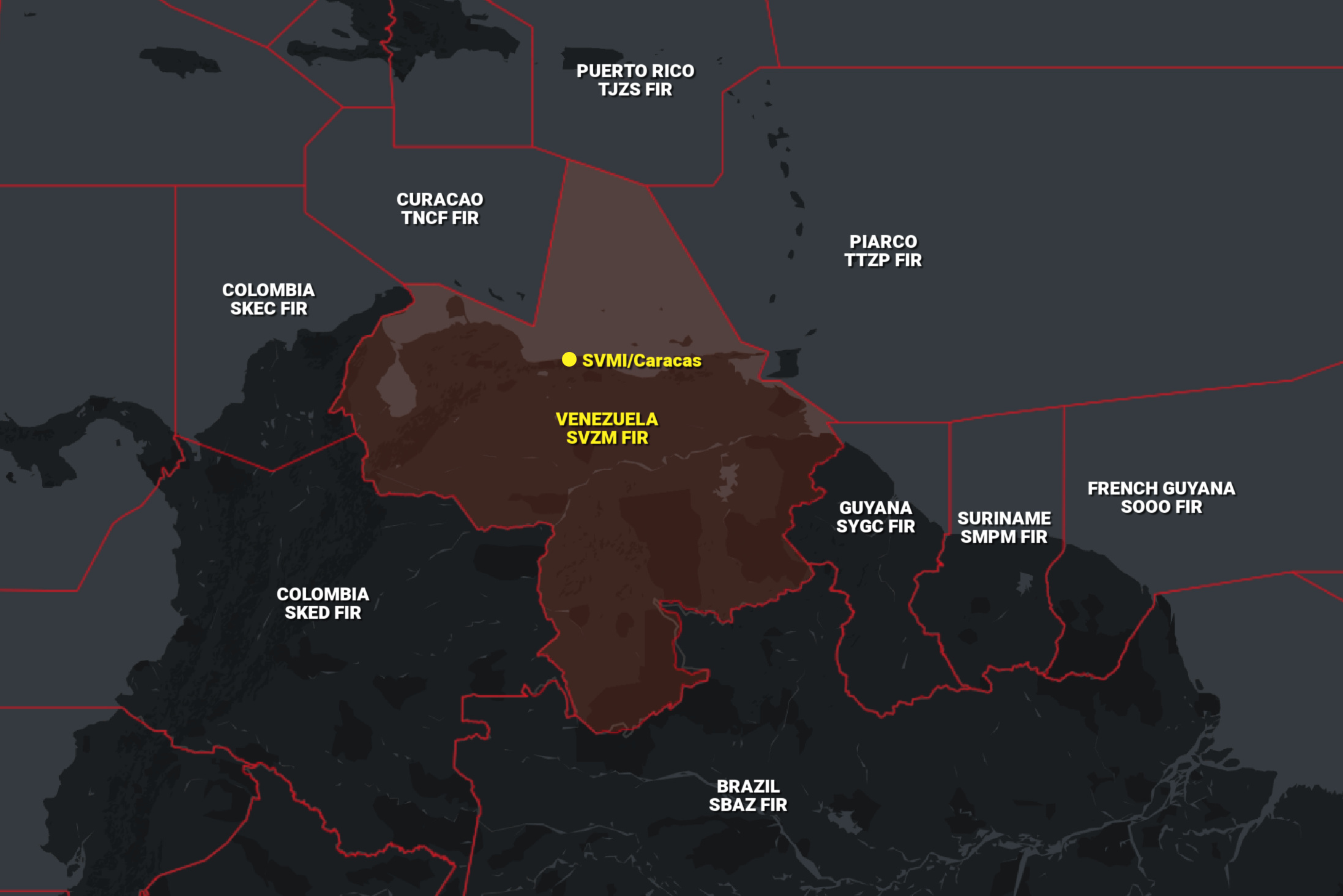
The primary risk is lingering GPS interference and military activity. The FAA warns that GPS problems can continue after aircraft leave the SVZM/Maiquetia FIR, and that Venezuelan air-defence systems could reach civil flight levels, raising the risk of misidentification.
Major events:
Jan 2026: US strikes in Venezuela led the FAA to briefly restrict flights in the SVZM/Maiquetia FIR and nearby Caribbean FIRs. The restrictions were lifted within hours, and the disruption soon eased.
Nov 2025: The FAA warned of GPS interference and increased military activity. Several airlines suspended or rerouted flights, and Venezuela revoked six airlines’ operating permits.
See OPSGROUP Briefing: Venezuela & Caribbean Airspace Update - Jan 2026
The primary risk is lingering GPS interference and military activity. The FAA warns that GPS problems can continue after aircraft leave the SVZM/Maiquetia FIR, and that Venezuelan air-defence systems could reach civil flight levels, raising the risk of misidentification.
Major events:
Jan 2026: US strikes in Venezuela led the FAA to briefly restrict flights in the SVZM/Maiquetia FIR and nearby Caribbean FIRs. The restrictions were lifted within hours, and the disruption soon eased.
Nov 2025: The FAA warned of GPS interference and increased military activity. Several airlines suspended or rerouted flights, and Venezuela revoked six airlines’ operating permits.
Current warnings list :
| Source | Reference | Issued | Valid to | |
|---|---|---|---|---|
| EASA | Information Note | 16 Feb 2026 | 31 Mar 2026 | |
| USA | FAA Information Note Venezeula | 21 Nov 2025 | Ongoing |
Source: EASA
Reference: Information Note
Issued: 16-Feb-26, valid until: 31 Mar 2026
Plain English: Operators should take potential risk into account in the airspace of Venezuela and neighbouring airspace.
Information Note on the threat and risk situation in the airspace of Venezuela (FIR Maiquetia - VYYF) and neighbouring airspace
Airspace affected:
- FIR Maiquetia (SVZM),
- FIR San Juan (TJZS),
- FIR Curacao (TNCF), and
- FIR Piarco (TTZP) west of 57° 00′ 00″ W.
Civil air operators are advised to take potential risk into account in their risk assessment and routing decisions.
Airspace affected:
- FIR Maiquetia (SVZM),
- FIR San Juan (TJZS),
- FIR Curacao (TNCF), and
- FIR Piarco (TTZP) west of 57° 00′ 00″ W.
Civil air operators are advised to take potential risk into account in their risk assessment and routing decisions.
Source: USA
Reference: FAA Information Note Venezeula
Issued: 21-Nov-25, valid until: Ongoing
Plain English: In late 2025 Venezeula has carried out a mass mobilization of military assets, including the presence of advanced surface-to-air weaponry capable of reaching aircraft at all levels.
While no intent to target civil aviation has been announced, substantial risks exist for overflights.
In addition, there has been an increase in GPS interference in the SVZM/Maiquetia FIR with lasting effects on overflights. Jamming and spoofing may extend as far as 250nm from the source.
While no intent to target civil aviation has been announced, substantial risks exist for overflights.
In addition, there has been an increase in GPS interference in the SVZM/Maiquetia FIR with lasting effects on overflights. Jamming and spoofing may extend as far as 250nm from the source.
FAA Background Information Regarding U.S. Civil Aviation – For the Maiquetia (SVZM) Flight Information Region (FIR)
Since September 2025, there has been an increase in Global Navigation Satellite System (GNSS) interference in the Maiquetia Flight Information Region (SVZM FIR), as well as activity associated with increasing Venezuela military readiness. Some civil aircraft recently reported GNSS interference while transiting the SVZM FIR, which, in some cases, caused lingering effects throughout the flight. GNSS jammers and spoofers can affect aircraft out to 250 nautical miles and can impact a wide variety of critical communication, navigation, surveillance, and safety equipment on aircraft. Additionally, since early September, Venezuela has conducted multiple military exercises and directed the mass mobilization of thousands of military and reserve forces. While Venezuela has at no point expressed an intent to target civil aviation, the Venezuelan military possesses advanced fighter aircraft and multiple weapons systems capable of reaching or exceeding civil aircraft operating altitudes, as well as potential low-altitude risk from man-portable air defense systems (MANPADS) and anti-aircraft artillery. The FAA will continue to monitor the risk environment for U.S. civil aviation operating in the region and make adjustments, as appropriate, to safeguard U.S. civil aviation.
Since September 2025, there has been an increase in Global Navigation Satellite System (GNSS) interference in the Maiquetia Flight Information Region (SVZM FIR), as well as activity associated with increasing Venezuela military readiness. Some civil aircraft recently reported GNSS interference while transiting the SVZM FIR, which, in some cases, caused lingering effects throughout the flight. GNSS jammers and spoofers can affect aircraft out to 250 nautical miles and can impact a wide variety of critical communication, navigation, surveillance, and safety equipment on aircraft. Additionally, since early September, Venezuela has conducted multiple military exercises and directed the mass mobilization of thousands of military and reserve forces. While Venezuela has at no point expressed an intent to target civil aviation, the Venezuelan military possesses advanced fighter aircraft and multiple weapons systems capable of reaching or exceeding civil aircraft operating altitudes, as well as potential low-altitude risk from man-portable air defense systems (MANPADS) and anti-aircraft artillery. The FAA will continue to monitor the risk environment for U.S. civil aviation operating in the region and make adjustments, as appropriate, to safeguard U.S. civil aviation.