
Syria
Risk Level: Two - Danger exists
[ about risk levels ]
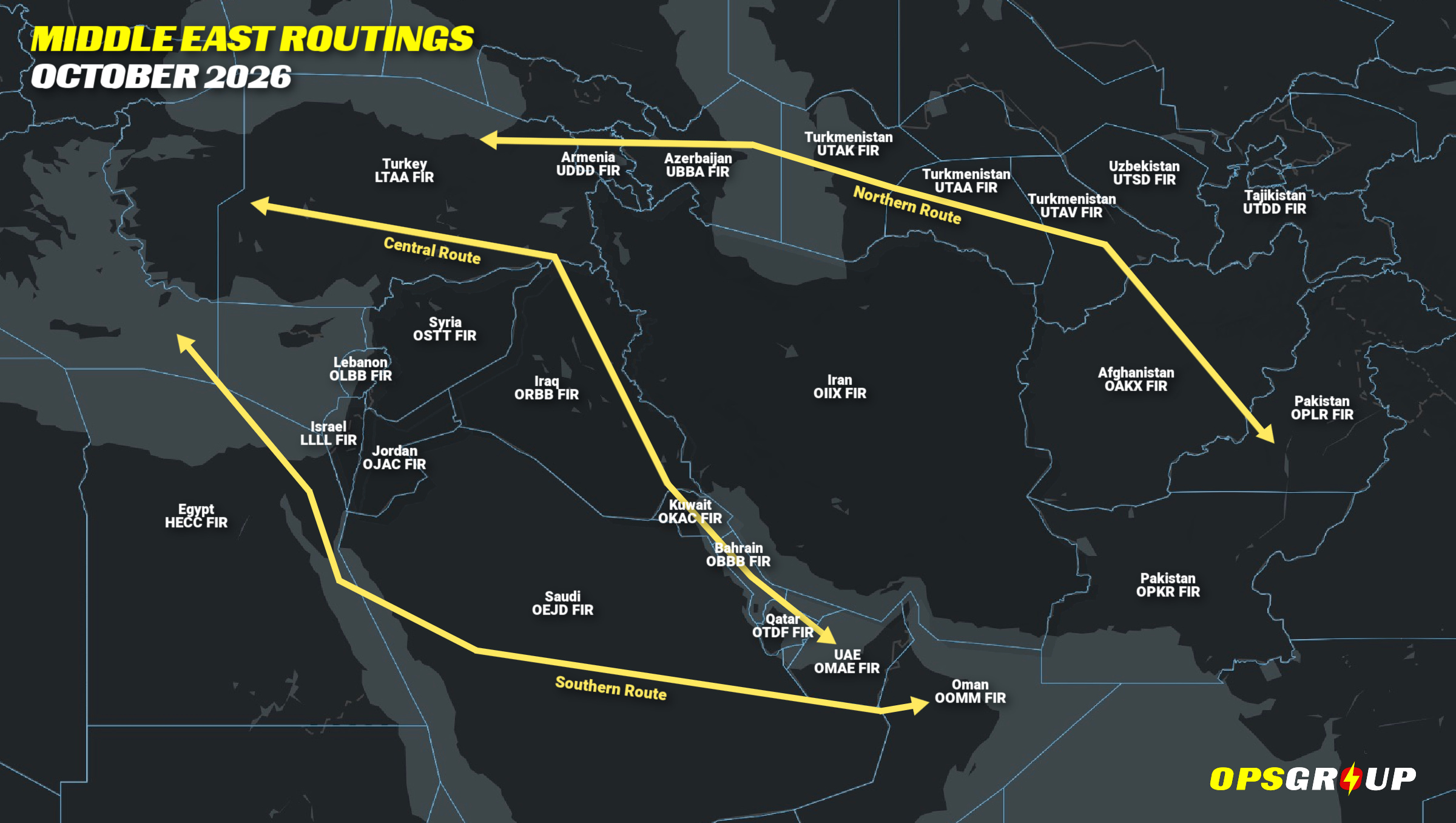
Oct 2026: The OSTT/Damascus FIR remains high risk, although some regional operators have resumed overflights as an alternative to Iran and Iraq routings. EASA now permits flights at FL260 and above in most of the FIR, but prohibits operations at all levels in the western part. Several countries continue to advise against or prohibit operations in Syrian airspace.
See OPSGROUP Briefing: Middle East airspace situation - 2026
The primary risk is ongoing military activity, including Israeli airstrikes and missiles and drones being intercepted over Syria. Drones, rockets and MANPADS are an additional threat at lower levels. The risk is highest in south-western Syria and at lower levels, but can increase across the FIR if the wider regional conflict escalates.
Major events:
Oct 2026: EASA revised its guidance, prohibiting flights in western Syria at all levels and below FL260 elsewhere in the FIR.
Mar 2026: OSTT/Damascus FIR closed following US and Israeli strikes on Iran.
Dec 2024: Syrian airspace closed following the fall of the Assad regime.
Oct 2023: Airstrikes damaged runways at OSDI/Damascus and OSAP/Aleppo.
Feb 2020: An A320 diverted after being caught in crossfire near Damascus.
Sep 2018: A Russian Il-20 was shot down in error near the Syria-Cyprus FIR boundary.
See OPSGROUP Briefing: Middle East airspace situation - 2026
The primary risk is ongoing military activity, including Israeli airstrikes and missiles and drones being intercepted over Syria. Drones, rockets and MANPADS are an additional threat at lower levels. The risk is highest in south-western Syria and at lower levels, but can increase across the FIR if the wider regional conflict escalates.
Major events:
Oct 2026: EASA revised its guidance, prohibiting flights in western Syria at all levels and below FL260 elsewhere in the FIR.
Mar 2026: OSTT/Damascus FIR closed following US and Israeli strikes on Iran.
Dec 2024: Syrian airspace closed following the fall of the Assad regime.
Oct 2023: Airstrikes damaged runways at OSDI/Damascus and OSAP/Aleppo.
Feb 2020: An A320 diverted after being caught in crossfire near Damascus.
Sep 2018: A Russian Il-20 was shot down in error near the Syria-Cyprus FIR boundary.
Current warnings list :
| Source | Reference | Issued | Valid to | |
|---|---|---|---|---|
| Italy | Notam LIRR E2211/26 | 01 Sep 2026 | 29 Nov 2026 | |
| Canada | AIC 17/26 | 26 Dec 2024 | Ongoing | |
| USA | SFAR 114 | 27 Dec 2023 | 30 Dec 2028 | |
| USA | FAA Information Note Syria/Israel | 23 Apr 2021 | Ongoing | |
| France | AIC 011/26 | 09 Apr 2020 | Ongoing | |
| UK | UK AIP ENR 1.1 (1.4.5) | 22 Oct 2018 | Ongoing | |
| USA | Notam KICZ A0009/18 | 14 Apr 2018 | Ongoing | |
| EASA | CZIB 2017-03R19 | 31 Mar 2017 | 31 Oct 2026 | |
| EASA | CZIB 2017-03R20 | 31 Mar 2017 | 30 Nov 2026 | |
| UK | UK AIP ENR 1.1 (1.4.5) | 12 Jun 2015 | Ongoing |
Source: Italy
Reference: Notam LIRR E2211/26
Issued: 01-Sep-26, valid until: 29 Nov 2026
Plain English: Italian operators should avoid the OSTT/Damascus FIR.
ITALIAN AIR CARRIERS AND CAPTAINS OF AIRCRAFT IN CHARGE OF AIR SERVICES OPERATED BY CARRIERS HOLDING AN OPERATING LICENSE ISSUED BY ITALY, WHETHER THEY ARE CONTRACTUAL CARRIERS AND/OR OPERATING CARRIERS, OR PERFORMING AIR SERVICES THROUGH A WET LEASE OR A CODESHARE AGREEMENT AS WELL AS FOR ANY FLIGHT MADE WITH AN AIRCRAFT REGISTERED IN ITALY WHEN PLANNING FLIGHT OPERATIONS ARE RECOMMENDED TO AVOID DAMASCUS FIR (OSTT) AT ALL ALTITUDES ACCORDING TO EASA SAFETY DIRECTIVES.
Source: Canada
Reference: AIC 17/26
Issued: 26-Dec-24, valid until: Ongoing
Plain English: Canadian operators are prohibited from entering the airspace of Syria due to the potential risk from anti- aviation weaponry and military operations. Also caution for flights near the OSTT/Damascus FIR.
Level 3 (prohibition)
SECURITY – HAZARDOUS SITUATION IN SYRIA. Canadian Air Operators and owners of aircraft registered in Canada are prohibited from entering FIR Damascus (OSTT) and are recommended to take all potential risk information into account when conducting risk assessments and making routing decisions that involve operations near FIR OSTT. Potential risk from anti-aviation weaponry and military operations.
SECURITY – HAZARDOUS SITUATION IN SYRIA. Canadian Air Operators and owners of aircraft registered in Canada are prohibited from entering FIR Damascus (OSTT) and are recommended to take all potential risk information into account when conducting risk assessments and making routing decisions that involve operations near FIR OSTT. Potential risk from anti-aviation weaponry and military operations.
Source: USA
Reference: SFAR 114
Issued: 27-Dec-23, valid until: 30 Dec 2028
Plain English: US operators are prohibited from entering the OSTT/Damascus FIR.
This action extends the prohibition against certain flight operations in the Damascus Flight Information Region (FIR) (OSTT) by all: U.S. air carriers; U.S. commercial operators; persons exercising the privileges of an airman certificate issued by the FAA, except when such persons are operating U.S.-registered aircraft for a foreign air carrier; and operators of U.S.-registered civil aircraft, except when the operator of such aircraft is a foreign air carrier, for an additional five years, from December 30, 2023, until December 30, 2028. The FAA finds this action necessary to address significant safety-of-flight risks to U.S. civil aviation associated with the enduring complex conflict in Syria. The FAA also republishes the approval process and exemption information for this Special Federal Aviation Regulation (SFAR), consistent with other recently published flight prohibition SFARs.
Source: USA
Reference: FAA Information Note Syria/Israel
Issued: 23-Apr-21, valid until: Ongoing
Plain English: An errant surface-to-air missile fired by Syrian air defences missed its target and landed in Israel on 22 Apr 2021. Syria is actively using long range anti-aircraft weaponry which poses a risk to civil aircraft in the region. While US operators are banned from the OSTT/Damascus FIR, the FAA warns the threat is extended to adjacent FIRs in the Eastern Mediterranean region including the LLLL/Tel Aviv, OJAC/Amman, OLBB/Beirut and LCCC/Nicosia FIRs. Use caution if operating in the area.
Title: FAA Information Note - Syria/Israel - Errant surface to air missile impacts near Israeli critical infrastructure.
Click the link for full text.
Click the link for full text.
Source: France
Reference: AIC 011/26
Issued: 09-Apr-20, valid until: Ongoing
Plain English: French operators should avoid Syrian airspace.
From 09/04/2020 and until further notice, pilots in command of aircraft performing air services mentioned in paragraph 1.1 are requested not to penetrate into the airspace of Syria (OSTT FIR (DAMASCUS)).
Source: UK
Reference: UK AIP ENR 1.1 (1.4.5)
Issued: 22-Oct-18, valid until: Ongoing
Plain English: UK operators advised of potential risk within 200 NM of the OSTT/Damascus FIR due to anti-aviation weaponry.
Security - Hazardous Situation in Vicinity of Syria
UK civil air operators are advised to take potential risk into account when operating up to 200 NM outside FIR DAMASCUS (OSTT). Potential risk from anti-aircraft weaponry.
UK civil air operators are advised to take potential risk into account when operating up to 200 NM outside FIR DAMASCUS (OSTT). Potential risk from anti-aircraft weaponry.
Source: USA
Reference: Notam KICZ A0009/18
Issued: 14-Apr-18, valid until: Ongoing
Plain English: Exercise caution within 200 NM of the Damascus FIR due to military activity. Possibility of GPS Interference, Communication jamming, and long-range surface to air missiles in the area.
KICZ A0009/18
SECURITY..UNITED STATES OF AMERICA ADVISORY FOR AIRSPACE IMMEDIATELY ADJACENT TO DAMASCUS FLIGHT INFORMATION REGION (OSTT FIR).
THOSE PERSONS DESCRIBED IN PARAGRAPH A BELOW ARE ADVISED TO EXERCISE CAUTION WHEN OPERATING IN THE AIRSPACE WITHIN 200 NAUTICAL MILES OFTHE DAMASCUS FLIGHT INFORMATION REGION (OSTT FIR) DUE TO HEIGHTENED MILITARY ACTIVITY IN OR AROUND SYRIA. THIS MILITARY ACTIVITY MIGHT INCLUDE GPS INTERFERENCE, COMMUNICATIONS JAMMING, AND POSSIBLE ERRANT LONG-RANGE SURFACE-TO-AIR MISSILES ORIGINATING FROM SYRIAN TERRITORY, WITHIN THE OSTT FIR, AND STRAYING INTO ADJACENT AIRSPACE,THAT COULD POSE AN INADVERTENT RISK TO U.S. CIVIL AVIATION OPERATING IN THIS REGION. TITLE 14, CODE OF FEDERAL REGULATIONS, SECTION 91.1609, SPECIAL FEDERAL AVIATION REGULATION NO. 114 PROHIBITION AGAINST CERTAIN FLIGHTS IN THE DAMASCUS FIR REMAINS IN EFFECT.
A. APPLICABILITY. THIS NOTAM APPLIES TO: ALL U.S. AIR CARRIERS AND COMMERCIAL OPERATORS; ALL PERSONS EXERCISING THE PRIVILEGES OF AN AIRMAN CERTIFICATE ISSUED BY THE FAA, EXCEPT SUCH PERSONS OPERATING U.S.-REGISTERED AIRCRAFT FOR A FOREIGN AIR CARRIER; AND ALL OPERATORS OF AIRCRAFT REGISTERED IN THE UNITED STATES, EXCEPT WHERE THE OPERATOR OF SUCH AIRCRAFT IS A FOREIGN AIR CARRIER.
B. PLANNING. THOSE PERSONS DESCRIBED IN PARAGRAPH A PLANNING TO OPERATE WITHIN 200 NAUTICAL MILES OF THE OSTT FIR SHOULD EXERCISE CAUTION AND MUST REVIEW CURRENT SECURITY/THREAT INFORMATION AND NOTAMS AND COMPLY WITH ALL APPLICABLE FAA REGULATIONS, OPERATIONS SPECIFICATIONS, MANAGEMENT SPECIFICATIONS, AND LETTERS OF AUTHORIZATION, INCLUDING UPDATING B450.
C. OPERATIONS. EXERCISE CAUTION DURING FLIGHT OPERATIONS IN THE ABOVE NAMED AREA DUE TO HEIGHTENED MILITARY ACTIVITY IN OR AROUND SYRIA AND THE POTENTIAL RISK TO U.S. CIVIL AVIATION IN THE REGION.THOSE PERSONS DESCRIBED IN PARAGRAPH A MUST REPORT ANY SAFETY/SECURITY INCIDENTS TO THE FAA AT ASH-AXE-CITE-WATCH@FAA.GOVOR +1 202-267-3333 OR 1-844-412-1794.
ADDITIONAL INFORMATION IS PROVIDED AT: https://www.faa.gov/AIR_TRAFFIC/PUBLICATIONS/US_RESTRICTIONS/
SFC - UNL, 14 APR 00:16 2018 UNTIL PERM.
Source: EASA
Reference: CZIB 2017-03R19
Issued: 31-Mar-17, valid until: 31 Oct 2026
Plain English: Operators should not enter the airspace of Syria.
This CZIB is issued based on information currently available to EASA, the European Commission and Member States in order to share information which is considered necessary to ensure the safety of flights over zones of interest and indicate areas of high risk.
The airspace over Syria continues to be affected by the presence of multiple military forces, including State and non-state actors, as well as recurrent foreign military operations.
The risk of Israeli strikes and other military activities contribute to an overall volatile situation with the potential for rapid and unpredictable escalation.
In terms of airspace management, fragmented control of the airspace and limited coordination mechanisms reduce the effectiveness of deconfliction and the timely dissemination of relevant information.
The presence and potential activation of air defence systems, combined with ongoing military activity and a high level of alert among military forces, increase the likelihood of misidentification of civil aircraft. In addition, the presence of violent non-state actors with the capability to use unmanned aerial systems, rockets and MANPADS creates additional risks in the airspace.
The combination of active military operations, air defence capabilities and limited mitigating factors results in a high risk to civil aviation at all altitudes and flight levels.
Air operators should:
1. Not operate in the airspace of Syria at all altitudes and flight levels.
2. Closely monitor airspace developments in the region and follow all available aeronautical publications issued by Syria, or on their behalf by the Aviation Authorities of the neighbouring States, including information shared through the European Information Sharing and Cooperation Platform on Conflict Zones, alongside available guidance or direction from their national authorities.
Source: EASA
Reference: CZIB 2017-03R20
Issued: 31-Mar-17, valid until: 30 Nov 2026
Plain English: Operators should not fly in the western part of the OSTT/Damascus FIR (west of the ZELAF–BASEM–LOTAX–LATEB line). Elsewhere in the FIR, flights below FL260 are also prohibited.
This CZIB is issued based on information currently available to EASA, the European Commission and Member States in order to share information which is considered necessary to ensure the safety of flights over zones of interest and indicate areas of high risk.
The airspace over Syria continues to be affected by the wider regional security dynamic, the presence of multiple State and non-State actors, as well as recurrent foreign military operations.
Iranian missile and UAS transits towards Israel and US/Jordanian targets remain recurrent, but largely escalation driven. Their direct impact on civil overflights of Syria is generally assessed as limited due to the trajectories involved. However, interception activity against Iranian ballistic missiles targeting Israel or Jordan may create high risks to civil aviation in particular in south-western Syrian airspace. In addition, interceptions of ballistic missiles targeting Israel may take place at considerable distances from Israeli airspace and may result in falling debris affecting other parts of Syrian airspace.
Israeli military strikes against targets in Syria remain recurrent, although they are generally limited in duration and concentrated in the south-west of the country. At the same time, the overall degradation of Syria’s long-range air-defence network has reduced the risk of misidentification and unintended engagement of civil aircraft. Air-defence systems associated with other State actors are assessed as primarily providing localised protection of specific areas and are not currently considered to have a significant direct impact on civil overflight operations.
At lower altitudes, violent non-State actors retain capabilities, including UAS, rockets and MANPADS, creating additional risks primarily below FL260.
Available data also indicate that kinetic and associated air-defence activity is concentrated predominantly during the hours of darkness.
While improvements have been observed in the dissemination of aeronautical information and the management of conflict-related risks, fragmented control of the airspace and limited coordination mechanisms continue to constrain effective deconfliction and the timely dissemination of relevant information.
Overall, the main risks to civil aviation remain concentrated in the south-western parts of Syria and at lower altitudes across the country. At higher altitudes, the risk to overflights is reduced. Nevertheless, regional escalation in the Middle East may result in missile and UAS activity, associated interceptions and falling debris, temporarily increasing risk exposure, including at higher flight levels.
EASA, together with the Commission and Member States, will continue to closely monitor the situation, with a view to assess whether there is an increase or decrease of the risk for EU aircraft operators due to the evolution of the threat and risk situation.
Air operators should:
1. Not operate at all flight levels and altitudes, west of the line connecting navigation points ZELAF – BASEM – LOTAX - LATEB, including airways segments forming this boundary.
2. Not operate below FL 260 in the remainder of the FIR Damascus (OSTT).
3. Exercise caution and take potential risks into account when operating at and above FL260 in the portion of the Damascus FIR (OSTT) not covered by point 1 above.
4. Consider scheduling operations during daylight hours as an additional risk-mitigation measure.
5. Ensure that an up-to-date risk assessment and a high level of contingency planning are in place for operations within the affected airspace, and be prepared for short notice instructions from the State authorities.
6. Closely monitor airspace developments in the region and follow all available aeronautical publications concerning the region, including information shared through the European Information Sharing and Cooperation Platform on Conflict Zones, alongside available guidance or direction from their national authorities.
Source: UK
Reference: UK AIP ENR 1.1 (1.4.5)
Issued: 12-Jun-15, valid until: Ongoing
Plain English: UK operators must not enter the OSTT/Damascus FIR.
Security - Hazardous Situation in Syria
In accordance with Direction under the Aviation Security Act 1982, UK civil operators so served are prohibited to enter FIR DAMASCUS (OSTT) / territory and airspace of the Syrian Arab Republic. Potential risk from anti-aircraft weaponry.
UK operators not currently subject to direction under the Aviation Security Act should contact UK Department for Transport (DfT) before operating in this area.