
Oman
Risk Level: Three - Caution
[ about risk levels ]
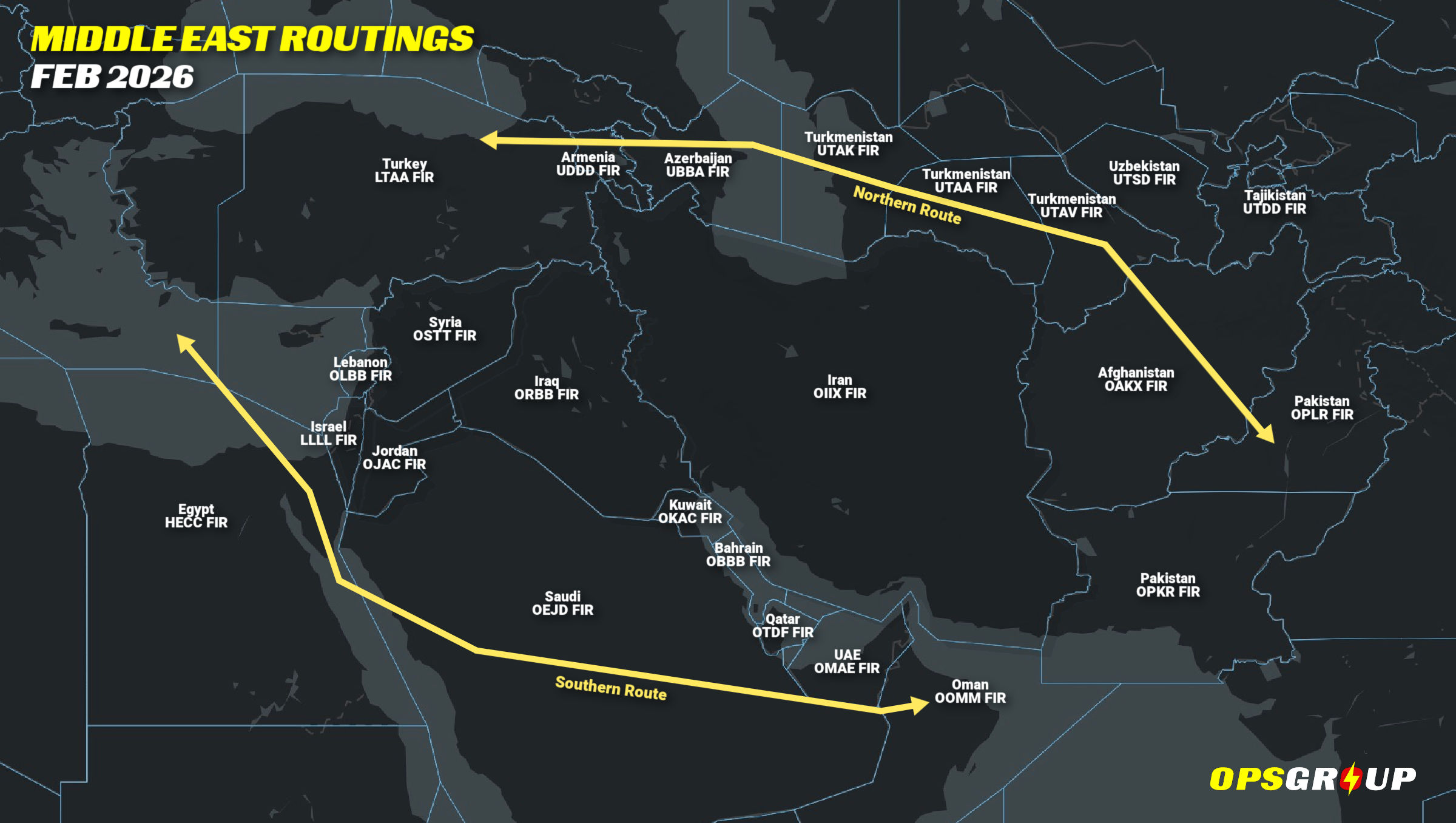
March 2026: Oman airspace remains open and is now heavily used as part of the main southern bypass routing around the closed central Middle East corridor. Following large-scale US and Israeli strikes on Iran beginning Feb 28 and ongoing Iranian retaliation, regional disruption remains significant. Iran has warned that conflict activity may extend over the Persian Gulf and Oman Sea. The situation remains active and unpredictable.
See OPSGROUP Briefing: Middle East airspace situation - March 2026
The primary risk is spillover of missile or drone activity into Gulf airspace, short-notice airspace restrictions, and reported GNSS interference. Oman forms part of the Egypt - Saudi - Oman southern bypass, which is seeing higher-than-normal traffic levels.
France currently advises its operators not to enter the OOMM/Muscat FIR. EASA’s latest CZIB applies at all altitudes to Oman due to the risk from missiles, air defence systems and interception activity.
Major events:
March 2026: Central Middle East corridor closed following US and Israeli strikes on Iran and subsequent Iranian retaliation; Oman becomes key southern bypass route.
June 2025: Israel and Iran exchanged missile strikes, prompting renewed airspace warnings across the Gulf region.
Oct 2024: Israel and Iran carried out missile attacks against each other, leading many operators to avoid airspace between the two countries.
See OPSGROUP Briefing: Middle East airspace situation - March 2026
The primary risk is spillover of missile or drone activity into Gulf airspace, short-notice airspace restrictions, and reported GNSS interference. Oman forms part of the Egypt - Saudi - Oman southern bypass, which is seeing higher-than-normal traffic levels.
France currently advises its operators not to enter the OOMM/Muscat FIR. EASA’s latest CZIB applies at all altitudes to Oman due to the risk from missiles, air defence systems and interception activity.
Major events:
March 2026: Central Middle East corridor closed following US and Israeli strikes on Iran and subsequent Iranian retaliation; Oman becomes key southern bypass route.
June 2025: Israel and Iran exchanged missile strikes, prompting renewed airspace warnings across the Gulf region.
Oct 2024: Israel and Iran carried out missile attacks against each other, leading many operators to avoid airspace between the two countries.
Current warnings list :
| Source | Reference | Issued | Valid to | |
|---|---|---|---|---|
| France | Notam LFFF F0579/26 | 27 Mar 2026 | 10 Apr 2026 | |
| EASA | CZIB 2026-03-R5 | 28 Feb 2026 | 10 Apr 2026 |
Source: France
Reference: Notam LFFF F0579/26
Issued: 27-Mar-26, valid until: 10 Apr 2026
Plain English: French operators should avoid Oman airspace, except southern routes at or above FL320.
F0579/26 NOTAMR F0489/26
Q) LFXX/QXXXX/I/BO/E/000/999/4412N00040E460
A) LFBB LFFF LFRR LFEE LFMM B) 2603271352 C) 2604102359
E) FRENCH AIR CARRIERS AND CAPTAINS OF AIRCRAFT IN CHARGE OF AIR SERVICES OPERATED BY CARRIERS HOLDING AN OPERATING LICENSE ISSUED BY FRANCE, WHETHER THEY ARE CONTRACTUAL CARRIERS AND/OR OPERATING CARRIERS, OR PERFORMING AIR SERVICES THROUGH A WET LEASE OR A CODESHARE AGREEMENT AS WELL AS FOR ANY FLIGHT MADE WITH AN AIRCRAFT REGISTERED IN FRANCE ARE REQUESTED NOT TO PENETRATE INTO THE AIRSPACE OF OMAN (FIR MUSCAT (OOMM)), EXCEPT :
- MAINTAINING ALL TIMES A FLIGHT LEVEL ABOVE OR EQUAL TO FL320, FOR ROUTES LOCATED SOUTH OF THE SEGMENTS DEFINED BY THE FOLLOWING REPORTING POINTS, RESPECTING THE SEQUENCE BELOW :
DANOM 225454N450509E
KEDON 202516N555850E
VELOD 234617N573430E
THE AIR OPERATOR MUST CARRY OUT A ROBUST RISK ASSESSMENT TO ENSURE THAT THE FLIGHT CAN BE CONDUCTED UNDER SATISFACTORY SAFETY AND SECURITY CONDITIONS BEFORE ENTERING THIS AREA.
Q) LFXX/QXXXX/I/BO/E/000/999/4412N00040E460
A) LFBB LFFF LFRR LFEE LFMM B) 2603271352 C) 2604102359
E) FRENCH AIR CARRIERS AND CAPTAINS OF AIRCRAFT IN CHARGE OF AIR SERVICES OPERATED BY CARRIERS HOLDING AN OPERATING LICENSE ISSUED BY FRANCE, WHETHER THEY ARE CONTRACTUAL CARRIERS AND/OR OPERATING CARRIERS, OR PERFORMING AIR SERVICES THROUGH A WET LEASE OR A CODESHARE AGREEMENT AS WELL AS FOR ANY FLIGHT MADE WITH AN AIRCRAFT REGISTERED IN FRANCE ARE REQUESTED NOT TO PENETRATE INTO THE AIRSPACE OF OMAN (FIR MUSCAT (OOMM)), EXCEPT :
- MAINTAINING ALL TIMES A FLIGHT LEVEL ABOVE OR EQUAL TO FL320, FOR ROUTES LOCATED SOUTH OF THE SEGMENTS DEFINED BY THE FOLLOWING REPORTING POINTS, RESPECTING THE SEQUENCE BELOW :
DANOM 225454N450509E
KEDON 202516N555850E
VELOD 234617N573430E
THE AIR OPERATOR MUST CARRY OUT A ROBUST RISK ASSESSMENT TO ENSURE THAT THE FLIGHT CAN BE CONDUCTED UNDER SATISFACTORY SAFETY AND SECURITY CONDITIONS BEFORE ENTERING THIS AREA.
Source: EASA
Reference: CZIB 2026-03-R5
Issued: 28-Feb-26, valid until: 10 Apr 2026
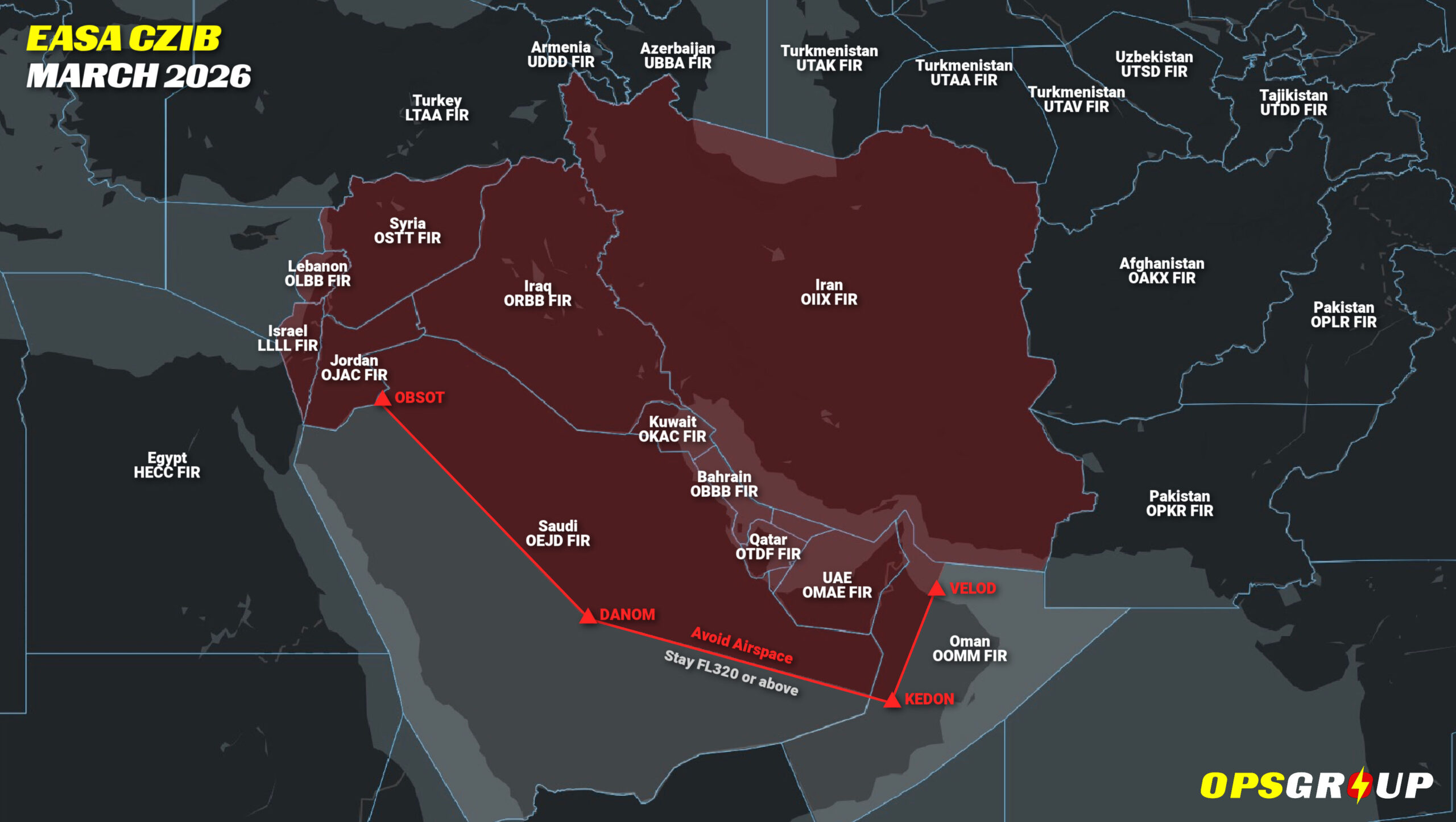
Plain English: Operators should avoid airspace of Bahrain, Iran, Iraq, Israel, Jordan, Kuwait, Lebanon, Qatar, UAE, Oman and Saudi Arabia. Exception: southern Saudi and Oman airspace permitted only at FL320 or above (as per this map).
This CZIB is issued based on information currently available to EASA, the European Commission and Member States in order to share information which is considered necessary to ensure the safety of flights over zones of interest and indicate areas of high risk.
On 28 February 2026, the United States and Israel conducted military strikes targeting sites within Iranian territory. In response, Iran has carried out retaliatory attacks.
Given the ongoing military intervention and Iranian strikes, there are additional high risks not only to the airspace of Iran but also to that of neighbouring States hosting U.S. military bases or otherwise affected by the hostilities and associated military activities, including interceptions.
The possession of all-altitude capable air-defence systems, cruise and ballistic missiles and the use of air assets capable to operate at all-altitudes, including interception capability make the entire affected airspace vulnerable to spill-over risks, misidentification, miscalculation and failure of interception procedures.
Iranian retaliatory attacks have, so far, primarily targeted the eastern parts of Saudi Arabia, while the airspace of Oman has, to date, been subject to a relatively limited level of kinetic activity, impacting primarily low and medium flight altitudes. Therefore, varying levels of risk exist across FIR Jeddah and FIR Muscat.
EASA, together with the Commission and Member States, will continue to closely monitor the situation, with a view to assess whether there is an increase or decrease of the risk for EU aircraft operators due to the evolution of the threat and risk situation.
Air operators should:
1. Not operate within the affected airspace at all flight levels and altitudes, with the exception specified in point 2 below.
2. Not operate below FL 320 within the airspace of Saudi Arabia and Oman located South of the segments defined by the following compulsory reporting points, respecting the sequence below:
- OBSOT 295451N373455E
- DANOM 225454N450509E
- KEDON 200516N555850E
- VELOD 234617N573430E
3. Implement a robust monitoring process and up to date risk assessment when intending to operate within the airspace specified in point 2 above.
4. Closely monitor airspace developments in the region and follow all available aeronautical publications concerning the region, including information shared through the European Information Sharing and Cooperation Platform on Conflict Zones, alongside available guidance or direction from their national authorities.
On 28 February 2026, the United States and Israel conducted military strikes targeting sites within Iranian territory. In response, Iran has carried out retaliatory attacks.
Given the ongoing military intervention and Iranian strikes, there are additional high risks not only to the airspace of Iran but also to that of neighbouring States hosting U.S. military bases or otherwise affected by the hostilities and associated military activities, including interceptions.
The possession of all-altitude capable air-defence systems, cruise and ballistic missiles and the use of air assets capable to operate at all-altitudes, including interception capability make the entire affected airspace vulnerable to spill-over risks, misidentification, miscalculation and failure of interception procedures.
Iranian retaliatory attacks have, so far, primarily targeted the eastern parts of Saudi Arabia, while the airspace of Oman has, to date, been subject to a relatively limited level of kinetic activity, impacting primarily low and medium flight altitudes. Therefore, varying levels of risk exist across FIR Jeddah and FIR Muscat.
EASA, together with the Commission and Member States, will continue to closely monitor the situation, with a view to assess whether there is an increase or decrease of the risk for EU aircraft operators due to the evolution of the threat and risk situation.
Air operators should:
1. Not operate within the affected airspace at all flight levels and altitudes, with the exception specified in point 2 below.
2. Not operate below FL 320 within the airspace of Saudi Arabia and Oman located South of the segments defined by the following compulsory reporting points, respecting the sequence below:
- OBSOT 295451N373455E
- DANOM 225454N450509E
- KEDON 200516N555850E
- VELOD 234617N573430E
3. Implement a robust monitoring process and up to date risk assessment when intending to operate within the airspace specified in point 2 above.
4. Closely monitor airspace developments in the region and follow all available aeronautical publications concerning the region, including information shared through the European Information Sharing and Cooperation Platform on Conflict Zones, alongside available guidance or direction from their national authorities.