
Iran
Risk Level: One - Do Not Fly
[ about risk levels ]
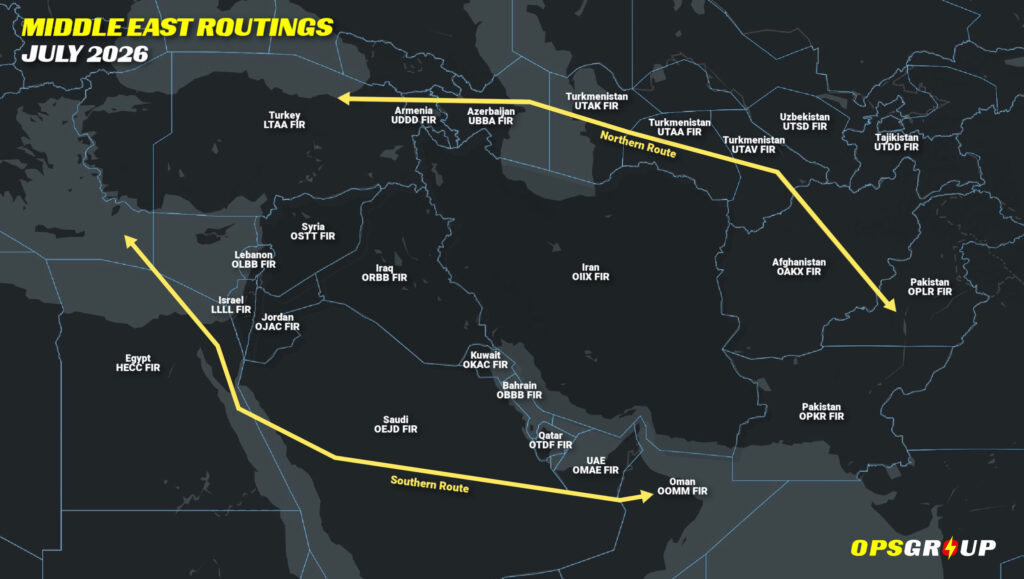
July 2026: The US-Iran ceasefire has effectively broken down, with renewed military action and attacks around the Strait of Hormuz. Iranian airspace (the OIIX/Tehran FIR) remains only partially open, and very few international operators are using it. Most Europe-Asia traffic continues to route south via Egypt/Saudi or north via the Caucasus/Afghanistan.
See OPSGROUP Briefing: Middle East airspace situation - 2026
The primary risk in Iranian airspace remains misidentification of civil aircraft by air defence systems during periods of heightened tension. Iran has previously operated advanced air defence and conducted missile activity close to busy international routes with little warning to civil aviation, and the shoot-down of Ukraine International Airlines flight 752 over Tehran in Jan 2020 shows how quickly the situation can deteriorate. Several states continue to warn against operations in Iranian airspace, and EASA continues to advise operators not to operate in the OIIX/Tehran FIR at any altitude under its current CZIB.
Major events:
July 2026: EASA's current CZIB continues to advise operators not to operate in the OIIX/Tehran FIR at any altitude following renewed military activity in the region.
June 2026: Iran partially reopened the eastern part of the OIIX/Tehran FIR for overflights, while the western part remains closed.
March 2026: OIIX/Tehran FIR closed following large-scale US and Israeli strikes on Iranian military targets and subsequent Iranian missile and drone retaliation across the Middle East.
June 2025: Israel and Iran exchanged missile strikes, prompting renewed airspace warnings and avoidance.
Oct 2024: Israel and Iran carried out missile attacks against each other, leading most international operators to avoid both airspaces.
Jan 2020: Iran shot down Ukraine International Airlines flight 752 over Tehran after misidentifying the aircraft as a hostile target.
See OPSGROUP Briefing: Middle East airspace situation - 2026
The primary risk in Iranian airspace remains misidentification of civil aircraft by air defence systems during periods of heightened tension. Iran has previously operated advanced air defence and conducted missile activity close to busy international routes with little warning to civil aviation, and the shoot-down of Ukraine International Airlines flight 752 over Tehran in Jan 2020 shows how quickly the situation can deteriorate. Several states continue to warn against operations in Iranian airspace, and EASA continues to advise operators not to operate in the OIIX/Tehran FIR at any altitude under its current CZIB.
Major events:
July 2026: EASA's current CZIB continues to advise operators not to operate in the OIIX/Tehran FIR at any altitude following renewed military activity in the region.
June 2026: Iran partially reopened the eastern part of the OIIX/Tehran FIR for overflights, while the western part remains closed.
March 2026: OIIX/Tehran FIR closed following large-scale US and Israeli strikes on Iranian military targets and subsequent Iranian missile and drone retaliation across the Middle East.
June 2025: Israel and Iran exchanged missile strikes, prompting renewed airspace warnings and avoidance.
Oct 2024: Israel and Iran carried out missile attacks against each other, leading most international operators to avoid both airspaces.
Jan 2020: Iran shot down Ukraine International Airlines flight 752 over Tehran after misidentifying the aircraft as a hostile target.
Current warnings list :
| Source | Reference | Issued | Valid to | |
|---|---|---|---|---|
| France | Notam LFFF F1994/26 | 30 Sep 2026 | 14 Oct 2026 | |
| Germany | Notam EDWW B0746/26 | 11 Sep 2026 | 12 Nov 2026 | |
| Italy | Notam LIRR E2212/26 | 01 Sep 2026 | 29 Nov 2026 | |
| EASA | CZIB 2026-04-R2 | 08 Jul 2026 | 16 Nov 2026 | |
| Germany | AIC 03/26 | 15 Feb 2025 | Ongoing | |
| USA | SFAR 117 | 03 Oct 2024 | 31 Oct 2027 | |
| UK | UK AIP ENR 1.1 (1.4.5) | 03 Oct 2024 | Ongoing | |
| France | AIC 011/26 | 09 Apr 2020 | Ongoing | |
| USA | Notam KICZ A0016/20 | 17 Feb 2020 | Ongoing | |
| Canada | AIC 17/26 | 10 Jan 2020 | Ongoing |
Source: France
Reference: Notam LFFF F1994/26
Issued: 30-Sep-26, valid until: 14 Oct 2026
Plain English: French operators should not enter the airspace of Iran.
FRENCH AIR CARRIERS AND CAPTAINS OF AIRCRAFT IN CHARGE OF AIR SERVICES OPERATED BY CARRIERS HOLDING AN OPERATING LICENSE ISSUED BY FRANCE, WHETHER THEY ARE CONTRACTUAL CARRIERS AND/OR OPERATING CARRIERS, OR PERFORMING AIR SERVICES THROUGH A WET LEASE OR A CODESHARE AGREEMENT AS WELL AS FOR ANY FLIGHT MADE WITH AN AIRCRAFT REGISTERED IN FRANCE ARE REQUESTED NOT TO PENETRATE INTO THE ENTIRE AIRSPACE OF IRAN (FIR TEHRAN (OIIX)). THIS NOTAM SUPERSEDES THE RESTRICTIONS CONCERNING IRAN AIRSPACE (FIR TEHRAN (OIIX)) ISSUED IN PARAGRAPH 3.14 IRAN OF THE AIC NR A011/26 CURRENTLY IN EFFECT.
Source: Germany
Reference: Notam EDWW B0746/26
Issued: 11-Sep-26, valid until: 12 Nov 2026
Plain English: German operators should not enter the airspace of Iran. Overrides the caution in the previous AIC.
SECURITY - HAZARDOUS SITUATION IN IRAN CIVIL GERMAN AIR OPERATORS ARE RECOMMENDED NOT TO ENTER FIR TEHRAN (OIIX). POTENTIAL RISK TO AVIATION FROM ESCALATING CONFLICT AND ANTI-AVIATION WEAPONRY. THIS NOTAM OVERRULES THE RECOMMENDATION PROVIDED IN THE CURRENTLY APPLICABLE AIC.
Source: Italy
Reference: Notam LIRR E2212/26
Issued: 01-Sep-26, valid until: 29 Nov 2026
Plain English: Italian operators should avoid the OIIX/Tehran FIR.
ITALIAN AIR CARRIERS AND CAPTAINS OF AIRCRAFT IN CHARGE OF AIR SERVICES OPERATED BY CARRIERS HOLDING AN OPERATING LICENSE ISSUED BY ITALY, WHETHER THEY ARE CONTRACTUAL CARRIERS AND/OR OPERATING CARRIERS, OR PERFORMING AIR SERVICES THROUGH A WET LEASE OR A CODESHARE AGREEMENT AS WELL AS FOR ANY FLIGHT MADE WITH AN AIRCRAFT REGISTERED IN ITALY ARE RECOMMENDED TO AVOID OIIX FIR AND ENSURE THAT A ROBUST RISK ASSESSMENT IS IN PLACE TOGETHER WITH A HIGH LEVEL OF CONTINGENCY PLANNING IN WHOLE MIDDLE EAST ACCORDING TO EASA SAFETY DIRECTIVES.
Source: EASA
Reference: CZIB 2026-04-R2
Issued: 08-Jul-26, valid until: 16 Nov 2026
Plain English: Operators should avoid Iran airspace.
This CZIB is issued based on information currently available to EASA, the European Commission and Member States in order to share information which is considered necessary to ensure the safety of flights over zones of interest and indicate areas of high risk.
On 28 February 2026, the United States and Israel conducted military strikes targeting sites within Iranian territory. In response, Iran carried out retaliatory attacks. The resulting military conflict created high risks not only to the airspace of Iran but also to that of neighbouring States hosting U.S. military bases or otherwise affected by the hostilities and associated military activities, including interceptions.
A temporary ceasefire between the United States and Iran was initially announced on 8 April 2026 and remained in effect until 17 June 2026, when both parties signed a Memorandum of Understanding extending it for a further 60 days. However, its implementation remains fragile, as tensions continue to remain at a high level.
Therefore, further close monitoring to assess whether it leads to a sustained reduction of risk to civil aviation is required. Should the existing truce break down, Iranian airspace is likely to be exposed to imminent threats.
Recurrent Iranian attacks against commercial vessels and efforts to control the Strait of Hormuz create risks not only to the surrounding airspace, but also increase the likelihood of retaliatory actions that could affect Iranian airspace directly.
Given the ongoing high level of tensions and the potential for further military action, Iran maintains a high level of alert for its air force and air defence units nationwide, which creates an increased likelihood of misidentification within the FIR Tehran (OIIX).
In terms of airspace management, Iranian authorities have taken measures at certain stages of the conflict to address airspace risks by implementing temporary airspace closures and restrictions. However, a sudden resumption of hostilities, due to their unpredictable nature, could pose challenges to the timely and effective implementation of such measures.
Unpredictable military developments, combined with the presence and possible use of a wide range of weapons and air defence systems, create a high risk to civil flights at all altitudes and flight levels.
EASA, together with the Commission and Member States, will continue to closely monitor the situation, with a view to assess whether there is an increase or decrease of the risk for EU aircraft operators due to the evolution of the threat and risk situation.
Air operators should:
1. Not operate within the airspace of Iran, FIR Tehran (OIIX), at all altitudes and flight levels;
2. Closely monitor airspace developments in the region and follow all available aeronautical publications, in particular airspace closures or restrictions issued by State authorities, alongside available guidance or direction from their national authorities including information shared through the European Information Sharing and Cooperation Platform on Conflict Zones.
On 28 February 2026, the United States and Israel conducted military strikes targeting sites within Iranian territory. In response, Iran carried out retaliatory attacks. The resulting military conflict created high risks not only to the airspace of Iran but also to that of neighbouring States hosting U.S. military bases or otherwise affected by the hostilities and associated military activities, including interceptions.
A temporary ceasefire between the United States and Iran was initially announced on 8 April 2026 and remained in effect until 17 June 2026, when both parties signed a Memorandum of Understanding extending it for a further 60 days. However, its implementation remains fragile, as tensions continue to remain at a high level.
Therefore, further close monitoring to assess whether it leads to a sustained reduction of risk to civil aviation is required. Should the existing truce break down, Iranian airspace is likely to be exposed to imminent threats.
Recurrent Iranian attacks against commercial vessels and efforts to control the Strait of Hormuz create risks not only to the surrounding airspace, but also increase the likelihood of retaliatory actions that could affect Iranian airspace directly.
Given the ongoing high level of tensions and the potential for further military action, Iran maintains a high level of alert for its air force and air defence units nationwide, which creates an increased likelihood of misidentification within the FIR Tehran (OIIX).
In terms of airspace management, Iranian authorities have taken measures at certain stages of the conflict to address airspace risks by implementing temporary airspace closures and restrictions. However, a sudden resumption of hostilities, due to their unpredictable nature, could pose challenges to the timely and effective implementation of such measures.
Unpredictable military developments, combined with the presence and possible use of a wide range of weapons and air defence systems, create a high risk to civil flights at all altitudes and flight levels.
EASA, together with the Commission and Member States, will continue to closely monitor the situation, with a view to assess whether there is an increase or decrease of the risk for EU aircraft operators due to the evolution of the threat and risk situation.
Air operators should:
1. Not operate within the airspace of Iran, FIR Tehran (OIIX), at all altitudes and flight levels;
2. Closely monitor airspace developments in the region and follow all available aeronautical publications, in particular airspace closures or restrictions issued by State authorities, alongside available guidance or direction from their national authorities including information shared through the European Information Sharing and Cooperation Platform on Conflict Zones.
Source: Germany
Reference: AIC 03/26
Issued: 15-Feb-25, valid until: Ongoing
Plain English: Caution to German operators in the airspace of Iran due to the potential risk from anti-aviation weaponry.
SECURITY - HAZARDOUS SITUATION IN IRAN
Civil German air operators are advised to take potential risk into account in their risk assessment and routing decisions within FIR TEHRAN (OIIX). Potential risk from anti-aviation weaponry.
Civil German air operators are advised to take potential risk into account in their risk assessment and routing decisions within FIR TEHRAN (OIIX). Potential risk from anti-aviation weaponry.
Source: USA
Reference: SFAR 117
Issued: 03-Oct-24, valid until: 31 Oct 2027
Plain English: US operators are prohibited from overflying the OIIX/Tehran FIR due to the risk of misidentification, and unannounced military activities in the region.
This action extends the prohibition against certain flight operations in the Tehran Flight Information Region (FIR) (OIIX) by all: U.S. air carriers; U.S. commercial operators; persons exercising the privileges of an airman certificate issued by the FAA, except when such persons are operating U.S.-registered aircraft for a foreign air carrier; and operators of U.S.-registered civil aircraft, except when the operator of such aircraft is a foreign air carrier, for an additional three years, from October 31, 2024, to October 31, 2027. The FAA finds this action necessary to address significant unacceptable safety-of-flight risks to U.S. civil aviation operations that continue in the Tehran FIR (OIIX) during periods of heightened regional tensions and increased military activities. The FAA also republishes the approval process and exemption information for this Special Federal Aviation Regulation (SFAR), consistent with other recently published flight prohibition SFARs.
Source: UK
Reference: UK AIP ENR 1.1 (1.4.5)
Issued: 03-Oct-24, valid until: Ongoing
Plain English: UK operators should not enter the OIIX/Tehran FIR due to potential risk from anti-aviation weaponry.
Security - Hazardous Situation in Iran
UK civil air operators are recommended not to enter FIR TEHRAN (OIIX). Potential risk from anti-aircraft weaponry and heightened military activity.
UK civil air operators are recommended not to enter FIR TEHRAN (OIIX). Potential risk from anti-aircraft weaponry and heightened military activity.
Source: France
Reference: AIC 011/26
Issued: 09-Apr-20, valid until: Ongoing
Plain English: French operators should not overfly the western half of the country (everywhere west of 54 Degrees East longitude); overflights of the eastern half should be at or above FL320.
From 09/04/2020 and until further notice, pilots in command of aircraft performing air services mentioned in paragraph 1.1 are requested not to penetrate in the part of the TEHRAN FIR (OIIX) located west of the 54th meridian and to ensure that their aircraft maintain at all times a flight level above or equal to FL320 in the part of the TEHRAN FIR (OIIX) located east of the 54th meridian.
Source: USA
Reference: Notam KICZ A0016/20
Issued: 17-Feb-20, valid until: Ongoing
Plain English: US operators should exercise caution in the overwater airspace in the Persian Gulf and Gulf of Oman. Avoid the airways nearest to the OIIX/Tehran FIR whenever possible, to reduce the risk of miscalculation or misidentification by air defence systems.
A0016/20 (Issued for KICZ)
SECURITY..UNITED STATES OF AMERICA ADVISORY FOR OVERWATER AIRSPACE ABOVE THE PERSIAN GULF AND THE GULF OF OMAN.
THOSE PERSONS DESCRIBED IN PARAGRAPH A BELOW SHOULD EXERCISE CAUTION WHEN OPERATING IN OVERWATER AIRSPACE ABOVE THE PERSIAN GULF AND THE GULF OF OMAN IN THE KUWAIT FLIGHT INFORMATION REGION (FIR) (OKAC), JEDDAH FIR (OEJD) , BAHRAIN FIR (OBBB), EMIRATES FIR (OMAE), AND MUSCAT FIR (OOMM) DUE TO CONTINUED ELEVATED MILITARY POSTURING AND POLITICAL TENSIONS IN THE REGION.
NOTAM KICZ A0002/20, WHICH PROHIBITS U.S. CIVIL AVIATION OPERATIONS IN THE TEHRAN FIR (OIIX), REMAINS IN EFFECT UNTIL FURTHER NOTICE.
A. APPLICABILITY. THIS NOTAM APPLIES TO: ALL U.S. AIR CARRIERS AND COMMERCIAL OPERATORS; ALL PERSONS EXERCISING THE PRIVILEGES OF AN AIRMAN CERTIFICATE ISSUED BY THE FAA, EXCEPT SUCH PERSONS OPERATING U.S. REGISTERED AIRCRAFT FOR A FOREIGN AIR CARRIER; AND ALL OPERATORS OF AIRCRAFT REGISTERED IN THE UNITED STATES, EXCEPT WHERE THE OPERATOR OF SUCH AIRCRAFT IS A FOREIGN AIR CARRIER.
B. PLANNING. THOSE PERSONS DESCRIBED IN PARAGRAPH A PLANNING TO OPERATE IN THE ABOVE-NAMED AREA MUST REVIEW CURRENT SECURITY/THREAT INFORMATION AND NOTAMS AND COMPLY WITH ALL APPLICABLE FAA REGULATIONS, OPERATIONS SPECIFICATIONS, MANAGEMENT SPECIFICATIONS, AND LETTERS OF AUTHORIZATION, INCLUDING UPDATING B450.
C. OPERATIONS. AVOID AIR ROUTES NEAREST TO THE TEHRAN FIR (OIIX) BOUNDARY, WHENEVER POSSIBLE, TO REDUCE THE RISK OF MISCALCULATION OR MISIDENTIFICATION BY AIR DEFENSE SYSTEMS. ADDITIONALLY, AIRCRAFT OPERATING IN THE ABOVE-NAMED AREA MAY ENCOUNTER INADVERTENT GPS INTERFERENCE AND OTHER COMMUNICATIONS JAMMING, WHICH COULD OCCUR WITH LITTLE OR NO WARNING.
THOSE PERSONS DESCRIBED IN PARAGRAPH A MUST REPORT SAFETY AND/OR SECURITY INCIDENTS TO THE FAA AT +1 202-267-3333. ADDITIONAL INFORMATION IS PROVIDED AT: HTTPS://WWW.FAA.GOV/AIR_TRAFFIC/PUBLICATIONS/US_RESTRICTIONS/.
SFC - UNL, 17 FEB 19:54 2020 UNTIL PERM. CREATED: 17 FEB 20:00 2020
SECURITY..UNITED STATES OF AMERICA ADVISORY FOR OVERWATER AIRSPACE ABOVE THE PERSIAN GULF AND THE GULF OF OMAN.
THOSE PERSONS DESCRIBED IN PARAGRAPH A BELOW SHOULD EXERCISE CAUTION WHEN OPERATING IN OVERWATER AIRSPACE ABOVE THE PERSIAN GULF AND THE GULF OF OMAN IN THE KUWAIT FLIGHT INFORMATION REGION (FIR) (OKAC), JEDDAH FIR (OEJD) , BAHRAIN FIR (OBBB), EMIRATES FIR (OMAE), AND MUSCAT FIR (OOMM) DUE TO CONTINUED ELEVATED MILITARY POSTURING AND POLITICAL TENSIONS IN THE REGION.
NOTAM KICZ A0002/20, WHICH PROHIBITS U.S. CIVIL AVIATION OPERATIONS IN THE TEHRAN FIR (OIIX), REMAINS IN EFFECT UNTIL FURTHER NOTICE.
A. APPLICABILITY. THIS NOTAM APPLIES TO: ALL U.S. AIR CARRIERS AND COMMERCIAL OPERATORS; ALL PERSONS EXERCISING THE PRIVILEGES OF AN AIRMAN CERTIFICATE ISSUED BY THE FAA, EXCEPT SUCH PERSONS OPERATING U.S. REGISTERED AIRCRAFT FOR A FOREIGN AIR CARRIER; AND ALL OPERATORS OF AIRCRAFT REGISTERED IN THE UNITED STATES, EXCEPT WHERE THE OPERATOR OF SUCH AIRCRAFT IS A FOREIGN AIR CARRIER.
B. PLANNING. THOSE PERSONS DESCRIBED IN PARAGRAPH A PLANNING TO OPERATE IN THE ABOVE-NAMED AREA MUST REVIEW CURRENT SECURITY/THREAT INFORMATION AND NOTAMS AND COMPLY WITH ALL APPLICABLE FAA REGULATIONS, OPERATIONS SPECIFICATIONS, MANAGEMENT SPECIFICATIONS, AND LETTERS OF AUTHORIZATION, INCLUDING UPDATING B450.
C. OPERATIONS. AVOID AIR ROUTES NEAREST TO THE TEHRAN FIR (OIIX) BOUNDARY, WHENEVER POSSIBLE, TO REDUCE THE RISK OF MISCALCULATION OR MISIDENTIFICATION BY AIR DEFENSE SYSTEMS. ADDITIONALLY, AIRCRAFT OPERATING IN THE ABOVE-NAMED AREA MAY ENCOUNTER INADVERTENT GPS INTERFERENCE AND OTHER COMMUNICATIONS JAMMING, WHICH COULD OCCUR WITH LITTLE OR NO WARNING.
THOSE PERSONS DESCRIBED IN PARAGRAPH A MUST REPORT SAFETY AND/OR SECURITY INCIDENTS TO THE FAA AT +1 202-267-3333. ADDITIONAL INFORMATION IS PROVIDED AT: HTTPS://WWW.FAA.GOV/AIR_TRAFFIC/PUBLICATIONS/US_RESTRICTIONS/.
SFC - UNL, 17 FEB 19:54 2020 UNTIL PERM. CREATED: 17 FEB 20:00 2020
Source: Canada
Reference: AIC 17/26
Issued: 10-Jan-20, valid until: Ongoing
Plain English: Canadian operators should not enter the OIIX/Tehran FIR, due to the potential risk from anti-aviation weaponry and military operations.
Level 2 (Recommendation)
SECURITY – HAZARDOUS SITUATION IN IRAN. Canadian Air Operators and owners of aircraft registered in Canada are recommended not to enter FIR Tehran (OIIX). Potential risk from antiaviation weaponry and military operations.
SECURITY – HAZARDOUS SITUATION IN IRAN. Canadian Air Operators and owners of aircraft registered in Canada are recommended not to enter FIR Tehran (OIIX). Potential risk from antiaviation weaponry and military operations.