
Jordan
Risk Level: Three - Caution
[ about risk levels ]
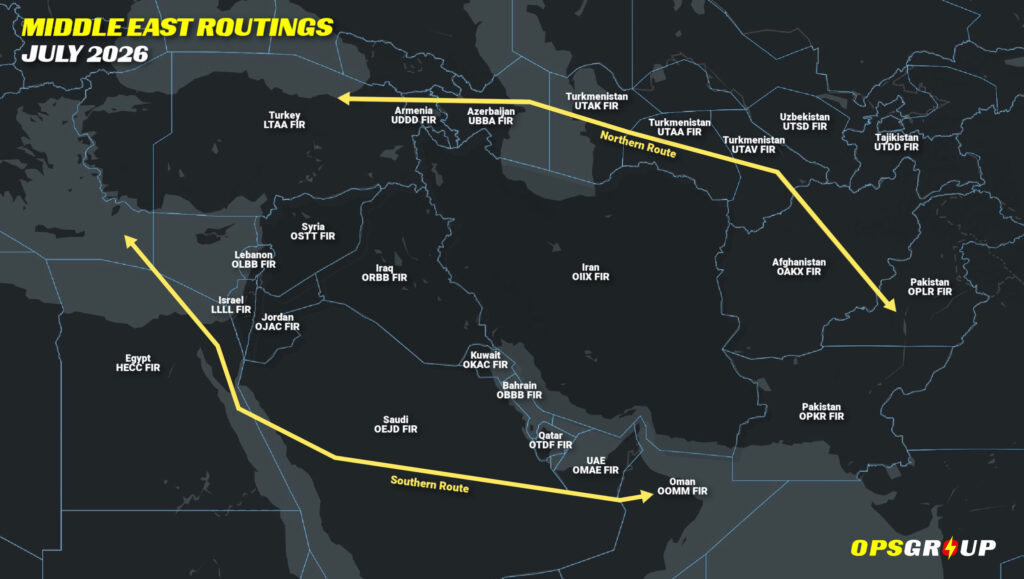
Oct 2026: OJAC/Amman FIR remains open and Jordan has not published conflict-related airspace restrictions. However, the security situation deteriorated after renewed attacks in early September, and current international guidance is to avoid the FIR at all altitudes.
See OPSGROUP Briefing: Middle East airspace situation - 2026
The primary risk is missile and drone activity linked to regional conflicts. Jordan has previously been affected by missiles and drones crossing its airspace during escalations involving Israel and Iran. Air-defence activity adds a risk of interception, misidentification and falling debris. France and Germany advise not to enter the FIR, while European guidance also recommends avoiding it at all altitudes.
Major events:
Sep 2026: Renewed attacks in early September increased the risk to civil aviation in Jordanian airspace. France subsequently renewed its warning for French operators not to enter OJAC/Amman FIR.
Aug 2026: Germany advised its operators not to enter OJAC/Amman FIR.
Feb-Jul 2026: Jordan remained open throughout the Iran conflict, although missile and drone activity affected several neighbouring countries.
Apr 2024: Jordan temporarily closed its airspace during Iran’s drone and missile attack on Israel.
See OPSGROUP Briefing: Middle East airspace situation - 2026
The primary risk is missile and drone activity linked to regional conflicts. Jordan has previously been affected by missiles and drones crossing its airspace during escalations involving Israel and Iran. Air-defence activity adds a risk of interception, misidentification and falling debris. France and Germany advise not to enter the FIR, while European guidance also recommends avoiding it at all altitudes.
Major events:
Sep 2026: Renewed attacks in early September increased the risk to civil aviation in Jordanian airspace. France subsequently renewed its warning for French operators not to enter OJAC/Amman FIR.
Aug 2026: Germany advised its operators not to enter OJAC/Amman FIR.
Feb-Jul 2026: Jordan remained open throughout the Iran conflict, although missile and drone activity affected several neighbouring countries.
Apr 2024: Jordan temporarily closed its airspace during Iran’s drone and missile attack on Israel.
Current warnings list :
| Source | Reference | Issued | Valid to | |
|---|---|---|---|---|
| France | Notam LFFF F2002/26 | 30 Sep 2026 | 14 Oct 2026 | |
| Germany | Notam EDWW B0678/26 | 17 Aug 2026 | 22 Oct 2026 | |
| EASA | CZIB 2026-08-R2 | 22 Jul 2026 | 16 Oct 2026 |
Source: France
Reference: Notam LFFF F2002/26
Issued: 30-Sep-26, valid until: 14 Oct 2026
Plain English: French operators should not enter the airspace of Jordan.
FRENCH AIR CARRIERS AND CAPTAINS OF AIRCRAFT IN CHARGE OF AIR SERVICES OPERATED BY CARRIERS HOLDING AN OPERATING LICENSE ISSUED BY FRANCE, WHETHER THEY ARE CONTRACTUAL CARRIERS AND/OR OPERATING CARRIERS, OR PERFORMING AIR SERVICES THROUGH A WET LEASE OR A CODESHARE AGREEMENT AS WELL AS FOR ANY FLIGHT MADE WITH AN AIRCRAFT REGISTERED IN FRANCE ARE REQUESTED NOT TO PENETRATE INTO THE ENTIRE AIRSPACE OF JORDAN (FIR AMMAN (OJAC)).
Source: Germany
Reference: Notam EDWW B0678/26
Issued: 17-Aug-26, valid until: 22 Oct 2026
Plain English: German operators should not enter the airspace of Jordan.
SECURITY - HAZARDOUS SITUATION IN JORDAN
CIVIL GERMAN AIR OPERATORS ARE RECOMMENDED NOT TO ENTER FIR AMMAN (OJAC). POTENTIAL RISK FROM ANTI-AVIATION WEAPONRY, MILITARY OPERATIONS AND ARMED. CONFLICTS.
CIVIL GERMAN AIR OPERATORS ARE RECOMMENDED NOT TO ENTER FIR AMMAN (OJAC). POTENTIAL RISK FROM ANTI-AVIATION WEAPONRY, MILITARY OPERATIONS AND ARMED. CONFLICTS.
Source: EASA
Reference: CZIB 2026-08-R2
Issued: 22-Jul-26, valid until: 16 Oct 2026
Plain English: Operators should avoid the airspace of Jordan.
This CZIB is issued based on information currently available to EASA, the European Commission and Member States in order to share information which is considered necessary to ensure the safety of flights over zones of high risk.
As a consequence of the military conflict between the United States and Iran, the regional security situation remains highly volatile, with significant fluctuations in the level of kinetic military activity affecting Jordanian airspace. Periods of relative calm have been followed by renewed attacks, demonstrating the potential for a rapid deterioration with little or no warning. The renewed attacks in early September 2026 indicate deterioration of the security situation and the re-emergence of conditions associated with a high level of risk to civil aviation.
Recurrent Iranian missile attacks, and to a lesser extent drone attacks, against assets located in Jordan, together with the activation of air-defence systems, create an increased risk of misidentification of civil aircraft, as well as risks associated with missile overflights, interception activity and falling debris.
In terms of airspace management, no conflict-related airspace restrictions, route closures or operational advisories have been issued publicly by the Jordanian authorities despite the recent increase in military activity affecting the airspace. Therefore, operators should be prepared to comply with tactical deconfliction in the event of kinetic activity.
EASA, together with the Commission and Member States, will continue to closely monitor the situation, with a view to assess whether there is an increase or decrease of the risk for EU aircraft operators due to the evolution of the threat and risk situation.
Air operators should:
1. Not operate within the airspace of Jordan, FIR Amman (OJAC), at all altitudes and flight levels;
2. Ensure that an up-do-date risk assessment is in place together with a high level of contingency planning for their operations and be ready for short notice instructions from State authorities.
3. Closely monitor airspace developments in the region and follow all available aeronautical publications concerning the region, including information shared through the European Information Sharing and Cooperation Platform on Conflict Zones, alongside available guidance or direction from their national authorities.
As a consequence of the military conflict between the United States and Iran, the regional security situation remains highly volatile, with significant fluctuations in the level of kinetic military activity affecting Jordanian airspace. Periods of relative calm have been followed by renewed attacks, demonstrating the potential for a rapid deterioration with little or no warning. The renewed attacks in early September 2026 indicate deterioration of the security situation and the re-emergence of conditions associated with a high level of risk to civil aviation.
Recurrent Iranian missile attacks, and to a lesser extent drone attacks, against assets located in Jordan, together with the activation of air-defence systems, create an increased risk of misidentification of civil aircraft, as well as risks associated with missile overflights, interception activity and falling debris.
In terms of airspace management, no conflict-related airspace restrictions, route closures or operational advisories have been issued publicly by the Jordanian authorities despite the recent increase in military activity affecting the airspace. Therefore, operators should be prepared to comply with tactical deconfliction in the event of kinetic activity.
EASA, together with the Commission and Member States, will continue to closely monitor the situation, with a view to assess whether there is an increase or decrease of the risk for EU aircraft operators due to the evolution of the threat and risk situation.
Air operators should:
1. Not operate within the airspace of Jordan, FIR Amman (OJAC), at all altitudes and flight levels;
2. Ensure that an up-do-date risk assessment is in place together with a high level of contingency planning for their operations and be ready for short notice instructions from State authorities.
3. Closely monitor airspace developments in the region and follow all available aeronautical publications concerning the region, including information shared through the European Information Sharing and Cooperation Platform on Conflict Zones, alongside available guidance or direction from their national authorities.