
Kuwait
Risk Level: Three - Caution
[ about risk levels ]
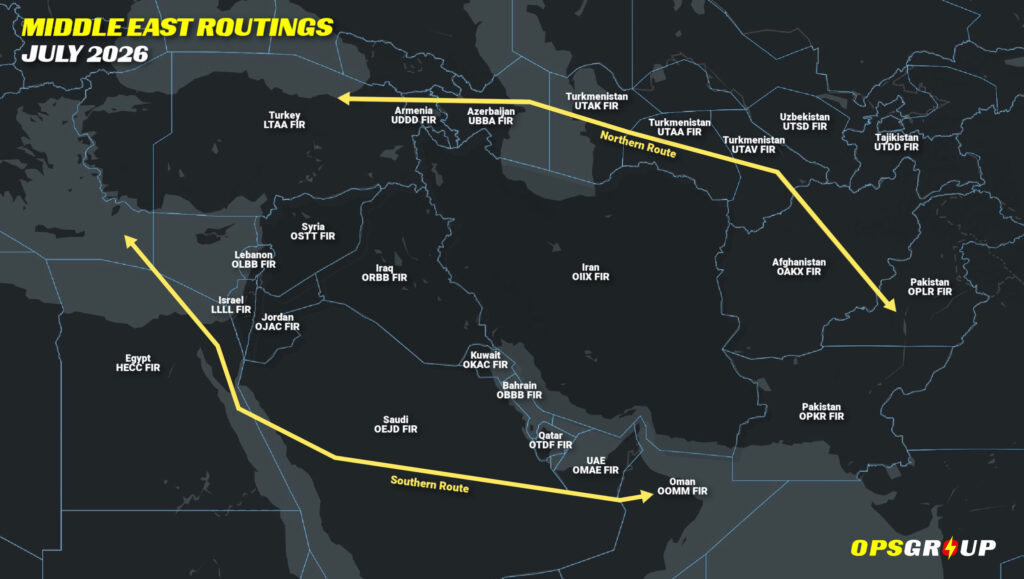
July 2026: The US-Iran ceasefire has effectively broken down, with renewed military action and attacks around the Strait of Hormuz. Kuwait has been directly affected by the conflict, and the OKAC/Kuwait FIR remains open for arrivals and departures only - overflights continue to be prohibited.
See OPSGROUP Briefing: Middle East airspace situation - 2026
The primary risk is missile and drone activity linked to the wider Iran conflict. Kuwait has already been directly affected by strikes at OKKK/Kuwait airport and other military targets in the country, and there have been no significant downgrades to recent airspace warnings. EASA now advises operators not to operate in the OKAC/Kuwait FIR at any altitude under its current CZIB.
Major events:
July 2026: EASA issued a new CZIB advising operators not to operate in the OKAC/Kuwait FIR at any altitude following renewed military activity in the Gulf.
Feb-Jul 2026: OKAC/Kuwait FIR closed and reopened several times during the Iran conflict. It is currently open for arrivals and departures only, with overflights remaining prohibited.
March 2026: Missile and drone strikes damaged OKKK/Kuwait airport.
June 2025: Israel and Iran exchanged missile strikes across the region.
See OPSGROUP Briefing: Middle East airspace situation - 2026
The primary risk is missile and drone activity linked to the wider Iran conflict. Kuwait has already been directly affected by strikes at OKKK/Kuwait airport and other military targets in the country, and there have been no significant downgrades to recent airspace warnings. EASA now advises operators not to operate in the OKAC/Kuwait FIR at any altitude under its current CZIB.
Major events:
July 2026: EASA issued a new CZIB advising operators not to operate in the OKAC/Kuwait FIR at any altitude following renewed military activity in the Gulf.
Feb-Jul 2026: OKAC/Kuwait FIR closed and reopened several times during the Iran conflict. It is currently open for arrivals and departures only, with overflights remaining prohibited.
March 2026: Missile and drone strikes damaged OKKK/Kuwait airport.
June 2025: Israel and Iran exchanged missile strikes across the region.
Current warnings list :
| Source | Reference | Issued | Valid to | |
|---|---|---|---|---|
| France | Notam LFFF F1811/26 | 02 Sep 2026 | 16 Sep 2026 | |
| EASA | CZIB 2026-07R2 | 14 Jul 2026 | 30 Sep 2026 |
Source: France
Reference: Notam LFFF F1811/26
Issued: 02-Sep-26, valid until: 16 Sep 2026
Plain English: French operators should not enter the airspace of Kuwait.
FRENCH AIR CARRIERS AND CAPTAINS OF AIRCRAFT IN CHARGE OF AIR SERVICES OPERATED BY CARRIERS HOLDING AN OPERATING LICENSE ISSUED BY FRANCE, WHETHER THEY ARE CONTRACTUAL CARRIERS AND/OR OPERATING CARRIERS OR PERFORMING AIR SERVICES THROUGH A WET LEASE OR A CODESHARE AGREEMENT AS WELL AS FOR ANY FLIGHT MADE WITH AN AIRCRAFT REGISTERED IN FRANCE ARE REQUESTED NOT TO PENETRATE INTO THE ENTIRE AIRSPACE OF KUWAIT (FIR KUWAIT (OKAC)).
Source: EASA
Reference: CZIB 2026-07R2
Issued: 14-Jul-26, valid until: 30 Sep 2026
Plain English: Operators should avoid airspace over the waters of the Persian Gulf within Bahrain, Kuwait, Qatar and UAE FIRs, plus the Gulf of Oman within the Muscat FIR west of 58 degrees east, except as necessary for arrivals/departures from aerodromes within the affected FIRs.
This CZIB is issued based on information currently available to EASA, the European Commission and Member States in order to share information which is considered necessary to ensure the safety of flights over zones of interest and indicate areas of high risk.
Following the military conflict between the United States and Iran, the regional security situation remains volatile, creating additional risks in the airspace of the affected countries.
Iranian efforts to maintain control over the Strait of Hormuz, recurrent attacks against commercial vessels, and related US military actions create high risks for the airspace over the waters of Bahrain, Kuwait, Qatar and the United Arab Emirates, as well as for the airspace over the waters in the Gulf of Oman west of longitude 58°E.
The presence of major US military facilities in the region increases the likelihood that the States covered by this CZIB may be directly exposed to Iranian missile and drone attacks. The surrounding maritime airspace may also be affected by missile or drone overflights, interception activity, falling debris and the wider consequences of regional military escalation.
The heightened readiness and activation of national and US air-defence systems increase the risk of misidentification, unintended engagement and collateral effects affecting civil aircraft. Military activity may occur with little or no warning in confined airspace, significantly reducing the time available to aircraft operators and air navigation service providers to mitigate exposure through tactical rerouting or timely airspace management measures.
Regional authorities have implemented temporary airspace closures and restrictions at different stages of the conflict. However, the unpredictable nature and rapid evolution of military activity may challenge the timely and effective implementation of such measures.
Unpredictable military developments, combined with the possible use of missiles, drones, combat aircraft and air-defence systems, create a high risk to civil flights at all altitudes and flight levels over the waters within the concerned airspace.
While risks over the waters of the Persian Gulf remain high, operations necessary for arrivals at or departures from aerodromes within the affected FIRs may be conducted with sufficient mitigation, provided they are based on an up-to-date risk assessment and continuous risk monitoring. Residual risks also remain over the land territory of the affected States, where operators should continue to exercise caution and take account of possible missile and drone activity, air-defence operations and falling debris.
EASA, together with the Commission and Member States, will continue to closely monitor the situation, with a view to assess whether there is an increase or decrease of the risk for EU aircraft operators due to the evolution of the threat and risk situation.
Air operators should:
1. Not operate at all altitudes and flight levels within the airspace over the waters of the Persian Gulf within FIR Bahrain (OBBB), FIR Kuwait (OKAC), FIR Doha (OTDF), FIR Emirates (OMAE), except to the extent necessary for arrivals at or departures from aerodromes within the affected FIRs.
2. Not operate within the airspace over the waters of the Gulf of Oman within the FIR Muscat (OOMM) west of longitude 58°E at all altitudes and flight levels.
3. Exercise caution and take potential risks into account when operating in the airspace over the land territory within the above mentioned FIRs.
4. Ensure that an up-to-date risk assessment and a high level of contingency planning are in place for operations within the affected airspace, and be prepared for short notice instructions from the State authorities.
5. Closely monitor airspace developments in the region and follow all available aeronautical publications concerning the region, including information shared through the European Information Sharing and Cooperation Platform on Conflict Zones, alongside available guidance or direction from their national authorities.
Following the military conflict between the United States and Iran, the regional security situation remains volatile, creating additional risks in the airspace of the affected countries.
Iranian efforts to maintain control over the Strait of Hormuz, recurrent attacks against commercial vessels, and related US military actions create high risks for the airspace over the waters of Bahrain, Kuwait, Qatar and the United Arab Emirates, as well as for the airspace over the waters in the Gulf of Oman west of longitude 58°E.
The presence of major US military facilities in the region increases the likelihood that the States covered by this CZIB may be directly exposed to Iranian missile and drone attacks. The surrounding maritime airspace may also be affected by missile or drone overflights, interception activity, falling debris and the wider consequences of regional military escalation.
The heightened readiness and activation of national and US air-defence systems increase the risk of misidentification, unintended engagement and collateral effects affecting civil aircraft. Military activity may occur with little or no warning in confined airspace, significantly reducing the time available to aircraft operators and air navigation service providers to mitigate exposure through tactical rerouting or timely airspace management measures.
Regional authorities have implemented temporary airspace closures and restrictions at different stages of the conflict. However, the unpredictable nature and rapid evolution of military activity may challenge the timely and effective implementation of such measures.
Unpredictable military developments, combined with the possible use of missiles, drones, combat aircraft and air-defence systems, create a high risk to civil flights at all altitudes and flight levels over the waters within the concerned airspace.
While risks over the waters of the Persian Gulf remain high, operations necessary for arrivals at or departures from aerodromes within the affected FIRs may be conducted with sufficient mitigation, provided they are based on an up-to-date risk assessment and continuous risk monitoring. Residual risks also remain over the land territory of the affected States, where operators should continue to exercise caution and take account of possible missile and drone activity, air-defence operations and falling debris.
EASA, together with the Commission and Member States, will continue to closely monitor the situation, with a view to assess whether there is an increase or decrease of the risk for EU aircraft operators due to the evolution of the threat and risk situation.
Air operators should:
1. Not operate at all altitudes and flight levels within the airspace over the waters of the Persian Gulf within FIR Bahrain (OBBB), FIR Kuwait (OKAC), FIR Doha (OTDF), FIR Emirates (OMAE), except to the extent necessary for arrivals at or departures from aerodromes within the affected FIRs.
2. Not operate within the airspace over the waters of the Gulf of Oman within the FIR Muscat (OOMM) west of longitude 58°E at all altitudes and flight levels.
3. Exercise caution and take potential risks into account when operating in the airspace over the land territory within the above mentioned FIRs.
4. Ensure that an up-to-date risk assessment and a high level of contingency planning are in place for operations within the affected airspace, and be prepared for short notice instructions from the State authorities.
5. Closely monitor airspace developments in the region and follow all available aeronautical publications concerning the region, including information shared through the European Information Sharing and Cooperation Platform on Conflict Zones, alongside available guidance or direction from their national authorities.